Showing posts with label 2010. Show all posts

Friday, May 13, 2011

Fair Game

Fair Game (2010)
Directed by Doug Liman. Starring Naomi Watts and Sean Penn.

I was just young enough during the George W. Bush presidency and Valarie Plame scandal that I didn't really follow the full story. This movie does an excellent job filling in those gaps for me, detailing one of the biggest scandals to rock the intelligence agencies in recent years. There are apparently many discussions online about historical accuracy and creative liberty in the film... but as the book cites Valarie Plame and Joseph Wilson's autobiographies as sources, it's clear that, at the very least, their side of the story is being told well.

The film is directed by Doug Liman, best known for his thriller spy films like The Bourne Identity and Mr. and Mrs. Smith. At times, the overly dramatic tendencies from those films show through, somewhat out-of-place in a political biopic. So, perhaps the film has some difficulty with the balance between its multiple genres. Yet, the acting is superb, and the story drives the movie with a relentless intensity. Above all, it's the mood of the film that stands out... it simmers with anger at the system, and leaves the viewer feeling similarly ticked off.

This is a smart film with a "docudrama" leaning... one that shows such a nasty side of our political system that it's hard to believe it's based in real events.

Saturday, April 23, 2011

The Chronicles of Narnia: The Voyage of the Dawn Treader

The Chronicles of Narnia: The Voyage of the Dawn Treader (2010)
Directed by Michael Apted. Starring Ben Barnes, Skandar Keynes, and Georgie Henley.

When a franchise changes hands for the first time, it can lead to trouble. Sure, you've got your James Bonds and Harry Potters which have survived multiple creative shifts, but for every one of these, there's another several that didn't succeed. (This is particularly true of comic book movies... X-Men and Spiderman come to mind -- but more on that soon). After being the creative force and the studio behind both The Lion, The Witch, and the Wardrobe and Prince Caspian, both Andrew Adams and Disney sat this one out. Still, it was full force ahead under Walden Media. (On a less obvious note, the composer of the first two films, Harry Gregson-Williams also did not return... to my particular and great disappointment).

Still, The Voyage of the Dawn Treader brings the book to life, is adventurous and entertaining, and is reasonably true to the spirit of the franchise thus far. It's been a while since I've read the book, so it was nice to rediscover the story with the film. Much like Prince Caspian, it takes certain liberties to make it a more interesting movie -- for once, in my opinion, there's actually not enough material in the book for the film, and this has been true with the last few, if not all, Narnia movies. That's what makes them such great film adaptations. They can bring the books to life and, in a sense, improve on them.

Dawn Treader is a very different story from the other two. It's not structured around a single enemy and doesn't climax with a battle. Instead, it's an adventure-on-the-high-seas tale, a treasure hunt that takes our characters to strange and scary lands beyond the edge of the map. The film modifies this with a mysterious "green mist" that, in a sense, is the "bad guy" of the story. So, for anyone feeling fatigued by the structure of Prince Caspian resembling the storyline of Lion/Witch/Wardrobe, this film is relatively fresh.

Additionally, the faces change. If you haven't read the Narnia books, you may not be familiar with this, but nearly every book introduces a new character or two, who then carries on the series in the next. The Pevensies begin in Lion/Witch/Wardrobe and return in Prince Caspian... but by Dawn Treader, Peter and Susan are too old for Narnia. So, this time, it's just Edmund and Lucy, except that they accidentally bring along their annoying cousin Eustace. (Eustace later goes on to return to Narnia in the next book, with his friend Polly, who then returns without him in the book after that). Caspian is back (though interestingly, Ben Barnes dropped the Mediterranean accent and reverted to his native British lilt this time around... awkward at first, but better all around in the end).

I'm writing this after my second viewing of the film -- the first in theaters, the second with some of the kids I babysit. Both times, I noticed that the audience was younger than I would have thought. Overall, I think these films lack the darkness and intensity that, say, can be found in a rival fantasy franchise, The Lord of the Rings, something that I would wager is the leading factor in drawing in an older demographic. Still, the film is an entertaining, Disney-esque film (though it now lacks Disney) that is fitting "on the shelf" next to the first two. It is a pity that this series has dropped off (in terms of box office and popular interest), as it's looking unlikely that future books will be adapted onscreen (at least with this generation of actors -- in the future, who knows?) 

In the end, and I think I'm qualified to say this, fans of the series won't be disappointed in seeing this next book in the series brought to life. Though it lacks the scale and grandeur of the first two, it is still imaginative and spectacular in its representation of Narnia.

Friday, April 22, 2011

The King's Speech

The King's Speech (2010)
Directed by Tom Hooper. Starring Collin Firth, Geoffrey Rush, and Helena Bonham Carter.

83rd Oscars - 8 Nominations and 4 Won: Best Picture, Best Director (Tom Hooper), Best Original Screenplay (David Seidler), Best Actor Leading Role (Collin Firth)

Several months ago, The King's Speech won Best Picture, along with a number of other awards, at the 83rd Oscar Ceremony. Some people were disappointed in this winning -- let me say right off that I was not one of them. Sure, there's the argument that Inception was a more interesting film, the kind the Academy needs to branch out and start awarding (I agree with that). And, sure, The Social Network was more a film "for my generation" (I also think that's right)... But The King's Speech is a solid, well-made, well-acted, well-done film, well worth praising. I'm writing this after viewing it a second time, since it's now on DVD, so I can safely say I see its merits.

I mean, what's not to like? It's a feel-good, underdog tale, a slice of history and a biopic, starring two talented and - until recently - wildly underrated actors, and an actress who is such a surprising chameleon that she can play the Queen's Mother at the same time she's filming Harry Potter! Several months out, I think lot of the negative comments regarding this winning Big Picture distill into one argument: it is too Oscary. In other words, the Academy rewards too many pictures of this nature - stories of someone overcoming hardship, battling something (in this case, a speech defect), and rising above your problems to triumph in the public sphere. (Seriously, glance at a list of Best Picture winners. So many of them fit this formula).

So, yes, this film is a bit predictable - at least, predictable as a winner. The biggest complaint about the 83rd Oscar Ceremony was that the whole night was a bore; the biggest surprise was Kirk Douglas's presentation of the Best Supporting Actress category. (For the record, I still enjoyed the show, but I always get carried away by the glitz and glamour!) If you share this viewpoint, I encourage you to try looking at it another way: in The King's Speech, these filmmakers managed to make gold (literally) out of a tried and true filmic setup.... They managed to take something that's been done and done again, and still do it well! Any-who... In my opinion, The King's Speech makes a good addition to the Best Picture category. *steps off soapbox*

On a personal note, I really loved this film - both times watching it! Reading/watching ANYTHING about British history is one of my favorite pastimes, and it was interesting to learn about a king I knew little about, other than his relationship to Elizabeth II. I've already said that I adore Geoffrey Rush in my Pirates review... And so I enjoyed watching him take on, shall we say, a more substantial performance. Rush is delightfully eccentric and - for all that Collin Firth manages that st-st-stammer quite well - darn near carries the film. (It's a pity Rush didn't carry away a trophy as well). Speaking of Firth, he manages a transformation INTO Bertie, the second son who never wanted to be King. He is a man who must find his own inner strength in order to show said strength to his nation in a time of great hardship. He really brings this man to life. The film is emotional, yet uplifting. It carries you away yet somehow manages to speak to your own life. Bravo!

Sunday, April 10, 2011

Temple Grandin

Temple Grandin (2010)
Directed by Mick Jackson. Starring Claire Danes, Julia Ormond, and David Strathairn.

This was not so much a remarkable film as it was a remarkable role.

Claire Danes excels in this performance as Temple Grandin, a contemporary woman with autism, which couldn't have been an easy role to play. Temple dealt with autism in a time when very little was known about it and it was definitely not culturally accepted. For example, the one doctor we see in the film basically blames it on her mother not doing a good job raising her (gotta love the 50s). Temple went on, with the help of a caring teacher, to make it through school and college, and on to master's and doctoral degrees. She then went on to work with animals, which she could understand better than people. Appalled by the conditions on ranches, she went on to redesign many of the systems used in cattle ranches throughout the slaughter process, to allow the cows to stay more calm. Finally, she went on to be an advocate and celebrity in terms of bringing awareness to those living with autism.

Yeah, wow. What a life.

And the film, though an HBO movie and not a theatrical release, is well done. It manages to hint at what autism is like, showing the world through Temple's eyes. For example, when her aunt asks her to open the gate, within a few days, she has managed to design a pulley system that allows one to pull the gate open for the car, allowing just long enough for the car to get through before it swings back closed. We see her figuring this out, imagining angles and forces. The way she sees the world is incredible -- in pictures, rather than words or ideas, like most of us think. Though this is well understood now, it was hardly even considered when Temple was growing up, which makes this film just that much more incredible.

I know Claire Danes best from the Baz Lurhman version of Romeo + Juliet so it was interesting to see her tackle such a complex role. Though I didn't see this before awards season, I remember it taking home lots of trophies at both the Emmy's and Golden Globes... and the real Temple Grandin was at both shows. The images of Temple up on stage with Claire Danes floated around in my head as I watched this, and it added sweetness to the film.

This wasn't the kind of thing I would usually choose to watch on my own, but it was an interesting example of making a film that really explores an individual's POV. I was utterly carried away by Temple's life and completely engrossed in the story. A well done work all around!

Sunday, February 27, 2011

Any Human Heart (Miniseries)

Starring Jim Broadbent, Matthew Macfadyen, and others.

Something a little different today... Rather than writing about a film, I thought I'd tell you about the recent British/PBS miniseries called Any Human Heart. Based on a book I hadn't heard of by an author named William Boyd, this showed up on my DVR and my family decided to give it a go...

Any Human Heart is about the life of one man, Logan Mountstuart, from youth to old age. It tells his story through several narrative devices including the idea that, as an old man, he is reflecting on his life as he sorts through boxes of papers, journals, and photos. Logan is a compelling hero, though he is certainly flawed, and even unlikable at times. This is a kind of Forrest Gump type of story -- with Logan reporting on the Spanish Civil War, being a spy in World War Two, meeting Ian Fleming and Ernest Hemingway, etc. At three-parts long (each part being roughly over an hour), the story is not rushed by any means -- it takes its time. 

Logan's life is tragic. He loves, and loses. Things don't always (or even often) go his way. He is a failed writer. But despite all this, there is something lyrical and beautiful about the way this miniseries handles his life. The title comes from a quote by Henry James, which is introduced by Laura Linney in the Masterpiece miniseries: "Never say you know the last word about any human heart." In my opinion, the "thesis," if you can call it that, which this quote as the title speaks to, is that one should never suppose to know everything about another person, let alone ourselves.

The most creative and interesting part of the story is how it deals with his aging. As you can see in the poster, there are three main actors who play Logan -- the first when he is in college, the second in his middle years, and then the third when he is retired and older. I prefer this very much to the bad aging of an actor using makeup or, even worse, CGI. The best part about this was that this was done consciously -- with the idea that humans become "different people" at different stages of their life. Each actor's Logan was slightly different, and that's perfectly okay because Logan himself -- the character -- was a different person throughout his years. This was much better than a film which doesn't acknowledge the actor has suddenly changed. As I understand it, this is particularly good since the book deals with a theme of multiple selves, so not only is this cinematic magic at its best, but an adept adaptation. 

Along these lines, I know that the book this was based upon is written in the form of a journal... and the film also preserves this in adaptation. Logan is often seen writing in his journal (his words given to us through narration), which gives us wonderful insight to HIS human heart. From time to time, when Logan has left off journaling and is returning to it, we hear him give a brief rundown of his status: age, health, happiness, etc. A fascinating way to describe a life in progress. 

In all, I enjoyed this phenomenally, though it is the kind of thing that probably missed getting  noticed by many people. For something so simple -- the story of one man's life -- this film was extraordinarily creative in HOW the story was told. And the acting was Masterpiece at its best... Jim Broadbent and Matthew McFadyen in particular were incredible. The miniseries format was really well-suited to this story as it was nice to get into a story and not have it end in two hours... to actually get a more detailed depiction of the human heart was wonderful. 

Friday, February 18, 2011

Animal Kingdom

Animal Kingdom (2010)
Directed by David Michôd. Starring James Frecheville, Guy Pearce, and Joel Edgerton.

83rd Oscars - 1 Nomination: Best Supporting Actress (Jacki Weaver)

This film is a very interesting portrait of an untraditional family in Australia. The main character, played by a newcomer actor with remarkable stoicism, moves in with his criminal uncles and saccharine grandmother after his mother overdoses. He is instantly submerged in the world of cops and robbers -- where both sides seem equally lost and lawless. The name is fitting, as I reflect on the film, as a kind of animal madness and violence seems to have taken over the lives of these characters. There is an mafia undertone to the twangy Australian accents as the world seems governed, above all else, by loyalty to one's family. Guy Pearce, the only really well known face in the movie, plays a solemn detective trying to make sense of the whole thing and help the main young boy. I certainly would not have seen Animal Kingdom had it not shown up on the Oscar list, but it was a film that pulled me in, to say the least.

Of course, as she was nominated for the Best Supporting Actress category, one must consider Jacki Weaver's performance as the grandmother with extra care. It's hard to know what to make of this character. There's something extra creepy about her, from the way she relates to her sons (often kissing them on the lips for a tad too long, as an example) to her overall too-perky demeanor. Yes, she steals scenes. However, I would wager that there is one scene alone that earned her a nomination. Near the end of the film, (not spoiling too much), when her boys are in prison, she must take over and set things right. She effortlessly talks someone into helping her (aka blackmails/threatens them), but in the most insanely evil, saccharine way possible. This scene simply leaves you saying, "whoa," and though it is such a fragment of the film, the idea that this side of the grandmother has been there all along, below the surface, makes it an impressive performance.

I wouldn't recommend going out of your way to see this film, but if you like the gangster genre (particularly a different take on the classical mafia films), I would advise you to check it out.

Thursday, February 17, 2011

Blue Valentine

Blue Valentine (2010)
Directed by Derek Cianfrance. Starring Ryan Gosling and Michelle Williams.

83rd Oscars - 1 Nomination: Best Actress (Michelle Williams)

This is the first of the Oscar films -- and really of any of the films I've reviewed on this blog -- that I didn't care for, no, stronger... I didn't like. I wouldn't recommend it, though of course you may have different tastes in film than I do. Blue Valentine charts the course of a relationship from its beginning to its end. The film tells two stories in a parallel fashion; that of "boy meets girl", and that of "boy and girl's marriage implodes" several years later.

I found this film to be uncomfortable to watch and overly harsh in its creation of the main couple. I wasn't clear if the audience is supposed to root for them to stay together -- as was my initial instinct since we are also watching them fall in love -- or for them to just get it over with and separate -- which is where I ended up out of just plain dislike for both of the characters. I should add that I really wanted to like this film. It was created by a graduate from my school, so I feel a sense of pride (and reassurance) that Derek Cianfrance made it to the silver screen and Oscar nomination list with a big feature film. I even defended it as I walked out of the theater with my viewing companion. It was a very real portrayal of life (and that's a good thing), it took a non-Hollywood approach to love (which is refreshing), it was very creatively done... or so I argued.

But over time, I've come to realize that I didn't enjoy this film, and I didn't find any interesting ideas to make up for not liking it. It's non-traditional in its portrayal of love, but to the point that makes me miss the traditional approach. I mean, even though romantic comedies are full of fluff, you don't leave the theater feeling like my heart has been trampled repeatedly. It's not that I don't like breakup films -- Revolutionary Road from a few years ago was tragic and intense, yet poignant as well. The performances in Blue Valentine by Gosling and Williams were good, I suppose, in that they totally created a pair of people that felt so real that I knew their flaws by heart and hated them. The aging in the two plotlines was subtle and the distance between them was carefully built up. Furthermore, this film had one of the most subtle flip-flops in time that I've ever seen, from falling in love to falling out of it. This was probably my favorite aspect of the movie's style. As Roger Ebert says in his review, it "moves between present and past as if trying to figure out what went wrong." This feeling is carefully constructed, and it makes me wonder what other films Cianfrance is capable of creating.

Perhaps I haven't lived and loved enough to appreciate the nuances of this film's portrayal of the course of a relationship. Yes, I fully admit that this film may have gone over my head. But aside from that, this story was too far away from filmic conventions, from my comfort zone... that I just couldn't reconcile what I was seeing with what I'm used to seeing in this genre. I think this is what makes it stand out for some, but it didn't work for me. There were many films in this year's Oscar season that I had to stretch as a film viewer to see. They were out of my usual genres and taste, and I was glad I gave them a go. The Fighter, Rabbit Hole, 127 Hours, Black Swan ... these were all films I didn't think I wanted to see, but that I was glad I saw afterwards. Blue Valentine simply doesn't fall in this same category.

Tuesday, February 15, 2011

127 Hours

127 Hours (2010)
Directed by Danny Boyle. Starring James Franco.

83rd Oscars - 6 nominations: Best Picture, Actor (James Franco), Editing, Writing (Adapted Screenplay), Score (A.R. Rahman), Original Song.

Of all the best picture nominees, I wavered the most about whether or not I wanted to see 127 Hours. I love Danny Boyle -- his Millions to Slumdog Millionaire are excellent -- and I think he has a great ability to find beauty in the human spirit. Furthermore, I find survivor stories uplifting, and I recently read the fantastic book Miracle in the Andes by Nando Parrado (about a plane crash). Lastly, I continue to be intrigued by the man that is James Franco. Despite all this, I just didn't know if I could handle watching a man cut his own arm off on film. I had almost written it off completely when I decided I was going to see all of the Best Picture and Acting nominees regardless of any qualms I had.

Above all, I need to tell you that this film is INCREDIBLE. I wholeheartedly recommend that everyone see it (if you're squeamish, close your eyes at the end!) and am disappointed it got overshadowed by more predictably Academy-friendly films like the "triumphant and edgy biopics" of The King's Speech and The Social Network. [By the way, the arm-cutting is, quite honestly, such a small moment in an otherwise completely beautiful film, that it's certainly not a valid reason to skip the film altogether.]

Aron Ralston (Franco) at the beginning of the film cannot be tamed. He lives with a wild abandon, throwing himself into the middle-of-nowhere in Moab, Utah; carelessly grabbing supplies, and figuring he can always return his mother's phone call tomorrow (...if only he had picked up that phone and told her where he was going). Once out on the trail, he bumps into two girls, lost, and offers to give them directions. He leads them on a special route that involves sliding down a narrow crevice, and then dropping several hundred feet into a pool of luminescent blue water. And, I have to say, he makes the audience want to take that drop with him. He is a man who wants to live, and live hard -- and the film lures you into his carefree and adventurous spirit.

That's why it's such a surprise -- even though you probably know what happens in the film -- when a rock shifts and he falls and ends up trapped. The ultimate wild child has been pinned down, and at first, neither you nor him want to believe it. But then you do. He assesses his supplies, and realizes that he didn't tell anyone where he was going. Round about this time is when the film's title card actually comes on the screen -- surprising, because it must be a good 30 minutes into the film. When "127 Hours" shows up, you realize that the title is like a stopwatch... how long can he survive?

My favorite scene in the film features Ralston, who keeps his moral up by talking into his video camera until the battery dies, enacting a talk show. With the use of camera angles and sound effects such, Ralston is made to be the host, guest, and call-in listener, all in one. This scene, and the whole film in general, makes me admire James Franco to the nth degree. This isn't a film of ensemble cast members playing off each other for maximum effect -- what you see for almost the entire film is Franco, carrying your attention, and messing with your emotions for an hour and a half. And, boy, does he put you through the emotional ringer. He plays so many roles -- so many "types" of Ralstons, if you will, that it really brings new meaning to "Best Lead Actor."

I could go on and on about this film -- and I already have -- so let me round off this discussion by commenting on how artistic it was. There's something very non-classical about Danny Boyle's approach to this film. One simple shot in particular springs to mind... before Ralston is trapped, as he's hiking toward his destination, he runs his hand along the fluid red Moab rocks. The camera follows him closely, arching over the smooth stone. It's a small moment with breathtaking beauty and significance to the film. Furthermore, Boyle  utilizes multiple cameras and split-screen in an interesting way. He lessens the blow of the final gory arm-hacking moment with the use of an impressive array of fast cuts. He highlights Ralston's experiences with hallucinations, memories, and dream sequences. It's incredibly thoughtful and makes for quite the masterpiece. Bravo!

Sunday, February 13, 2011

Biutiful

Biutiful (2010
Directed by Alejandro González Iñárritu. Starring Javier Bardem.

83rd Oscars - 2 Nominations: Best Foreign Film, Best Actor (Javier Bardem).

It's hard to say what Biutiful is really about. I can tell you that the plot involves a man living in Barcelona after he finds out he has cancer. It deals with his family -- two children and bipolar wife/ex-wife. It shows his work, which deals with the immigrant underground workforce (Chinese factory workers and African street-hawkers). It even deals with his ability to communicate with ghosts, as tangential as it is. In short, it's a beautifully done film, but it's hard to pin down what it's trying to say or what to take away from it.

I often feel that films from Spanish-speaking countries (Biutiful is from a Mexican director) are speaking a different cinematic language than I understand. They deal with narrative and meaning in a foreign way compared to what I am used to. I know this sounds obvious, but I've been watching French and Italian and even Russian films for two semesters now and with those, I'm able to grasp what the filmmaker is trying to do. With recent Spanish films -- not just Biutiful but also the work of directors like the great Pedro Almodovar and even Guillermo del Toro (in his less Hollywood-based work) -- I get the distinct feeling that I'm missing out on understanding what is significant.

Maybe I'm too American in my viewing expectations in that I expect a film to say something, rather than just handle big ideas, which this film certainly does beautifully. Letting go of that expectation, let me say that I was impressed by this film's portrayal of love, life, and death. There's a scene that sticks in my mind in which Bardem pauses while walking home at twilight, and looks up to see a flock of birds fluttering this way and that against the darkening sky. Birds are often the symbol of the soul, so perhaps this scene is saying that how an individual makes peace with guilt, pain, and loss relates to their soul.

What made this film worth watching was Javier Bardem's performance. He is the heart and soul of the film. His solemn face and gravelly voice keeps the film from dropping into abstraction. He is an anchor amongst all the film's emotions and ideas. It's easy to see why this was the Oscar nominated performance of the movie. Overall, largely because of Bardem, I thought there was something haunting about this film -- something I can't pin down, which makes it all the more mysterious and memorable.

Saturday, February 12, 2011

Black Swan

Black Swan (2010)
Directed by Darren Aronofsky. Starring Natalie Portman, Mila Kunis, and Vincent Cassel.

83rd Oscars - 5 Nominations: Best Picture, Actress (Natalie Portman), Directing, Editing, and Cinematography.

This is an impressive psychological thriller. You're thrown into a world where perfection is the name of the game. Nina (Portman), a ballerina who recently scored the lead part in a production of Swan Lake, must learn to embody both the White Swan (which aligns with her naive personality easily) and also the sensual and dark Black Swan. As Nina descend into madness, the film follows, and the audience's grip on reality fades. By the end, it is nearly impossible to know what to believe and what's in Nina's mind.

It's really unusual to have a film (or perhaps I just don't usually watch the type of film) that makes it so you have NO IDEA what to believe. When the madness of the main character is as much a truth as the true events in her life, I think the audience really gets inside the character's mind. In addition to Nina's madness, this is a film about paranoia and duality. Nina flickers from worrying about her understudy Lily (Kunis) to her mother to simply fearing herself and what is happening to her. It is this last fear which I think is the most fearsome "evil" of all, for if you can't trust in yourself, what do you have left? All in all, these are powerful thematic elements that, despite the fairly simple story, make for a complex and interesting film.

This film is also quite melodramatic -- which is an interesting label since the term comes from "music" + "drama." Of course, since the film is centered around Nina's profession as a ballerina, music is key because it brings her dance performances to life. The soundtrack is loosely based on Tchaikovsky's music, so much of it brings up classic ballet scores. However, the soundtrack was composed by Clint Mansell, who has worked with Darren Aronofsky before, on films like Requiem for a Dream (which I haven't seen). I guarantee you know the key piece of music from that film as it has been used it gazillions of trailers.

Black Swan is out of my usual filmgoing comfort zone, as with many Oscar films I viewed this year, and I can't really compare it to other psychological thrillers. I certainly found it suspenseful, misleading, and creepy (partly due to the CGI additions, as when Nina plucks a real black feather out of her skin). I'm not sure if it would have been as big of a hit this year if not for the Portman's dedication to actually honing her skills as a ballerina. Indeed, this is a role that I don't think any ol' actress could play. It takes the right kind of innocent demeanor and yet comfort on the screen (she's been in films since she was a child).

Just one note from the film history part of my brain: I think it's interesting that this film cannot escape the shadow of THE ballet film of all time, The Red Shoes (1948). This is a film that I have yet to see, but it is fascinating to me that one movie can come along and define an entire topic for over 50 years. Does ballet just lend itself toward one kind of story? Or did that film simply tell the story so well that no one else has tried until Black Swan? Interesting to ponder, particularly if you've seen both.

Overall, I think this film is most eerie because the echoing suggestions it makes that resonate with reality. It is so often said that one must be perfect to be the best, that one should get lost in what they love... but here is the dark side of those ideals. In a world of Olympics and award-winning dancers, actresses, and artists, there is a very scary danger of going too far. Yes, Nina wants to be perfect. But where does perfect end, and madness begin?

The Fighter

The Fighter (2010)
Directed by David O. Russell. Starring Mark Wahlberg, Christian Bale, Amy Adams, Melissa Leo.

83rd Oscars - 7 Nominations: Best Picture, Directing, Editing, Supporting Actor (Christian Bale), Supporting Actress (Amy Adams), Supporting Actress (Melissa Leo), Writing (Original Screenplay).

The Fighter plays on two consistently good genres: the "based on a true story" biopic and the underdog sports story. It tells the of the life of boxer "Irish" Micky Ward, his family (including his manager mother and crack-addicted trainer brother), and his first big successes in the sport. I found it to be highly entertaining -- indeed, by the end, it was riveting. What makes it work to the degree that it does are the eccentric natures of the supporting characters, the stoicism of the protagonist, and the energy coursing throughout the final boxing matches.

Honestly, I had written off this film in the "I don't do boxing movies" category. I don't like watching this kind of violence on film... I can watch swords and guns ad infinitum, but people punching the crap out of each other gets hard to watch for me very quickly. So, for the same reason that I haven't (and probably won't) see Million Dollar Baby and that I didn't want to see Fight Club (though I have in fact seen it twice), I was prepared to give this one a pass. Still, the looming SEVEN Oscar nominations changed my mind and I decided that I couldn't miss it. In the end, I was sucked into the drama of Micky's boxing matches.

It's rare to see a film where the main character plays a fairly small role. Don't get me wrong, Mark Wahlberg's performance was solid... it just wasn't spectacular. What really stood out to me was Christian Bale (Micky's brother) and Amy Adams (his girlfriend). Many others seem to find Melissa Leo (his mother) impressive as well, and she seems likely to win the Supporting Actress Oscar. I'm not sure that I found her performance to all THAT amazing, or that I would call it the best of the year, but she certainly did command the stage, so to speak, when she was onscreen.

Christian Bale falls into the category of how-the-heck-has-he-never-been-nominated-for-an-Oscar and it seems this is finally HIS year. He's really quite amazing in this role. Physically, he's managed to transform into the skeletal appearance of a truly drug-addicted individual. His face is gaunt, he seems like a gust of wind could blow him over, yet there he is training Micky. What makes him interesting is the way he subtly portrays being haunted by the great boxer he never became. I mean, he seems to mean well in terms of coaching Micky, even his destructive behavior does land him in jail, but you can tell that he would rather be the one in the ring than someone standing on the sidelines. Emotionally, he's a firecracker.  Significantly, he did seem true to the spirit of the real-life Dicky (there's a brief clip of the real Micky and Dicky over the credit scroll).

This film has something interesting to say about success... that behind every "great man" and "great win," there is a team of support, a story, a fleet of family and friends. This is an important message. In our society, I think, we place too much emphasis on individualism. This film makes an important argument against this tendency and it seems clear that Micky's win equally belongs to every other character in the film.

Overall, The Fighter falls into that rare category of truly being both an audience-pleaser and an award-winner. It seems likely that it will win at least two Oscars (for the Supporting Acting categories -- Bale and Leo) -- these actors have already won Golden Globes. It managed to please the critics in that regard. Yet, it also packed the theater I was in even near the end of its run, and kept everyone laughing and cheering until the end. This did not just get a Best Picture nomination because the Academy was trying to appeal to more people under the new 10 Best Picture model -- I bet it would have stood a fair chance at a nomination even if there had still only be 5 slots. This is a film I was not expecting to like, but that I would now heartily recommend.

Friday, February 11, 2011

Winter's Bone

Winter's Bone (2010)
Directed by Debra Granik. Starring Jennifer Lawrence and John Hawkes.

83rd Oscars - 4 nominations: Best Picture, Supporting Actor (John Hawkes), Actress (Jennifer Lawrence), Writing (Adapted Screenplay).

Bleak, above all, is the word that comes to mind in regards to the filmWinter's Bone. Set in the Ozarks, this film might as well be from another time period or another country, as its depiction of such a dirt poor lifestyle is just about as far from my own experience as you can get. Even the coloring of the film is gray and muted, as desolate as the story itself.

Winter's Bone is the tale of a teenage girl, Ree, who must shoulder far more responsibility than she should be required to at her young age of 17. With a mentally ill and completely blank mother, a missing father wanted by the law for methmaking, and two young siblings unable to take care of themselves, Ree is a quiet heroine. Her real journey begins when the Sheriff informs her that her father, Jessup, used their house for bail, and if he doesn't show up to a court date, they will lose their home. Completely singleminded in her quest to set things right and find Jessup, dead or alive, Ree sets off to question her father's fearsome associates.

Never once do you get the sense that Ree wishes her life were any different. She goes about tasks -- whether trying to get a meeting with big boss "Thump" or skinning a squirrel -- with solemn determination. This is a girl who could easily rival the toughness of True Grit's Maddie Ross. For relative newcomer Jennifer Lawrence, nominated for an Oscar, this is not a flashy performance, but it is a solid one. Somehow, her bravery holds the film from diving into misery, wallowing in the poverty, and becoming a hopeless tale of a horrible life.

Also nominated is John Hawkes, who plays Ree's uncle Teardrop. I was certainly more riveted by his performance than by Lawrence's, but that's because his character is hard to figure out. As a man who seems to have given up on the world, he rallies in the face of Ree's need for help. Hawkes' performance was, in my opinion, what brought out the beautiful themes of family and patriarchy, poverty and honor, and self-sufficiency.

As someone interested in entering the film industry some day, I'm always encouraged by female filmmakers -- and Winter's Bone was both written and directed by women. Though there was something hard to watch about this film, there was also a sense of beauty. These women were careful in bringing this story to life. There are numerous shots of Ree tromping through the woods -- off to try one last thing to save her family's home. For every moment where you wonder at the cruelty of this lifestyle, there is an anchoring it in normalcy -- Ree's sister playing with a stuffed animal pony, or her brother scuffling around outside with a skateboard. There is something utterly human at the base of this film, even as it presents unimaginable hardship.

Thursday, February 10, 2011

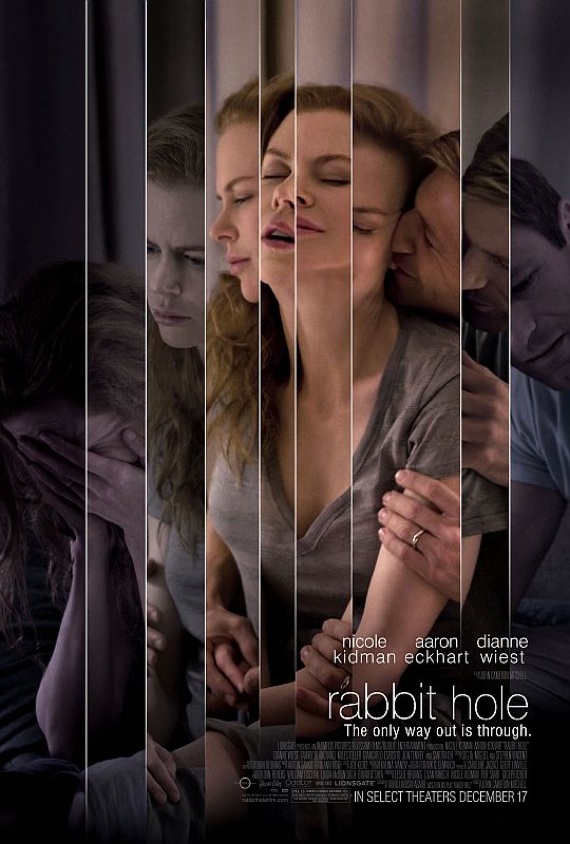
Rabbit Hole

Rabbit Hole (2010)
Directed by John Cameron Mitchell. Starring Nicole Kidman and Aaron Eckhart.

83 Oscars - 1 Nomination: Best Actress (Nicole Kidman)

Rabbit Holeis the harrowing story of a couple dealing with grief  after the death of their young son. Perhaps what is most interesting about this plot is that the child was hit by a car as he chased a dog out into the street. Thus, as tragic as it is, there is no "bad guy" and there is no one, really, to blame. Not even the teenage driver, who plays an important role in the story, is at fault for the accident. Overall, this film is simply about the parent's raw pain at their terrible loss, though this is now growing dull as it's been eight months since their son Danny's death, and about their attempts to move forward with their lives.

What I found most interesting was the way Rabbit Hole depicted grief, loss, tragedy, and death. Becca (Kidman) tries to handle it by moving on, slowly getting rid of what remained of Danny -- finger-paintings on the fridge, kiddie snacks in the cupboard, and clothes in the closet. Meanwhile, Howie (Eckhart) is trying to hold on to the memory of his son, often turning to a simple home video of Danny on his iPhone for comfort. Added to this are the characters in a grief support group (one of whom Howie grows quite close to), and Becca's family, who have their own experiences with loss and life.

Despite how it sounds, this film is not unbearably dark. There are moments of hope and lightness. There is a sense that, though the grief will never go away, as one character says, it will become bearable. There is a light at the end of the tunnel -- or rather, the rabbit hole.

Quite honestly, it's somewhat disappointing to me that both of the leads didn't receive Oscar nominations. Even in a Blockbuster like The Dark Knight, I thought Aaron Eckhart was a formidable actor. Though Nicole Kidman does dominate the picture, I thought Kidman's performance was more of a group effort -- that it was made stronger through contrast to Eckhart and the other actors. That said, hers is an impressive performance. Kidman is in beige and baggy clothes, with frizzy hair and little makeup. In short, she is the opposite of the glamorous actress I often think of her as (it's amazing compare her in this film to her role in Moulin Rouge). This is a bare-bones, raw role. Though I don't think she's really a contender to win in the Best Lead Actress category, I think this nomination is an important recognition of an impressive performance.

This film is based on a play, and looking at Rabbit Hole through the film student's eye, I was aware of these origins. Throughout film history, there is a give and take between movies and theater. Films came out of the great vaudeville entertainment tradition, and at various points in films, performances and stories were quite theatrical -- with frontal address, limited sets, etc. Many films have been adapted from theater. This film, though made more complex in many ways in the transition to  the filmic medium (for example, characters drive around quite a lot), still doesn't seem to have moved too far from the stage. The film style is simple, the music unobtrusive. I don't mean this as a critique -- far from it. I found it to be refreshingly simple; focused on its subject matter, characters, plot and themes above all else. I think this, more than anything else, really played a large role in letting Kidman shine.

Saturday, January 29, 2011

Academy Award Nominations

For a full list of the 83rd Oscar Nominations, click here. The Oscars will be held on Sunday, February 27th, hosted by James Franco and Anne Hathaway.

Oh boy, Awards Season. The votes are being cast, envelopes are being sealed, and "I didn't think I'd win but I prepared a speech just in case" speeches are being written.

Oscar nominations were announced earlier this week, shortly after the Golden Globes were broadcast on January 16th. This is the second year of having 10 Best Picture nominees instead of 5, and yet again we have two hosts. I haven't seen all the nominated films this year. It's not a great year for the squeamish (between 127 Hours, Black Swan, and The Fighter, three films I still can't decide about seeing or skipping). In total, I've seen 6 of the Best Picture nominees -- and I may try to raise that number a little higher before the big night. Here's a quick rundown of who/what I'm rooting for, who I think will win a few major categories, etc...

- For best Picture, it would make me insanely happy to see Inception or even Toy Story 3 win, but I know that there's just about a snowball's chance in hell of that happening, so instead I'm being practical and rooting for The King's Speech. The Social Network got a lot of awards at the Globes, and, though it was good, I didn't think it was THAT good. I thought The King's Speech was heartwarming, funny, and interesting (historically-speaking, I learned something). It has masterful performances (I'm also rooting for it in the Actor, Collin Firth and Supporting Actor, Geoffrey Rush). I'm starting to think that I may need to see both of these films again before the big night. Additionally, for best Animated Picture, I think it's pretty much a given that Toy Story 3 will win (and I think it completely deserves it).

- For the Actress category, I'm guessing it will go to either Annette Bening or Natalie Portman, and I'd be happy to see either of them win. It seems like Bening deserves it after a long career (she has been nominated four times, but hasn't won, I believe -- kind of like Jeff Bridges last year) -- and she was quite good in The Kids Are All Right. On the flip side, though I haven't seen Black Swan, I have liked Natalie Portman for a long time, and it sounds like an incredible role for her to take on. For Supporting Actress, it'd be cool to see someone as young and talented as Hailee Steinfeld win, but she probably won't.

- For Directing, I was incredibly frustrated to see that Christopher Nolan was snubbed, wasn't even nominated. I really look up to him as a Director and so without him in the category, I don't have anyone that I'm really rooting for. For many of the creative and technical awards, I'll be rooting for Inception. That film had such incredible Visual Effects (most of them were actually done in real life -- without CGI!) and everything from the Cinematography to the Soundtrack to the film's Sound Editing was mindblowing. One further note about soundtrack -- Hans Zimmer is one of my favorite composers of all time, so it boggles my mind that he's only won an Oscar once, for The Lion King. I really hope he wins. Above all, though, I really hope Inception gets an award for Writing (Original) as it was SUCH a creative, unique, interesting screenplay. The only exception to my Inception rule is Art Direction, as I pretty much HAVE to root for Harry Potter and the Deathly Hallows: Part 1 in that category. As the HP franchise is wrapping up, I really hope it starts winning more awards (ala Lord of the Rings).

Will you be watching the Oscars? What are you rooting for? What were you surprised to see on or off the nominations list? How do you think James Franco and Anne Hathaway will be as hosts? If you've read this post and have any opinions, I'd love to hear about them in a comment.


Update! Turns out I've decided I want to do more than just talk about the few films I've seen... I want to see them all! I'm making it my goal to have seen all 10 Best Picture Nominees, plus all of the films nominated for any of the Acting categories by Oscar night. Can I do it? We'll see!

Sunday, January 23, 2011

True Grit

True Grit (2010)
Directed by Joel and Ethan Coen. Starring Jeff Bridges, Matt Damon, Josh Brolin, and Hailee Steinfeld. 

83rd Oscars - 10 nominations: Best Picture, Directing, Actor (Jeff Bridges), Actress in a Supporting Role (Hailee Steinfeld), Art Direction, Cinematography, Costume Design, Sound Editing, Sound Mixing, Writing (Adapted Screenplay).

True Grit is about a young girl whose father has been murdered by a man named Tom Chaney. Intent on seeing Chaney (Brolin) brought to justice, 14-year-old Maddie Ross (Steinfeld) hires a US Marshall (Bridges) to pursue him. Meanwhile, they meet a Texas Ranger (Damon) who is also in pursuit of Chaney. In my opinion, the key performance in True Grit is not that of Josh Brolin's menacing baddie, Matt Damon's bumbling ranger, or Jeff Bridges' drunken Marshall... it's the "grit" of Hailee Steinfeld.

One of the first film classes I took in college was Women and Film... (additionally,  I have run the projector for this class for two semesters, so I've heard the lectures multiple times). This class really influenced me and the way I watch movies. I always keep an eye out for assessing the portrayal of women in both old and new films. Let me tell you, Hailee Steinfeld's Maddie Ross is destined to be taught in this class. With her no-nonsense, you-better-take-me-seriously attitude, she's a true force to be reckoned with... and she can hold her own against in the wild wild West.

Something I continue to find interesting about this film is the degree to which the Coen Brothers are insisting it is not a remake of the 1969 John Wayne True Grit, but rather a fresh adaptation of the novel by Charles Portis. This strikes me as fairly amusing as, either way, it's not an original story... and it seems to stand for the abundance of remakes/adaptations (not to mention all the prequels and sequels) that abound in Hollywood nowadays. The near-absence of originality in Hollywood is something I'm interested in researching, actually, but I digress.

In considering about whether a film can NOT be a remake of another film when it IS an adaptation from the same source material, I stumbled across something rather interesting online... an awesome little video where someone cut together a few scenes from the 1969 and the 2010 versions of True Grit. As you'll notice, the dialogue is almost word for word. Are these just the most similar scenes in the two films, or are these clips representative? I don't know, I haven't seen the full 1969 film.

Still, these scenes are very similar. Does this disprove the Coen Bros' assertion that their film is different? I don't think so. After all, look at the difference in the performances... I find the 2010 version far more compelling. Notice how the same line can be played for more humor or intensity, how Maddie Ross stands out much more, how each shot in the Coen Bros film has a greater artistic sensibility.

This leads me to another train of thought...  Does this show a general trend? Does it mean that the quality of filmmaking nowadays is far greater than that of the 60s? My answer would be, yes and no. Filmmaking technology probably has something to do with the beautiful shots in the Coen Brothers version. Acting styles have certainly improved... But my "no" comes from the fact that the 1969 True Grit was made in a time when Westerns were churned out left and right... Nowadays, they're rarities (really the only other recent one I can think of is 2007's 3:10 to Yuma -- which incidentally, was also a remake, of a 1957 film). Thus, I think there is greater artistry in newer Western films because Hollywood isn't saturated with them.

I would recommend this film as an all-around good time. It's interesting historically and is a fun adventure story. It will be interesting to see how it fairs at the Oscars.

For more on this film, I encourage you to check out this interview with the Coen Brothers.