Showing posts with label In Theaters. Show all posts

Friday, June 17, 2011

Midnight In Paris

Midnight in Paris (2011)
Directed by Woody Allen. Starring Owen Wilson, Rachel McAdams, Marion Cotillard, and more.

It's rare to find a movie so good that you walk out of the theater grinning ear-to-ear. Sure, there are movies that are "good" - aka award winning, or "good" - aka Summer Blockbuster so explosive that they burn up the box office, or "good" - well-made, plotted, acted, etc. But there's another class of good, which Midnight in Paris is in, that's magical, that's purely enjoyable. This is a film that's creative, funny, beautifully shot, filled with expert performances, meaningful, thoughtful... It's a true gem and a crowd-pleaser, so right off the bat, I recommend that you see it.

Midnight in Paris may be Woody Allen's gazillionth film, and sure, a lot of people have complaints about his recent work... but really, this movie just goes to show the extent to which Allen is a master of his craft. He's a true auteur, writing and directing stories with such a clear touch that you could be plopped down halfway through the movie, and quickly identify it as an Allen work. There aren't many of these types of directors nowadays -- at least, not many that haven't become Spielburgs and Lucases, plopping their name on any big budget epic space film or franchise. Allen's work remains quiet, simple, yet elegant.

From the opening shots of this film, I was in love. The credits begin with soft swooning music, and a series of five or ten second shots of various locales -- captured moments, moving photographs, really -- in Paris. Many of them are mundane, as if Allen plopped his camera down, found an interesting composition, and waited to see what he found. Scenes flit by at a refreshingly slow pace (compared to today's wild music video -style editing)... like a jogger in an outdoor park, or a crowd of people opening umbrellas as it begins to rain. The Eiffel Tower makes an appearance, as does the Lourve, but really, they are presented as merely small parts of the magical world that is Paris, France. Indeed, Allen, and in his stead (since he does not act in this film), star Owen Wilson spend the film waxing romantically and nostalgically about Paris... Paris in the rain, Paris in the 1920s, Paris at midnight...

[This paragraph, and only this paragraph contains mild spoilers... The main narrative device is not given away in the trailer, and I recommend staying ignorant about the plot if at all possible before you see it. But if you really want to know, don't say I didn't warn you:] The plot revolves around a simple narrative conceit: Wilson, so in love with the idea of Paris in the 1920s, finds himself there one evening after a nighttime (and slightly drunken) walk through the city. What follows is like a game where someone asks you, "You're having a dinner party, and you could invite 5 famous people... who would they be?" F. Scott Fitzgerald, Ernest Hemingway, Cole Porter all make appearances -- and that's just the first scene. The best part of the film is wondering who's lurking around the next corner for Wilson to bump into, and a surprisingly large series of well-known actors make appearances as various figures from the past. The beauty of all this is that Allen never explains how, why, if it's real, a dream, etc. And that's just fine with me. It's better to not know, and be carried away by the illusion of the past. Too often, we remain in a framework where everything has to be explained. So, for just this once, let it carry you away. The film is like a daydream for history buffs (particularly literary history), and you may miss some of the jokes if you don't know who's who.

Though I would not have pegged him as a suitable actor for the film, Wilson is SUPERB as a Woody Allen stand-in. In a lot of ways, he doesn't just play his character, but he plays Allen. It's amazing the extent to which he masters Allen's awkward way of dryly umming through a scene (particularly when a beautiful woman is involved). Though Allen will be returning to the screen in his next film (The Bop Decameron, due to be filmed in Rome for a 2012 release), he found an amazingly suitable replacement for himself here. Wilson brings the character to life as Allen would have, and in doing so, makes the whole film work. 

The film is funny in SO many ways. Little one-liners come at you too fast to remember, but long enough to glance over at your viewing companions, silently asking through your laughter, "did he really just say that?" Situational humor is bolstered by the presence of the many historical figures. The humor fits into so many genres -- Romantic Comedy type situations arise between Wilson and his girlfriend, played by Rachel McAdams. Classic Woody Allen absurdities find their way in, as would be expected.

Overall, what really pushed this over the edge from good to great (and right now, my opinions is hovering around "OMG I want to see it again") is the meaning that's buried beneath the humor, the story, and the characters. Allen is dealing with big ideas here... nostalgia and memory, the passage of time, the value of love and partnership, the meaning of life, the prospect of death. He doesn't hold back when it comes to wrestling with these concepts, but he doesn't drag the film down with them. He manages to keep it light, and in doing so, presents a rather hopeful (rare for Allen, in my opinion) vision of the world.

As I've done in the past, I want to bring in the great Roger Ebert's review of this film, which I recommend reading, and give him the final word:
This is Woody Allen's 41st film. He writes his films himself, and directs them with wit and grace. I consider him a treasure of the cinema. Some people take him for granted, although Midnight in Paris reported charmed even the jaded veterans of the Cannes press screenings. There is nothing to dislike about it. Either you connect with it or not. I'm wearying of movies that are for "everybody" -- which means, nobody in particular. Midnight in Paris is for me, in particular, and that's just fine with moi. 

Friday, June 10, 2011

Super 8

Super 8 (2011)
Directed by J.J. Abrams. Starring Joel Courtney, Elle Fanning, and Kyle Chandler

Now this is a horse of a different color! Super 8 is a blockbuster that doesn't feel like one; a contemporary film that looks like it was made 20 years ago; a Steven Spielberg -produced film that reads like it was directed by him. Super 8 shows that, for someone who's only directing his fourth film (if I counted correctly), J.J. Abrams is turning out to be quite a masterful creative figure in Hollywood.

It makes complete sense that Spielberg is attached to this film... in many ways, it's surprising it's not HIS film. Super 8 is equal parts Close Encounters, Jaws, and E.T., mixed and stirred with a bit of modern CGI and Cloverfield-esque monster magic mixed in. I love the way Abrams teases the monster movie conventions, treating it much like the shark in Jaws, delaying showing us the alien in full until most of the way into the film. And when do you see the monster, I found it all the more satisfying that Abrams took advantage of modern movie magic, creating an intriguing and "real" looking monster so much more than Spielberg was able to do in Close Encounters. The kids, of course, come straight out of E.T., or any other film from the 70s and 80s. The moment you see one of them grab a bicycle, you can't help but chuckle at the reminder of that classic film -- particularly after the Spielberg logo at the beginning.

I hope the Hollywood industry as a whole pays attention to this film. It seems to be both critically and popularly appealing and, overall, seems to have been praised. I love that Super 8 proves that a tent-pole picture doesn't have to be a sequel or part of a franchise, needn't feature a Hollywood A-lister, and can be enjoyed all the more for not being aimed specifically at the average 12 to 24 year-old male demographic. It has something for everyone... nostalgia for childhood, humor, mystery, characters you become invested in, a few thrills, epic CGI explosions and one heckuva creature.

In particular, I really enjoyed the relationships between the characters. These are young actors -- for some, but not all, this is their breakout role. The lead, in particular, Joel Courtney, is someone you quickly come to care about. He brings to life the budding relationship between his character and Alice with a sincerity that is impossible not to love. Furthermore, the male friendship between the whole group of young boys is superbly done. The way they chatter away at the same time, teasing and complaining, talking excitedly and telling the others to "shut up!" seems genuine and true to life.

Both related and unrelated to this film, I highly recommend you view this talk, which J.J. Abrams gave for TED a few years ago. Not only is it inspiring and interesting, but it is made all the more fascinating in conjunction with this, Abrams' latest film.

There are a lot of choices in the summer months, and if you don't want to head to the theaters, for every release, you have to pick and choose. Pick this one. You won't be disappointed.

Friday, May 20, 2011

Pirates of the Caribbean: On Stranger Tides

Pirates of the Caribbean: On Stranger Tides (2011)
Directed by Rob Marshall. Starring Johnny Depp, Geoffrey Rush, Kevin R. McNally, Penelope Cruz, and Ian McShane.

The release of Pirates of the Caribbean: On Stranger Tides, the fourth Pirates film, was a momentous occasion for me. In many ways, my love of these movies made me aspire to work in Hollywood and want to go to film school. Additionally, I can quote the first Pirates very nearly in its entirety, and I often rate Curse of the Black Pearl as my absolute favorite movie ever; Johnny Depp is my favorite actor; Hans Zimmer is my favorite composer... You get the idea. So, as it's been four years since At World's End, suffice it to say, I was extremely excited to see this movie.

While many will agree that the first Pirates film was genius, still more will argue that the overblown, out-of-control ambition that governed the second and third movies spoiled them. Too many mythologies, plot lines, characters, effects, and running times that were punishing (138 minutes / 150 minutes respectively), these sequels *tried to do too much.* Now, I would watch Johnny Depp in character as Captain Jack read the phone book for two hours and call it great fun, so perhaps I am biased, but I still enjoyed those films. That's not to say I don't agree that they went a bit overboard (so to speak).... This past week, I re-watched all three films to "prepare" for the fourth, and I definitely see where they lost many fans. This is all important to keep in mind going to On Stranger Tides. Even Johnny Depp was aware of it when making Dead Man's Chest and At World's End, as he told Entertainment Weekly in his recent cover story.

I've long believed that a film is what you make of it. You can control your enjoyment by crafting your expectations. If you expect Michael Bay to make an Oscar-worthy Transformers film, well, there's no two ways about it... you're going to be disappointed. Same if you expect Terrence Malick to make a fun, light, summer Blockbuster.  That said, it's a well known fact that sequels are rarely "as good as" or "better" than their parent films. And, my question is 'why should they be?' Yes, in an ideal world, it'd be great if a creative team could aspire to the same levels they reached before, but it's just not that likely in a business like the Hollywood dream factory.

If you want a film that is as good as Pirates of the Caribbean: Curse of the Black Pearl, go watch Pirates of the Caribbean: Curse of the Black Pearl. Films like that are good because they are new, they tried something risky (hello Johnny Depp's portrayal of Keith Richards-inspired Jack Sparrow), they are inventive and creative, unaware of (and thus free from worries about) how they will be received, etc. Sequels aren't and simply cannot live up to those qualities. So, please, if you go watch On Stranger Tides, don't expect Curse of the Black Pearl... or you will probably be disappointed. If you go in expecting to spend two hours with the FABULOUS Jack Sparrow on another one of his crazy adventures, you'll enjoy it eversomuch more.

I really liked On Stranger Tides. I thought it was very scaled down compared to the last film -- not just because of the lack of SO SO many characters and storylines,  not just because they filmed in Hawaii instead of the Caribbean... but because this story moves faster, has fewer twists and turns, and doesn't try to do as much. This is a character driven film, driven by Jack and the audience's changing understanding of who he is. Yes, he's a rum-soaked, wobbly-legged pirate... but as we see, he might just have a heart as well. And so, Penelope Cruz is a great addition to the plot as Angelica, daughter of the fearsome pirate Blackbeard, and once-lover of dear ol' Jack. (Fun fact: ever notice that little strip of lace dangling from Johnny's left wrist as part of his Captain Jack costume? He added it in when they were filming the second film, imagining it as a trinket given to him by a lover in the past. Well...) Angelica is in many ways a female version of Jack, which is a fabulous dynamic and one that makes the film feel fresh.

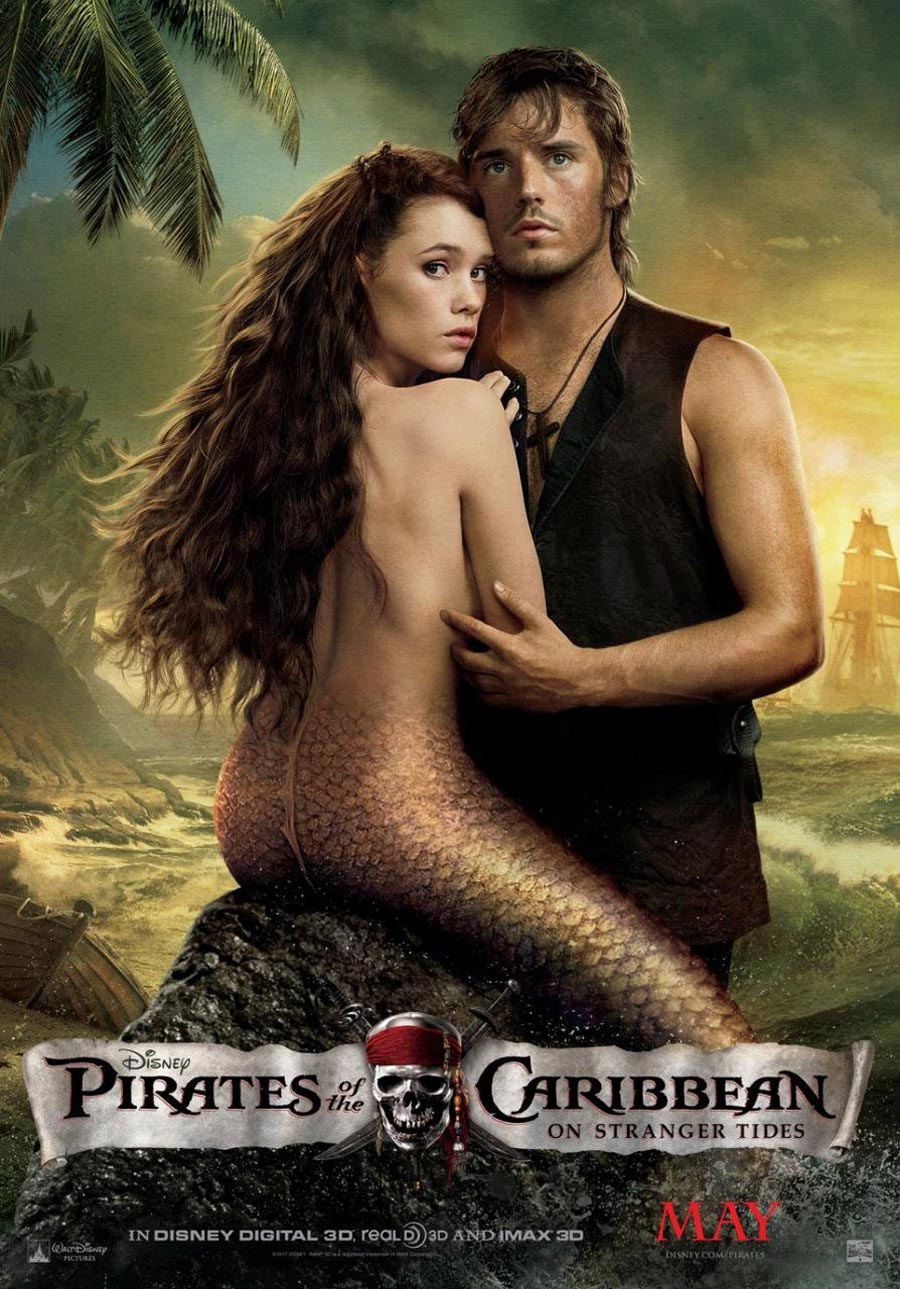
Furthermore, Geoffrey Rush makes a welcome return to this film -- ever since his line that "The code's more guidelines than actual rules," I've had a special place in my heart for Barbossa. The dynamic between Jack Sparrow and Hector Barbossa continues to evolve, and is interesting and fun, one of my favorite parts of the film. The plot is about the race to the Fountain of Youth -- something that was brought up at the end of the last film. Barbossa, the Spanish, and Blackbeard (also a new character) are racing to be the first to get there, and Jack gets caught up in the race. In order to drink from its waters and avoid mortality, you must have a mermaid... which brings in a neat sideplot featuring these newcomers, who certainly may appear in future films. (Yes, the screenplay for the fifth Pirates was turned in recently).

Overall, with all these ingredients in place, director Rob Marshall (Gore Verbinski didn't return for this one) steers the film through new locales -- London, for example -- to familiar lush islands, off cliffs and through caves to the Fountain. I thought there were some great action sequences, plenty of laugh-out-loud lines and moments, and some great development of relationships. In short, everything that I love about a Pirates film was present. My only bone to pick with this film was that, perhaps, the stakes weren't high enough and that the finale wasn't grand enough (yes, okay, grand words after the last two films, but perhaps they skewed my expectations). The action is pretty front-loaded -- with an exciting escape sequence within the first half hour -- that it left me wanting a bit more by the end. Still, given what I've said already about problems with the last two, perhaps it's better they steered clear of anything too crazy.

Personally, I can't wait to see On Stranger Tides at least once more in theaters, and I recommend you see it if you've ever enjoyed Captain Jack Sparrow. This film will entertain you for a couple of hours, and whisk you away on the high seas for another supernatural and grand adventure. It's fun, funny, and made for the fans... proof that this franchise will likely carry on for a while longer. And, well, that's fine by me... I'm not ready to see Jack hang up his hat just yet.

Sunday, May 15, 2011

Thor

Thor (2011)
Directed by Kenneth Branaugh. Starring Chris Hemsworth, Natalie Portman, Stellan Starsgard, and Anthony Hopkins.

Superhero movies are hard to review because of their sheer quantity nowadays. It's impossible to watch one without comparing it to another because they stack up so quickly in theaters. And yet, despite the fact that they are squished together into one extremely popular genre, I like to try to remember that these are still individual films.

Thor is on a particularly imaginative branch of the superhero film tree. Far more based in the realm of mythology and fantasy than the others, the hero doesn't get his powers from a spider bite or a fancy utility belt... he has them because he is the God of Thunder. Take that, Batman. In a lot of ways, this is a coming-of-age story more than one of good versus evil. Think along the lines of Peter Parker being told "With great power comes great responsibility." Thor must learn what to fight for, because from the film's opening, it's clear that he already knows how to fight -- to the point of recklessness.

Director Kenneth Branaugh, best known for film adaptations of Shakespeare plays (as well as his own acting), brings a clear vision and unusual touch to such a Blockbuster-y summer tentpole picture. The visual effects that bring Thor's to life are stunning -- in fact, I wanted to see more of his magical world than we did. And, in a dizzying display of marketing, the film does a wonderful job starting to set up The Avengers movie coming next year. (Captain America finishes off the set-up).*

So, while I enjoyed Thor, in retrospect, I think it fell a little flat. The romance was largely uninteresting -- though it was good to see Natalie Portman out of the pointe shoes. And the climactic battle, or perhaps the lead-up to it, was disappointing. In fact, I didn't realize it WAS the final battle until the credits rolled. Overall, this was a good popcorn flick. I'm glad to see a desire in the Marvel camp to be more creative, and to recruit interesting directors to make their films better, but in the end, I don't think it went above and beyond its Blockbuster status.


*I recommend that you ALWAYS stay until after the credits at Marvel movies.

Sunday, April 24, 2011

Water for Elephants

Water for Elephants (2011)
Directed by Francis Lawrence. Starring Robert Pattinson, Reese Witherspoon, Christoph Waltz, and Hal Holbrook.

Having read the book before watching Water for Elephants, it seemed to me that it would be pretty hard to mess it up -- the story is just that good. This proved to be true. So, while this isn't an incredible film, it's a good one, all because of its core plot, characters, and sparkling circus magic.

It's hard to boil this story down to a single genre or category. It's a historical piece that delves into the world of a traveling circus during the Great Depression. It's a coming-of-age story, and a dealing-with-age story, as its main character Jacob, in his 90s, reflects on the formative years of his life in his 20s. It's a spectacle film, while it's also driven by its narrative. Yet above all, it's a love story -- about forbidden love, love overcoming obstacles, and love triumphing in the end.

Following the death of his parents and loss of life as he knew it, young Jacob starts walking along the railroad tracks, lost, and looking for what to do next. The next chapter of his life very nearly runs him over, literally, in the form of a Benzini Brothers' Circus train. There, he delves into a new world, drawn to the circus' magic and, in particular, to the beautiful Marlena. The catch, (there's always a catch) is Marlena's husband August... owner of the circus (or, in the book, second-in-command), who is at times vindictive, kind, cruel, helpful, and downright frightening.

Of all the performances, Christoph Waltz's is the most impressive. This is due, of course, to his sheer skill -- witnessed most notably in an Oscar-winning role in Inglorious Basterds. Waltz crackles with electricity in every moment and brings every mood-swing to terrifying fruition. He is perfectly cast -- it's as if the role was written for someone with that twinkle in his eye, and that hardness in the set of his jaw.

Robert Pattinson, who I have mixed feelings about due to his body of work, turns in a solid performance. He is is emotional, yet also subdued, as he is not the center of the show, but rather the eyes watching it -- the audience's main subject of identification. And, indeed, he does a lot of watching and gaping and staring in this film. Reese Witherspoon is similarly good -- perhaps not great, but she certainly turns in the right attitude for her character. There's something slightly flat about the chemistry between the two actors. This was saved in my mind only by the chemistry of the characters, a holdover from my powerful experience reading Sara Gruen's novel.

Above all, I enjoyed a certain quality of the filmmaking that's difficult to put my finger on. There's a magic to the lighting, to the loving way the circus is brought to life. This is an enjoyable movie, but it's not a fluffy rom com. It's more serious than that. It has its dark moments, yet also its frivolity. At times romantic, suspenseful, and intriguing, it carries you away -- even if it's not the kind of film to make such a big impression that it will stay with you for years to come. (The same could NOT be said of the book, though, as it is an even more powerful experience and I likely WILL remember it for quite some time). In all, this is a good film to curl up with on a sleepy afternoon, particularly if you read and liked the book.

Saturday, April 16, 2011

Source Code

Source Code (2011)
Directed by Duncan Jones. Starring Jake Gyllenhaal, Michelle Monaghan, and Vera Farmiga.

This is a film that succeeds where many others have failed. Though it, in some regard, reminds me of at least a half dozen other movies (Vantage Point, Deja Vu, even the recent Adjustment Bureau, as well as the TV series 24), it manages to be inventive and exciting. I was not surprised to read that Duncan Jones also directed the fantastic film Moon from a few years ago... it shows the same fresh look at and deft handling of science fiction that is becoming rare as the genre merges more and more with mainstream Blockbuster filmmaking.

A key part of my review from this film is something I can't fully explain without giving the plot away too much... and that's something I would hate to do. There came a point roughly three quarters of the way through the film, as we were nearing the climax and the conclusion, where I saw two paths the remainder of the film could take. One would have left me feeling like I did about the Adjustment Bureau. It would have left me thinking the filmmakers weren't willing to commit to their own idea, willing to risk it all for a really interesting and "out there" imaginative sci-fi concept. The other, which is thankfully what ended up being the case, left me chattering with my viewing companions about "what it meant." I walked away pleased by a satisfying twist and a puzzling finale, still thinking about the possibilities it raised long after the credits rolled

Source Code wasn't a film I was intending to see -- at least not in theaters. While it seemed intriguing, it didn't hook me enough ahead of time, particularly with its release coming during school. But, I heard so much about it from others that, how could I resist? While I rarely listen to bad reviews, I definitely take recommendations -- particularly from friends -- seriously. It was nice to see a film I wasn't highly attached to, that I didn't have high hopes for, but that I was ready to be surprised by. So, down to business. Source Code is about a soldier who wakes up in someone else's body on a train that's going to explode in 8 minutes. Only, when it explodes, he doesn't die -- he wakes up, and is told to try again, try to figure out who caused the explosion. So he wakes up on the train again, and again. Of course, there's a girl, a bad guy, and a lot of twists, but it's the who of the main character and how of the main plot that are most intriguing.

As I look back on this film, the one thing I realize more and more is that I need to see it again. It's one that makes more sense once you've hit the ending, and of course you groan and say "oh, that's what they were doing earlier," and then chuckle at the ingenuity of it all. I love films like this -- those that reward an attentive audience member and multiple viewings. I love the ideas that Source Code deals with -- ones, as I've said, that have come up in many other science fiction films, but either not worked or deserved reconsidering. The past... the future: How are they connected? Can the past be changed? Is the future pre-determined? Fascinating. I love the opportunities Source Code took to be creative with the filmmaking... Like the more-or-less flop Vantage Point from a few years back, Source Code shows one scene multiple times, with variations. This is a device that is hard to do well, but is a fun one to try.

Source Code strikes a nice balance between being BIG (action-adventure, complicated idea but one that's understandable, special effects, movie star) and not too big (tightly-structured, not dominated by CGI, not too dumbed down). This is clearly not a summer Blockbuster like Inception. Though it has a similar feel, it's definitely a March release type. In all, this is a film I would recommend to catch on DVD if you, like I did, initially decided to pass on it.

Sunday, April 10, 2011

Jane Eyre

Jane Eyre (2011)
Directed by Cary Fukunaga. Starring Mia Wasikowski, Michael Fassbender, Jamie Bell, and Judi Dench.

Adapting a book into a film -- and making the film both good in its own right and good in comparison to the source material -- is never easy. However, there's a special place in the realm of "based on the book by" for those written by authors like Jane Austen and Charlotte Brontë... they just work. Perhaps its their cinematic settings in, often, Northern England, or their emotional plots, witty characters, and complex relationships. Plus, there's enough distance from the books that you rarely hear upset about something being changed or left out the way you hear people nitpick the latest Harry Potter film.

This latest version of Jane Eyre is no exception to the grand tradition of adapting 17th and 18th century books into films and TV series. I read the book Jane Eyre almost two years ago, when I had exhausted Jane Austen's works and was searching for something in the same vein (although it's not actually that similar). It's more difficult to grasp, somehow, than Austen. Jane Eyre is a very different heroine from Elizabeth Bennet, Woodhouse, or any other Austen ladies. She's a tortured soul, trapped in a life with no light at the end of the tunnel, and facing a darker story than the gals from Sense and Sensibility or even the suspicious chica in Northanger Abbey could ever handle. Still, there was something about the book that I felt I never could grasp. I couldn't imagine the story playing out in my mind's eye... the emotions weren't coming across right... character motivations were getting tangled up somehow.

Cue the movie. I was, rightly so it turns out, really looking forwards to seeing this story played out. Though the language in the writing is classic, I wanted to get past that and understand the heart of the story... the soul of Jane Eyre. This film version did an excellent job of making sense of the story for me. In Jane Eyre, happy endings seem impossible. Jane grows up unloved and unwanted by her aunt and cousins. She moves onto a school where her one friend dies. She moves onto a position as a governess only to have more trouble mar her path. In short, not a happy story. But, Jane is not an unlikable character. She's stoic, sure-footed, and decent hearted, despite all the forces in the world trying to make her otherwise.

Newcomer Michael Fassbender (also coming to theaters soon in the new X-Men: First Class) does an excellent job as Mr. Rochester. Judi Dench, as always, is fabulous. Mia Wasikowski (also seen in a diverse group of films that includes Alice in Wonderland and The Kids Are All Right) continues to prove herself as an excellent young actress. In fact, she alone makes this movie sing -- the other actors just back her up.

This was a movie I was expecting to like, and I wasn't disappointed. It's a great film to curl up with, particularly for fans of the genre or book. It's nice to see continued interest in these types of films (take the Keira Knightley led Pride and Prejudice from a few years ago) and I hope it continues.

Sunday, March 13, 2011

The Adjustment Bureau

The Adjustment Bureau (2011)
Directed by George Nolfi. Starring Matt Damon and Emily Blunt.

I sometimes read Roger Ebert's review of a film I'm attempting to write about... He's so good at what he does that I find it inspiring and thought-provoking. I do often have to challenge me afterwards to stick to my own ideas and language. However, just this once, I simply have to quote him (from this post)... "The Adjustment Bureau is about the conflict between free will and predestination, and right there you have the whole dilemma of life, don't you? Either it makes a difference what you choose to do, or the book had already been written, and all you can do is turn the pages."

I knew this movie was right up my alley even before seeing it... It's an interesting mix of Sci Fi and Romantic Comedy/Drama, and it deals with really interesting ideas about fate. The titular agency is a supposed group that keeps certain important people "on track" with the plans laid out for their lives. In fact, they are tasked with keeping the entire human species on track... but it's really the important people, those who are destined for great things that matter. The explanation for the bureau is fairly well fleshed out (although the head of it, the supreme "god-like" figure is murky and barely explained)...  We do get a rather witty glimpse into history, including the fun fact that the few times the Bureau tried a "hands-off" method led to the Dark Ages and the World Wars.

Thus, humans can't govern themselves, other than the tiny daily decisions... what size coffee to drink in the morning, and the like. So, from this premise, you would think that the film seems to put forth an argument for predestination. But I don't think it does, because the film is questioning predestination, testing free will, asking how the two could possibly work together. If anything it argues that free will is out there, but that it must be worked for. It's easy to be a sheep and follow the path laid out for you, but you can also try to reach a higher state of... call it enlightenment... in which you are in charge of your own destiny.

The film puts forth the story of one man, David (Damon) who decides he doesn't like the plan laid out for him. David must choose between his love for Elise and his aspirations in politics, but what happens if he doesn't choose "correctly", as the Bureau wants him to? Of course, the real kicker is that David was never supposed to really meet Elise... or at the very least, not supposed to fall in love with her. She was supposed to be a chance encounter in a men's bathroom... a catalyst that leads him to greatness. But David and Elise do meet again, on a public bus, when David's Bureau handler falls asleep on the job. Faced with the task of getting David back on track, the wonderful John Slattery (I'm not sure of his character's name) reveals all, thinking a full explanation of the Bureau, coupled with a threat to erase his memory if he should share this information with anyone, will solve the problem. Long story short, it doesn't.

This film is good, but it's missing something that would have made it great. It's as if it's not willing to go all in to the science fiction vision of the world it purports. This is not the next Inception, in other words... it treats its topic too lightly, somehow. The stakes for David and Elise never seem as high as those for Mal and Cob in Inception, for example. Though they grapple with similar things -- their entire grasp on reality as they know it falling apart -- The Adjustment Bureau seems to move on too quickly, or not buy into its own idea somehow.

Don't get me wrong, it's a solid, fun two-hour flick... but it's not nearly the class of film I'd expect in, as I've heard it called, "the post-Inception era." I've heard chatter online that Source Code, another film in a this genre may be a true film for the post-Inception age -- a time of intelligent and interesting films -- but I haven't had a chance to see Source Code yet, at the time I'm writing this.

I liked The Adjustment Bureau when all is said and done. Damon and Blunt, along with the supporting actors like Slattery (whom I love from Mad Men) and Anthony Mackie (whom I'm not very familiar with, but was wonderful in this) all turn in great performances. Damon and Blunt, surprisingly, have good chemistry... It's believable that these are two people chance would throw together, and they'd get along well. I'm not sure how memorable this film will be in the long run... Perhaps in a few years, I'll hear the title and say, "Oh, yeah, I saw that, it was good," but to be honest, it's just a March Blockbuster flick, good for a few hours of fun.

Saturday, March 12, 2011

Rango

Rango (2011)
Directed by Gore Verbinski. Starring (voices by) Johnny Depp, Isla Fisher, Abigail Breslin, Ned Beatty, Alfred Molina, Bill Nighy, and others.

Animated film Rango is a horse (or more accurately, a chameleon) of a different color. It's an animated film for adults, rather than children. Most films like this that try to cross the age line focus on the kids and throw in a few nods toward their parents; but the creative team lead by Gore Verbinski really seemed to have set out to make a smart, intelligent, grown-up flick.... and yes, it happens to be non-live action.

Furthermore, Rango was clearly made by somebody who loves films and has seen lots of them... After seeing it, I concluded that Gore Verbinski must be incredibly well versed in genres and cliches. The whole film is one big nod to the classic Western films of the 50s and 60s, drawing on every cowboy convention ever. However, it also tips its hat to surrealist films, Star Wars, Chinatown, and even Fear and Loathing in Las Vegas.

Johnny Depp gives an interesting and dynamic voice performance as the titular character (but really, that's to be expected of him)... as do many of the other actors -- most notably, Bill Nighy (whom I didn't recognize until part of the way into the film). Rango is an incredibly human lizard, which of course is what makes this film so appealing and real despite its animated nature. In the beginning, when he is alone in a glass tank riding in the back of a car, we see him neurotically longing for friends (which comprise the wind-up goldfish toy in the poster, and a headless, legless Barbie doll torso), attempting to figure out who he is, and what role to play (literally). When his tank falls out of the car and he is left stranded in the wilderness of the Mohave desert, we see him struggle to fit into his new surroundings (ironic, of course, since he is a chameleon). There is a wonderful light bulb moment when he first walks into the bar of the little town that the film is about... and Rango decides to reinvent himself.

The CGI animation is impressive. Fur, skin, and scale textures on the many animals are incredibly realistic... as are the desert surroundings. There's one scene that stays in my mind, where the sand is gently blowing in the nighttime breeze... and all I can say is that they nailed it. The sand sparkles in the right way, moves in the right way... It just looks real. If not for the stylization in the characters (oversized faces, and such -- like Rango's left eye), you honestly might question for a moment whether or not it was real.

Fun fact for those interested in how films are made: Verbinski and Co used a system they dubbed "emotion capture" to create the film... where the actors didn't just stand in sound booths and voice their lines, but actually acted the scenes out together. (Read more here.)

To sum up, I really enjoyed Rango. It was entertaining, yet didn't sacrifice intelligence to be so. It was a film that was savvy but legible. It was fun and funny and yet it dealt with some interesting themes (identity, community, environmentalism, interconnectedness). Of course, it helped that it featured my favorite actor and was made by the man who made my favorite movie (Pirates of the Caribbean: The Curse of the Black Pearl)... so I was perhaps pre-disposed to like it. But I really would recommend it to any type of film-goer as an all-around good movie.

Thursday, February 17, 2011

Blue Valentine

Blue Valentine (2010)
Directed by Derek Cianfrance. Starring Ryan Gosling and Michelle Williams.

83rd Oscars - 1 Nomination: Best Actress (Michelle Williams)

This is the first of the Oscar films -- and really of any of the films I've reviewed on this blog -- that I didn't care for, no, stronger... I didn't like. I wouldn't recommend it, though of course you may have different tastes in film than I do. Blue Valentine charts the course of a relationship from its beginning to its end. The film tells two stories in a parallel fashion; that of "boy meets girl", and that of "boy and girl's marriage implodes" several years later.

I found this film to be uncomfortable to watch and overly harsh in its creation of the main couple. I wasn't clear if the audience is supposed to root for them to stay together -- as was my initial instinct since we are also watching them fall in love -- or for them to just get it over with and separate -- which is where I ended up out of just plain dislike for both of the characters. I should add that I really wanted to like this film. It was created by a graduate from my school, so I feel a sense of pride (and reassurance) that Derek Cianfrance made it to the silver screen and Oscar nomination list with a big feature film. I even defended it as I walked out of the theater with my viewing companion. It was a very real portrayal of life (and that's a good thing), it took a non-Hollywood approach to love (which is refreshing), it was very creatively done... or so I argued.

But over time, I've come to realize that I didn't enjoy this film, and I didn't find any interesting ideas to make up for not liking it. It's non-traditional in its portrayal of love, but to the point that makes me miss the traditional approach. I mean, even though romantic comedies are full of fluff, you don't leave the theater feeling like my heart has been trampled repeatedly. It's not that I don't like breakup films -- Revolutionary Road from a few years ago was tragic and intense, yet poignant as well. The performances in Blue Valentine by Gosling and Williams were good, I suppose, in that they totally created a pair of people that felt so real that I knew their flaws by heart and hated them. The aging in the two plotlines was subtle and the distance between them was carefully built up. Furthermore, this film had one of the most subtle flip-flops in time that I've ever seen, from falling in love to falling out of it. This was probably my favorite aspect of the movie's style. As Roger Ebert says in his review, it "moves between present and past as if trying to figure out what went wrong." This feeling is carefully constructed, and it makes me wonder what other films Cianfrance is capable of creating.

Perhaps I haven't lived and loved enough to appreciate the nuances of this film's portrayal of the course of a relationship. Yes, I fully admit that this film may have gone over my head. But aside from that, this story was too far away from filmic conventions, from my comfort zone... that I just couldn't reconcile what I was seeing with what I'm used to seeing in this genre. I think this is what makes it stand out for some, but it didn't work for me. There were many films in this year's Oscar season that I had to stretch as a film viewer to see. They were out of my usual genres and taste, and I was glad I gave them a go. The Fighter, Rabbit Hole, 127 Hours, Black Swan ... these were all films I didn't think I wanted to see, but that I was glad I saw afterwards. Blue Valentine simply doesn't fall in this same category.

Tuesday, February 15, 2011

127 Hours

127 Hours (2010)
Directed by Danny Boyle. Starring James Franco.

83rd Oscars - 6 nominations: Best Picture, Actor (James Franco), Editing, Writing (Adapted Screenplay), Score (A.R. Rahman), Original Song.

Of all the best picture nominees, I wavered the most about whether or not I wanted to see 127 Hours. I love Danny Boyle -- his Millions to Slumdog Millionaire are excellent -- and I think he has a great ability to find beauty in the human spirit. Furthermore, I find survivor stories uplifting, and I recently read the fantastic book Miracle in the Andes by Nando Parrado (about a plane crash). Lastly, I continue to be intrigued by the man that is James Franco. Despite all this, I just didn't know if I could handle watching a man cut his own arm off on film. I had almost written it off completely when I decided I was going to see all of the Best Picture and Acting nominees regardless of any qualms I had.

Above all, I need to tell you that this film is INCREDIBLE. I wholeheartedly recommend that everyone see it (if you're squeamish, close your eyes at the end!) and am disappointed it got overshadowed by more predictably Academy-friendly films like the "triumphant and edgy biopics" of The King's Speech and The Social Network. [By the way, the arm-cutting is, quite honestly, such a small moment in an otherwise completely beautiful film, that it's certainly not a valid reason to skip the film altogether.]

Aron Ralston (Franco) at the beginning of the film cannot be tamed. He lives with a wild abandon, throwing himself into the middle-of-nowhere in Moab, Utah; carelessly grabbing supplies, and figuring he can always return his mother's phone call tomorrow (...if only he had picked up that phone and told her where he was going). Once out on the trail, he bumps into two girls, lost, and offers to give them directions. He leads them on a special route that involves sliding down a narrow crevice, and then dropping several hundred feet into a pool of luminescent blue water. And, I have to say, he makes the audience want to take that drop with him. He is a man who wants to live, and live hard -- and the film lures you into his carefree and adventurous spirit.

That's why it's such a surprise -- even though you probably know what happens in the film -- when a rock shifts and he falls and ends up trapped. The ultimate wild child has been pinned down, and at first, neither you nor him want to believe it. But then you do. He assesses his supplies, and realizes that he didn't tell anyone where he was going. Round about this time is when the film's title card actually comes on the screen -- surprising, because it must be a good 30 minutes into the film. When "127 Hours" shows up, you realize that the title is like a stopwatch... how long can he survive?

My favorite scene in the film features Ralston, who keeps his moral up by talking into his video camera until the battery dies, enacting a talk show. With the use of camera angles and sound effects such, Ralston is made to be the host, guest, and call-in listener, all in one. This scene, and the whole film in general, makes me admire James Franco to the nth degree. This isn't a film of ensemble cast members playing off each other for maximum effect -- what you see for almost the entire film is Franco, carrying your attention, and messing with your emotions for an hour and a half. And, boy, does he put you through the emotional ringer. He plays so many roles -- so many "types" of Ralstons, if you will, that it really brings new meaning to "Best Lead Actor."

I could go on and on about this film -- and I already have -- so let me round off this discussion by commenting on how artistic it was. There's something very non-classical about Danny Boyle's approach to this film. One simple shot in particular springs to mind... before Ralston is trapped, as he's hiking toward his destination, he runs his hand along the fluid red Moab rocks. The camera follows him closely, arching over the smooth stone. It's a small moment with breathtaking beauty and significance to the film. Furthermore, Boyle  utilizes multiple cameras and split-screen in an interesting way. He lessens the blow of the final gory arm-hacking moment with the use of an impressive array of fast cuts. He highlights Ralston's experiences with hallucinations, memories, and dream sequences. It's incredibly thoughtful and makes for quite the masterpiece. Bravo!

Sunday, February 13, 2011

Biutiful

Biutiful (2010
Directed by Alejandro González Iñárritu. Starring Javier Bardem.

83rd Oscars - 2 Nominations: Best Foreign Film, Best Actor (Javier Bardem).

It's hard to say what Biutiful is really about. I can tell you that the plot involves a man living in Barcelona after he finds out he has cancer. It deals with his family -- two children and bipolar wife/ex-wife. It shows his work, which deals with the immigrant underground workforce (Chinese factory workers and African street-hawkers). It even deals with his ability to communicate with ghosts, as tangential as it is. In short, it's a beautifully done film, but it's hard to pin down what it's trying to say or what to take away from it.

I often feel that films from Spanish-speaking countries (Biutiful is from a Mexican director) are speaking a different cinematic language than I understand. They deal with narrative and meaning in a foreign way compared to what I am used to. I know this sounds obvious, but I've been watching French and Italian and even Russian films for two semesters now and with those, I'm able to grasp what the filmmaker is trying to do. With recent Spanish films -- not just Biutiful but also the work of directors like the great Pedro Almodovar and even Guillermo del Toro (in his less Hollywood-based work) -- I get the distinct feeling that I'm missing out on understanding what is significant.

Maybe I'm too American in my viewing expectations in that I expect a film to say something, rather than just handle big ideas, which this film certainly does beautifully. Letting go of that expectation, let me say that I was impressed by this film's portrayal of love, life, and death. There's a scene that sticks in my mind in which Bardem pauses while walking home at twilight, and looks up to see a flock of birds fluttering this way and that against the darkening sky. Birds are often the symbol of the soul, so perhaps this scene is saying that how an individual makes peace with guilt, pain, and loss relates to their soul.

What made this film worth watching was Javier Bardem's performance. He is the heart and soul of the film. His solemn face and gravelly voice keeps the film from dropping into abstraction. He is an anchor amongst all the film's emotions and ideas. It's easy to see why this was the Oscar nominated performance of the movie. Overall, largely because of Bardem, I thought there was something haunting about this film -- something I can't pin down, which makes it all the more mysterious and memorable.

Saturday, February 12, 2011

Black Swan

Black Swan (2010)
Directed by Darren Aronofsky. Starring Natalie Portman, Mila Kunis, and Vincent Cassel.

83rd Oscars - 5 Nominations: Best Picture, Actress (Natalie Portman), Directing, Editing, and Cinematography.

This is an impressive psychological thriller. You're thrown into a world where perfection is the name of the game. Nina (Portman), a ballerina who recently scored the lead part in a production of Swan Lake, must learn to embody both the White Swan (which aligns with her naive personality easily) and also the sensual and dark Black Swan. As Nina descend into madness, the film follows, and the audience's grip on reality fades. By the end, it is nearly impossible to know what to believe and what's in Nina's mind.

It's really unusual to have a film (or perhaps I just don't usually watch the type of film) that makes it so you have NO IDEA what to believe. When the madness of the main character is as much a truth as the true events in her life, I think the audience really gets inside the character's mind. In addition to Nina's madness, this is a film about paranoia and duality. Nina flickers from worrying about her understudy Lily (Kunis) to her mother to simply fearing herself and what is happening to her. It is this last fear which I think is the most fearsome "evil" of all, for if you can't trust in yourself, what do you have left? All in all, these are powerful thematic elements that, despite the fairly simple story, make for a complex and interesting film.

This film is also quite melodramatic -- which is an interesting label since the term comes from "music" + "drama." Of course, since the film is centered around Nina's profession as a ballerina, music is key because it brings her dance performances to life. The soundtrack is loosely based on Tchaikovsky's music, so much of it brings up classic ballet scores. However, the soundtrack was composed by Clint Mansell, who has worked with Darren Aronofsky before, on films like Requiem for a Dream (which I haven't seen). I guarantee you know the key piece of music from that film as it has been used it gazillions of trailers.

Black Swan is out of my usual filmgoing comfort zone, as with many Oscar films I viewed this year, and I can't really compare it to other psychological thrillers. I certainly found it suspenseful, misleading, and creepy (partly due to the CGI additions, as when Nina plucks a real black feather out of her skin). I'm not sure if it would have been as big of a hit this year if not for the Portman's dedication to actually honing her skills as a ballerina. Indeed, this is a role that I don't think any ol' actress could play. It takes the right kind of innocent demeanor and yet comfort on the screen (she's been in films since she was a child).

Just one note from the film history part of my brain: I think it's interesting that this film cannot escape the shadow of THE ballet film of all time, The Red Shoes (1948). This is a film that I have yet to see, but it is fascinating to me that one movie can come along and define an entire topic for over 50 years. Does ballet just lend itself toward one kind of story? Or did that film simply tell the story so well that no one else has tried until Black Swan? Interesting to ponder, particularly if you've seen both.

Overall, I think this film is most eerie because the echoing suggestions it makes that resonate with reality. It is so often said that one must be perfect to be the best, that one should get lost in what they love... but here is the dark side of those ideals. In a world of Olympics and award-winning dancers, actresses, and artists, there is a very scary danger of going too far. Yes, Nina wants to be perfect. But where does perfect end, and madness begin?

The Fighter

The Fighter (2010)
Directed by David O. Russell. Starring Mark Wahlberg, Christian Bale, Amy Adams, Melissa Leo.

83rd Oscars - 7 Nominations: Best Picture, Directing, Editing, Supporting Actor (Christian Bale), Supporting Actress (Amy Adams), Supporting Actress (Melissa Leo), Writing (Original Screenplay).

The Fighter plays on two consistently good genres: the "based on a true story" biopic and the underdog sports story. It tells the of the life of boxer "Irish" Micky Ward, his family (including his manager mother and crack-addicted trainer brother), and his first big successes in the sport. I found it to be highly entertaining -- indeed, by the end, it was riveting. What makes it work to the degree that it does are the eccentric natures of the supporting characters, the stoicism of the protagonist, and the energy coursing throughout the final boxing matches.

Honestly, I had written off this film in the "I don't do boxing movies" category. I don't like watching this kind of violence on film... I can watch swords and guns ad infinitum, but people punching the crap out of each other gets hard to watch for me very quickly. So, for the same reason that I haven't (and probably won't) see Million Dollar Baby and that I didn't want to see Fight Club (though I have in fact seen it twice), I was prepared to give this one a pass. Still, the looming SEVEN Oscar nominations changed my mind and I decided that I couldn't miss it. In the end, I was sucked into the drama of Micky's boxing matches.

It's rare to see a film where the main character plays a fairly small role. Don't get me wrong, Mark Wahlberg's performance was solid... it just wasn't spectacular. What really stood out to me was Christian Bale (Micky's brother) and Amy Adams (his girlfriend). Many others seem to find Melissa Leo (his mother) impressive as well, and she seems likely to win the Supporting Actress Oscar. I'm not sure that I found her performance to all THAT amazing, or that I would call it the best of the year, but she certainly did command the stage, so to speak, when she was onscreen.

Christian Bale falls into the category of how-the-heck-has-he-never-been-nominated-for-an-Oscar and it seems this is finally HIS year. He's really quite amazing in this role. Physically, he's managed to transform into the skeletal appearance of a truly drug-addicted individual. His face is gaunt, he seems like a gust of wind could blow him over, yet there he is training Micky. What makes him interesting is the way he subtly portrays being haunted by the great boxer he never became. I mean, he seems to mean well in terms of coaching Micky, even his destructive behavior does land him in jail, but you can tell that he would rather be the one in the ring than someone standing on the sidelines. Emotionally, he's a firecracker.  Significantly, he did seem true to the spirit of the real-life Dicky (there's a brief clip of the real Micky and Dicky over the credit scroll).

This film has something interesting to say about success... that behind every "great man" and "great win," there is a team of support, a story, a fleet of family and friends. This is an important message. In our society, I think, we place too much emphasis on individualism. This film makes an important argument against this tendency and it seems clear that Micky's win equally belongs to every other character in the film.

Overall, The Fighter falls into that rare category of truly being both an audience-pleaser and an award-winner. It seems likely that it will win at least two Oscars (for the Supporting Acting categories -- Bale and Leo) -- these actors have already won Golden Globes. It managed to please the critics in that regard. Yet, it also packed the theater I was in even near the end of its run, and kept everyone laughing and cheering until the end. This did not just get a Best Picture nomination because the Academy was trying to appeal to more people under the new 10 Best Picture model -- I bet it would have stood a fair chance at a nomination even if there had still only be 5 slots. This is a film I was not expecting to like, but that I would now heartily recommend.

Thursday, February 10, 2011

Rabbit Hole

Rabbit Hole (2010)
Directed by John Cameron Mitchell. Starring Nicole Kidman and Aaron Eckhart.

83 Oscars - 1 Nomination: Best Actress (Nicole Kidman)

Rabbit Holeis the harrowing story of a couple dealing with grief  after the death of their young son. Perhaps what is most interesting about this plot is that the child was hit by a car as he chased a dog out into the street. Thus, as tragic as it is, there is no "bad guy" and there is no one, really, to blame. Not even the teenage driver, who plays an important role in the story, is at fault for the accident. Overall, this film is simply about the parent's raw pain at their terrible loss, though this is now growing dull as it's been eight months since their son Danny's death, and about their attempts to move forward with their lives.

What I found most interesting was the way Rabbit Hole depicted grief, loss, tragedy, and death. Becca (Kidman) tries to handle it by moving on, slowly getting rid of what remained of Danny -- finger-paintings on the fridge, kiddie snacks in the cupboard, and clothes in the closet. Meanwhile, Howie (Eckhart) is trying to hold on to the memory of his son, often turning to a simple home video of Danny on his iPhone for comfort. Added to this are the characters in a grief support group (one of whom Howie grows quite close to), and Becca's family, who have their own experiences with loss and life.

Despite how it sounds, this film is not unbearably dark. There are moments of hope and lightness. There is a sense that, though the grief will never go away, as one character says, it will become bearable. There is a light at the end of the tunnel -- or rather, the rabbit hole.

Quite honestly, it's somewhat disappointing to me that both of the leads didn't receive Oscar nominations. Even in a Blockbuster like The Dark Knight, I thought Aaron Eckhart was a formidable actor. Though Nicole Kidman does dominate the picture, I thought Kidman's performance was more of a group effort -- that it was made stronger through contrast to Eckhart and the other actors. That said, hers is an impressive performance. Kidman is in beige and baggy clothes, with frizzy hair and little makeup. In short, she is the opposite of the glamorous actress I often think of her as (it's amazing compare her in this film to her role in Moulin Rouge). This is a bare-bones, raw role. Though I don't think she's really a contender to win in the Best Lead Actress category, I think this nomination is an important recognition of an impressive performance.

This film is based on a play, and looking at Rabbit Hole through the film student's eye, I was aware of these origins. Throughout film history, there is a give and take between movies and theater. Films came out of the great vaudeville entertainment tradition, and at various points in films, performances and stories were quite theatrical -- with frontal address, limited sets, etc. Many films have been adapted from theater. This film, though made more complex in many ways in the transition to  the filmic medium (for example, characters drive around quite a lot), still doesn't seem to have moved too far from the stage. The film style is simple, the music unobtrusive. I don't mean this as a critique -- far from it. I found it to be refreshingly simple; focused on its subject matter, characters, plot and themes above all else. I think this, more than anything else, really played a large role in letting Kidman shine.

Sunday, January 23, 2011

True Grit

True Grit (2010)
Directed by Joel and Ethan Coen. Starring Jeff Bridges, Matt Damon, Josh Brolin, and Hailee Steinfeld. 

83rd Oscars - 10 nominations: Best Picture, Directing, Actor (Jeff Bridges), Actress in a Supporting Role (Hailee Steinfeld), Art Direction, Cinematography, Costume Design, Sound Editing, Sound Mixing, Writing (Adapted Screenplay).

True Grit is about a young girl whose father has been murdered by a man named Tom Chaney. Intent on seeing Chaney (Brolin) brought to justice, 14-year-old Maddie Ross (Steinfeld) hires a US Marshall (Bridges) to pursue him. Meanwhile, they meet a Texas Ranger (Damon) who is also in pursuit of Chaney. In my opinion, the key performance in True Grit is not that of Josh Brolin's menacing baddie, Matt Damon's bumbling ranger, or Jeff Bridges' drunken Marshall... it's the "grit" of Hailee Steinfeld.

One of the first film classes I took in college was Women and Film... (additionally,  I have run the projector for this class for two semesters, so I've heard the lectures multiple times). This class really influenced me and the way I watch movies. I always keep an eye out for assessing the portrayal of women in both old and new films. Let me tell you, Hailee Steinfeld's Maddie Ross is destined to be taught in this class. With her no-nonsense, you-better-take-me-seriously attitude, she's a true force to be reckoned with... and she can hold her own against in the wild wild West.

Something I continue to find interesting about this film is the degree to which the Coen Brothers are insisting it is not a remake of the 1969 John Wayne True Grit, but rather a fresh adaptation of the novel by Charles Portis. This strikes me as fairly amusing as, either way, it's not an original story... and it seems to stand for the abundance of remakes/adaptations (not to mention all the prequels and sequels) that abound in Hollywood nowadays. The near-absence of originality in Hollywood is something I'm interested in researching, actually, but I digress.

In considering about whether a film can NOT be a remake of another film when it IS an adaptation from the same source material, I stumbled across something rather interesting online... an awesome little video where someone cut together a few scenes from the 1969 and the 2010 versions of True Grit. As you'll notice, the dialogue is almost word for word. Are these just the most similar scenes in the two films, or are these clips representative? I don't know, I haven't seen the full 1969 film.

Still, these scenes are very similar. Does this disprove the Coen Bros' assertion that their film is different? I don't think so. After all, look at the difference in the performances... I find the 2010 version far more compelling. Notice how the same line can be played for more humor or intensity, how Maddie Ross stands out much more, how each shot in the Coen Bros film has a greater artistic sensibility.

This leads me to another train of thought...  Does this show a general trend? Does it mean that the quality of filmmaking nowadays is far greater than that of the 60s? My answer would be, yes and no. Filmmaking technology probably has something to do with the beautiful shots in the Coen Brothers version. Acting styles have certainly improved... But my "no" comes from the fact that the 1969 True Grit was made in a time when Westerns were churned out left and right... Nowadays, they're rarities (really the only other recent one I can think of is 2007's 3:10 to Yuma -- which incidentally, was also a remake, of a 1957 film). Thus, I think there is greater artistry in newer Western films because Hollywood isn't saturated with them.

I would recommend this film as an all-around good time. It's interesting historically and is a fun adventure story. It will be interesting to see how it fairs at the Oscars.

For more on this film, I encourage you to check out this interview with the Coen Brothers.