Showing posts with label Film History. Show all posts

Monday, April 18, 2011

D.D.L.J.

D.D.L.J aka Dilwale Dulhania Le Jayenge aka "The Lover Takes the Bride" (1995)
Directed by Aditya Chopra. Starring Shah Rukh Khan and Kajol. 

Much like The 36th Chamber of Shaolin, which I reviewed recently, DDLJ is an example of a non-Hollywood popular-cinema movie. Bollywood, aka Hindi-language cinema, is a huge and beloved industry (its audience is estimated to be 3 billion people globally -- almost half the world's population). Its films are boisterous, musical, colorful, predictable, and extremely fun to watch. DDLJ is one of the longest running Bollywood films -- though it was made in the 90s, it can still be found on some screens in India today. Though it clocks in at over 3 hours, it's a wild ride that's totally gorgeous (particularly on Blu-Ray), filled with catchy ear-worm songs, and starring one of the world's biggest movie stars (Shah Rukh Khan). In other words, it's well worth seeing.

This film is, of course, a boy meets girl story... but it's also about cultures and generations clashing. The two main characters are second-generation immigrants living in London who meet when traveling across Europe -- the boy, after college; the girl, before an arranged marriage is to take place. In a wonderful Pride and Prejudice -esque plot, hate becomes love, though the two are separated by the end of the trip and the girl's impending marriage. The second half of the film (most Bollywood movies have intermissions) transfers to India, where wedding preparations become the backdrop for the boy's last ditch efforts to get the girl -- or "take the bride."

In a lot of ways, this is a film driven by music -- more so at times than images. As you'll know if you've ever seen ANY clip of ANY Bollywood movie, the songs are lipsynched. More specifically, the songs are performed by vocal artists (who are sometimes more famous than the movie stars). This playback singing is as important as the movie story. Often, songs are released before films, and it is even said that Bollywood films are the "picturization" of the music. Still, the visuals are playful spectacles. Some scenes seem more like music videos than anything else -- see the many locations and jumps in this clip, from about a third of the way into the film, in which the "good girl" character gets drunk and has a wild night. Perhaps what's most striking in these films is the color... just look at that poster, an actual scene in the film (also, this is another great clip).

As one of the biggest Bollywood hits of all time, this is a wonderful film if you want to expand your horizons and get a representative taste of another culture's filmmaking. It's fun -- you'll be dancing in your seat in no time -- as well as romantic, funny, and crowd-pleasing.

Tuesday, April 12, 2011

The 36th Chamber of Shaolin

The 36th Chamber of Shaolin (1978)
Directed by Chia-Liang Liu. Starring Gordon Liu.
This was a fun film for me... an adventure into a new genre. The 36th Chamber of Shaolin appealed to me because, though it is not Hollywood and thus not what I'm used to, it still falls within the realm of "popular" cinema (as opposed to art/experimental/avant-garde film), and those are the kinds of movies I always enjoy. This is a classic example of a kung fu film from Hong Kong, a major national film industry and a beloved genre.

The movie is a period piece, telling of a land under a horrible oppressive leader. One man, fleeing the deaths of his family and friends, takes shelter in the famous Shaolin Temple, where he spends years mastering the 35 Chambers (aka levels) of kung fu training. Only when he has become a great master of kung fu does he propose starting a 36th Chamber -- one in which they will train the laymen so they too can fight oppression. This is a useful narrative hook that carries the film along, making you invested in the hero's development and providing ample opportunities to show off the main actor's impressive kung fu skills.

This film was the first for both its director/choreographer and star, and Gordon Liu at least went on to be massive star. Interestingly, he can also be seen in Quentin Tarantino's Kill Bill Vol. 1, a massive homage to HK cinema -- review coming soon! Liu, though certainly not an expressive actor, is a good fit for this role.

An interesting note on the history... these films had to appeal to multiple audiences: those that spoke Cantonese, Mandarin, and, yes, English. Thus, in the interest of being historically faithful, our teacher had us watch it in dubbed English, which was hilariously bad. Every character had an accent that sounded oddly like John Wayne. Bad, but well worth the experience!

This is a film that is well off the beaten track, but well worth watching for anyone who likes action/adventure films. Particularly if you're a fan of Tarantino, Jackie Chan, or any such modern film figures, it's great to see a film from Hong Kong with someone like Gordon Liu to go back to cinema's roots!

Thursday, April 7, 2011

Do the Right Thing

Do the Right Thing (1989)
Directed by and Starring Spike Lee

This is an EXPLOSIVE film with every moment bursting with energy. Overall, Spike Lee's film Do the Right Thing is loud, controversial, and as such, highly fascinating. Some people call this one of the most written about films in film history. This is another occasion where I will refer you to the great Roger Ebert's review of this film... not because I think his judgement of it is important, but rather because his description of seeing this movie for the first time captures the feeling quite well. Whether or not you have seen this film before, I encourage you to watch this clip in which one racial minority rapidly insults another. It captures the tension and simmering anger that rapidly boils out of control in this film.

This film takes "auteurism" to another level. Spike Lee is all over the film... as the star, the director, the writer, and producer. Thus, it's no wonder that he personally drew a lot of attention after its release, with many people asking him what he thought the "right thing" was, and whether he was advocating violence. Lee was three years out of NYU when he made this movie, and it moved him into the main stream attention rapidly. Everyone in the late 80s and early 90s seemed to have an opinion about what he was trying to say. Some remarked it was as if people were seeing different versions of the same movie, based on their comments.

I think this film is so powerful because it ripped elements of racism right out of the headlines. It references/draws a plot point from a couple of racially motivated attacks in New York in the 1980s (Michael Stewart and Eleanor Bumpers, by NYPD). It draws on old traditions of african americans in films, with actors like Ruby Dee and Ossie Davis. It has every nationality you can imagine, all jammed together into a tiny neighborhood on the hottest day of the year. It begins with the command from the now-iconic Samuel L. Jackson to "Waaaaakkkeee up!" -- but is it ever clear what the audience is meant to wake up to. This film raises more questions than it answers, and so what it does successfully is get you thinking. Lee remarked repeatedly on its release that he wasn't trying to advocate a certain viewpoint; more  that he was hoping to open up a dialogue.

Do the Right Thing is grappling with not just issues of race, but how to respond to racism. Non-violence or self-defence?, the movie asks. It does so using dialectical form, an idea from a Russian filmmaker named Eisenstein that a good argument is a thesis, and an antithesis, coming together to make a synthesis. Lee does the first part well, presenting two quotes by Martin Luther King Jr. and Malcolm X at the end of the film, each arguing different points of view about violence. He also continually presents this photo of MLK and Malcolm X throughout the film. However, what's the synthesis? That's up for the viewer to decide.

In short, this is not a film that is about entertaining you. It wants you to wake up and think about something that, yes, was controversial in 1989 -- and in many ways, I think, is still somewhat controversial today. Whether or not racial issues are part of our everyday lives any more, this film is an interesting look at what binds us together -- and tears us apart -- as Americans. This film is a masterpiece, from its vivid color and interesting angles, to its plot device, to its simple ability to string you along with hardly any action until the very end. It is historically significant and beautifully made, and I highly recommend it.

Fun fact... the year this fascinating film was released, Driving Miss Daisy won the Oscar for Best Picture. Could there be two MORE different films on the issue of race? 

Thursday, March 31, 2011

Close Encounters of the Third Kind

Close Encounters of the Third Kind (1977)
Directed by Steven Spielberg. Starring Richard Dreyfuss and Francois Truffaut.

Though it may not seem fitting at first, Close Encounters is an excellent follow-up film to discuss after Bonnie & Clyde. Let's follow the timeline... Interestingly, the New Hollywood generation of films I talked about yesterday quickly lead to the Blockbuster era of filmmaking. There are some positively classic examples of the early Blockbuster films, all of which I mentioned in my previous post (The Godfather, Jaws, and Star Wars were all key), and Close Encounters is also in the same vein. Just look at the year it was released... 1977. It's hard to think of Spielberg's alien film in conjunction with the release of the game changing Star Wars Episode IV: A New Hope, and I'm sure one overshadowed the other, but bad timing aside, Close Encounters of the Third Kind remains an intriguing UFO film rivaled only perhaps by Contact.

I had seen Close Encounters before viewing it again in my film history class -- of course. Spielberg is a fantastic filmmaker, and I'm sure I wasn't the only kid who grew up with E.T. then graduated to this as a more adult film version of a film about humans meeting aliens. Amazingly, this film really stands the test of time... We watched it in class on Blu-Ray on our nice large projection screen and it was *almost* like it would have been seeing it in theaters. To be honest, I was actually surprised how good even the spaceship and aliens at the end look... a little aged, perhaps, but in general, the special effects were quite well done for the 70s.

I find this movie interesting because it's particularly memorable to everyone who's seen it. Ask anyone what they remember, and I bet you'll hear a whistled version of the theme music, a joke about mashed potatoes, and a comment about the Devil's Tower. These things just stay with you. But there is more to the film than that, of course. Close Encounters is about believing in the impossible, and having others not believe in you. It's about children and adults seeing the world differently (as many of Spielberg's films are), and I think the film encourages a certainly childlike openness and wonder in the audience. In the end, it's wonderful to see a science fiction film that can hold its own in the annals of film history.

Though perhaps this film falls into the beginning of the era when Hollywood began caring more about Box Office returns than the quality of every storyline, I DON'T think Close Encounters is an example of a film or filmmaker that sold out. Okay, sure, this was a film that was made for roughly $19 million and made $300+ million, but this isn't a popcorn film like today's Transformers franchise... it's imaginative and creative. It made money, I'm sure, because people thought it was new and intriguing, and well-made. It's one of those movies where all of its pieces come together brilliantly -- from the special effects to John William's wondrous soundtrack to Richard Dreyfuss's manic acting. So, instead of seeing it already as a Hollywood Blockbuster, I think this film -- and others of the same period, like Star Wars -- mark the transition between "New Hollywood" and the Blockbuster era. Spielberg was still trying something new, like others in the 60s and 70s in Hollywood, but he was beginning to see that he could make money doing so. Still, he's aware of what came before... sci fi like 2001: Space Odyssey and even film history. (Fun fact: In an interesting nod to the French New Wave, which inspired many of the "movie brats," including Spielberg, it seems, the French scientist in Close Encounters is played by French filmmaker Francois Truffaut.)

Close Encounters is the best of both worlds... a smashing hit that is also an entertaining thrill. It's a film with a little bit of melodrama, some romance, a conspiracy theory or two, and plenty of eerie "close encounters" with flying saucers. This is a timeless hit that's worth seeing at any age.

Tuesday, March 29, 2011

Bonnie & Clyde

Bonnie & Clyde (1967)
Directed by Arthur Penn. Starring Warren Beatty and Faye Dunaway.

Let's return to film history with Bonnie and Clyde, which is a remarkable and landmark film. Famous for its graphic violence, among other things, this is a film that could only have been made in 1967 or later. Here's your historical context... Much like The Graduate (also 1967), this film came at the end of the life of the Production Code, a set of self-censorship rules Hollywood used to decide what was okay for movies and what wasn't. The code was officially abolished in 1968 and replaced with the MPAA rating system we have today (so instead of saying "you can't put that in a movie," now they just say, "you can't put that in a movie for 10-year-olds" -- etc). By 1967, though the code was still officially around, it was limping out the door (its decline is often said to have started in 1966).

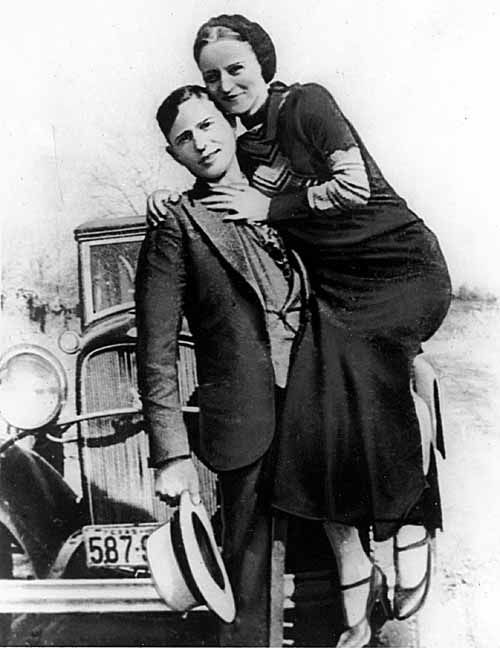
Bonnie Parker and Clyde Barrow are well-known cultural figures (so well known that apparently they are worthy of a new film called Bonnie & Clyde Vs. Dracula -- but I digress). The very "based on real life" lives of Bonnie and Clyde were those of depression-era outlaws... They were bank robbers in the "public enemy" era of the early 1930s. They were well known in their own time due to a great deal of publicity in the newspapers as they killed their way across the country, but interestingly, I think it was this film in '67 which really made them icons.

This film, in addition to its relationship to the Production Code, is a great example of a particularly important period in Hollywood. Just before the Blockbuster era was ushered in by films like The Godfather, Jaws, and Star Wars (the great three Coppola, Spielberg, and Lucas films, respectively), there was a burst of creative output from Hollywood studios. Following in the footsteps of many "new wave" filmmaking movements in many European countries, the so-called "New Hollywood" is a fascinating period... and Bonnie & Clyde is often considered the most important movie of this movement. Films under New Hollywood are characterized by being fresh and different from what came before (for "Old Hollywood," think big studio pictures like Cleopatra, My Fair Lady, and even The Sound of Music). New Hollywood films were made by a new generation of young filmmakers who went to film school and were aware of film history and filmmaking movements (the "movie brats"), as well as being individuals who were tapped into the counterculture energy sweeping the country in the late 60s and 70s.

Back now to Bonnie & Clyde. I found this film interesting because of its moral ambiguity. You are, after all, rooting for a couple who, according to history, killed at least nine policemen and possibly more civilians in a seemingly goal-less cross-country rampage, robbing gas stations and banks in a time when people didn't have money to spare. But you do, definitely, end up rooting for them. In no uncertain terms, I think, the film wants you to see them as the "good robbers" chased by the "bad cops." Their death, though something you anticipate, is not a resolution you look forward to -- In fact, as the end drew nearer, I was positively dreading it, especially since I had read a description of the famous final scene before. In all, I can see why this film was both controversial and well received by critics and the public alike. Of course, I can also see why this film struck a particular nerve with the youth generation in the 60s. After all, Bonnie's restlessness as well as the whole gang's disaffected nature bears resemblance to the feelings behind the counterculture movement. Faye Dunaway, with her glamorous blonde hair, very nearly could be a 60s girl, not someone living through the Great Depression.

This is a rare classic film that falls squarely on the list of "must see if you want to call yourself a film-lover" but that doesn't seem like a chore to watch (*cough*Citizen Kane*cough*). The editing is so well crafted that it makes me want to go back and watch it again. It's entertaining, emotional, well-acted, significant historically, and beautifully made. It is, in summation, a masterpiece of American filmmaking.

Thursday, February 17, 2011

Rebel Without a Cause

Rebel Without a Cause (1955)
Directed by Nicholas Ray. Starring James Dean, Natalie Wood, and Sal Mineo.

What makes an icon? Is it an iconic performance? A short-lived life with a tragic ending? A way of talking, walking; a presence?

Rebel Without a Cause presents an icon: James Dean. It was released in the same year Dean died and the film became a cult hit due to its association with this iconic individual.

This film fits into a genre that was new to Hollywood in the 50s: the teenpic. As film audiences waned due to a variety of reasons (including the migration to the suburbs, and TV chief among them), movies were increasingly targeted to a specific audience. Teenagers were a new demographic, with plenty of money to spend at the movies... enough to deserve films specifically made with them in mind.

On top of that, Rebel Without a Cause had its finger on the pulse of the time, tackling the key issue of a rise in juvenile delinquency. This movie, while not the only one to do so, was probably the first to so thoroughly personify the growing restlessness in the new generation of youth.

Furthermore, it manages to capture what it's like being a teenager, which is something that certainly has not or will not change, and enables the film to ring true today. Everyone is angry, and they don't know why. They want to prove themselves, but they don't know to whom. They're stuck straddling childhood and adulthood, living in both and neither world simultaneously.

Dean is impressive, showing off the newly developed Method Acting in which an actor was able to be more expressive by channeling personal experience and emotions through their character. The "chicken run," in which Dean and another character drive their cars toward the edge of a cliff, waiting to see who will be a coward and jump out first, tragically echoes Dean's death.

The film is GORGEOUS, especially after a semester of black & white. It features the then-newly developed CinemaScope widescreen and Warnercolor vivid color film. Facing increasing competition from TV, the film industry began to put a great deal of effort into technologies that would set movies apart from their in-the-living-room enemy. Color, widescreen aspect rations, and even 3-D were created around this time.

Though I understand some extent to which Rebel Without a Cause is a classic film, this was my first viewing of it. It's difficult to grasp everything -- Dean's performance, the emotional characters, the romance, the technology -- so I look forward to seeing it again in this future. All I know is that I was missing out on a great film, so if you haven't yet seen this classic movie, I strongly recommend you do so.

Tuesday, February 15, 2011

High Noon

High Noon (1952)
Directed by Fred Zinneman. Starring Gary Cooper and Grace Kelly.

Moving on from my myriad of 2011-Oscar-nominated film reviews, I return to Film History. Let's head to 1950s Hollywood. This is a period defined by its historical context and, for many of the movies, (including High Noon) you can't separate the time in which the film was made from the film itself.

The 1950s in the US should conjure up thoughts of the Cold War, fears of communism infiltrating America, Senator Joseph McCarthy and the HUAC hearings, etc. Key for a discussion of this film is the last item in my list. Numerous Hollywood individuals were called up to defend themselves against accusations of ties to communism, and to hopefully name other individuals with communist sympathies in front of the House of Un-American Activities Committee. Those who didn't cooperate with the Senate were then blacklisted by studios, meaning they weren't allowed to work again until they were re-categorized as friendly witnesses. Those who did name names were seen as sell-outs by some, patriotic by others. These events ruined countless careers and even some lives. In short, it was a terrible time all around.

In the film industry, this was also a period of re-vamping genres, giving them a "higher gloss treatment." Whereas Westerns, for example, had previous been seen as b-pictures, they were now given bigger budgets and treated more seriously. The same happened with the musical, historic epic, film noir melodrama, and teenpic genres.

Though High Noon is a western and a period film, it should be read as more about the time in which it was made than anything else. It is an allegory of the HUAC Hearings and the blacklist. Its basic plot is that of a Sheriff meant to leave town immediately following his wedding, but when he hears that a notorious criminal is out of prison and heading his way on the noon-train, he decides to stay behind and fight. Despite everyone urging him to go and no one being willing to help him, he makes his last stand alone. It's about a community not standing behind a hero, much like the Hollywood community not standing up for each other, but instead "naming names" for Joseph McCarthy and the Senate. In the film, like the real world at the time, it's unclear who bears responsibility for events and who is doing the right thing.

Of the figures involved in the film, Gary Cooper (the main actor) was a friendly witness at HUAC, while the screenwriter was actually blacklisted by Hollywood executives during the production of High Noon. So, an interesting mix of people were involved. This is a film that tries to deal with (and perhaps work through the psychological implications of) all the ups and downs of the time, while still using the staples of the Western genre. Because, yes, there is a lone gunman, clearly defined villains, a Quaker wife, a Mexican ex-girlfriend, a shoot-out, etc.

This film is interesting for two further reasons. First, it actually takes place roughly in real-time (meaning the plot-time = the time it takes to watch the movie). The time between when the noon train is due to arrive and the end of the film exactly corresponds with the time it takes events to elapse. The use of this technique builds tension and, I'm guessing, would have been a big breakthrough in a time before the TV show 24. Second, this film is marked by it's iconic score, which is basically just one song. One song, repeated in different variations, throughout the entire film. Oh, and the lyrics of this song just happen to reveal the plot of the entire film. Interesting, right? I admit, on the second viewing of High Noon, I found this to be annoying, but on the first, I thought it really tied the movie together.

Overall, this is a film that would appeal to buffs of the Western genre, history lovers, real-time action connoisseurs, and film students alike. It's complex but can also be simplified to a fun and exciting surface-level viewing.

Thursday, January 20, 2011

The Best Years of Our Lives

The Best Years of Our Lives (1946)
Directed by William Wyler. Starring Fredrick March, Dana Andrews, Myrna Loy, and others.

This is a really interesting film, but in my opinion, more so from a historical perspective than a film perspective. Of course, the two go hand in hand. Let me explain. This film was part of my Film History course's section on Hollywood's role in World War Two. I find it really fascinating that film was declared an "essential industry" during the war -- because of its role in keeping morale high, and its potential for propaganda. I've actually learned a fair amount about this subject before (and had seen this film once already) for a course I took last Spring, on film in the 1950s and 60s. But back to my main point... Hollywood played an important role in documenting the war, and in making films about the home front -- or, in the case of Best Years, about veterans returning home.

This film is long, but interesting (so much so that I didn't mind seeing it a second time). The three men who are the main characters must deal with the adjustment of returning from the war. Throughout the course of the film, the issues of readjustment, trauma (aka PTSD, though it wasn't named thus at the time), disability, reasons for the war / start of the Cold War, home front sacrifices, 40s love and marriage, consumerism, and much more are all raised.

Interestingly, one of the characters is a man who lost both of his hands in the war, and was trained by the Navy to use hooks instead. He, his family, and his girlfriend must all learn to live with his disability. The man who played this role was a non-actor: Harold Russell, and a veteran who really did lose his hands and receive training with hooks (a photo can be seen here). This brings a whole layer of realism to the film and makes it historically important.

Artistically/aesthetically, this film is important because it had the same cinematographer as Citizen Kane, Gregg Toland. Thus, it exhibits some of the same artistic characteristics... long takes and deep-focus; both of which make this quite a beautiful film.

There is a classic scene in this film which really, to me, represents true achievement in creative filmmaking. You can watch this clip on YouTube, here. In this scene, one of the film's veterans (who was a bomber pilot) is left to reflect in a junkyard of airplanes left over from the war. This character seems to have some lasting trauma in the war, as seen in a nightmare scene earlier in the film. The clip I've linked to seems to represent his working through his trauma to some extent.

To round out my discussion of this film, I just want to add that it was very successful in its release, winning the Best Picture Academy Award (and several other categories) the year it was released and garnering a huge domestic box office for its time. It's worth seeing if anything I've said intrigues you, or if you like films that capture their moment in history effectively.

Thursday, January 13, 2011

Citizen Kane

Citizen Kane (1941)
Directed by Orson Welles. Starring Orson Welles, Joseph Cotten, and Dorothy Comingore.

Whew, only my second post, and I'm already trying to tackle what is generally regarded as the best film of all time. We watched this film in Film History II yesterday, as something to contrast with Only Angels Have Wings. Whereas that film, and Howard Hawks' work in general, were examples of Classical Hollywood, Citizen Kane is an example of a non-classical film that was somehow still made in the Hollywood studio system.

Let me back up. I had seen Citizen Kane only once before, when I was in fourth or fifth grade. Suffice it to say, I didn't get it then. I was coming into yesterday's class -- and my Film History II course in general -- with the ultimate goal of figuring out why heck this film is such a big deal. After a second time seeing it, well, I'd say I have a slightly grasp of why this film is so remarkable.

Reasons this is an all-time great film, as I understand them:

1) Orson Welles was 26 when he made this film. Let me repeat, 26 years-old when he made what is called by men the #1 film of all time. Wow. No wonder they called him the "Boy Genius." As it says in an original review of Citizen Kane from the New York Times, Welles, (who had previous staged an all-black theater production of Macbeth and a radio production of War of the Worlds that many people thought was a real alien invasion)... "moved right into the movies, grabbed the medium by the ears, and began to toss it around with the dexterity of a seasoned veteran." To top it off, in my opinion, Welles is also a great actor. His portrayal of Charles Foster Kane is oddly moving. Even as you hate the man, you feel for him... not an easy thing to achieve with such an egomaniac.

1a) Welles got extraordinary creative freedom in making this film... the kind of opportunity that was rare under the studio system. Now, this is interesting (and this is a bit of a tangent) because Welles never really got this opportunity again. In fact, if I have my information right, he never got the final cut of his films again. Why? Because Citizen Kane was actually a financial flop. That's right... the film that many call #1 lost $150,000 at the box office! But let me get back to why this film is great...

2) Quite simply, in this movie, style and technique MATTERED. And this was rare for this day and age. Considering the historical context, it's really remarkable that Orson Welles was given basically a carte blanche from RKO Studios... the chance to make the kind of film he wanted to make. He was given a kind of artistic freedom that was not really heard of in Hollywood then.

3) The film is complex, but understandable. Okay, maybe the only thing you remember is "Rosebud..." but if you were to sit down and watch this film (which you should!), you would be able to follow it. It's comprehensible despite the heavy handed artistic technique, the non-linear time, and the flashback (and even flashback-within-a-flashback) device. In a time when studios literally thought you had to repeat things multiple times for the audience to understand it (this was called the "rule of threes"), a film that walks the line between confusing and complicated must have been incredibly refreshing to viewers.

4) The film is based on a true story -- the life of William Randolph Hearst, (as well as a bit of Howard Hughes and Welles himself mixed in there) and boy, was he an interesting guy. I mean, he basically started the Spanish-American War through his yellow journalism... not to mention the fact that he actually did build a real life Xanadu in Hearst Castle, which sounds like an incredible place.

So, yes, this film is impressive. It's certainly not MY favorite film of all time, but I can see why it has been called #1 and timeless by many. And yes, I'm going to call this a "must-see"... it's just THAT classic.

Tuesday, January 11, 2011

Only Angels Have Wings

Only Angels Have Wings (1939).
Directed by Howard Hawks. Starring Cary Grant and Jean Arthur.

This film is about male camaraderie & teamwork, aviation & adventure, and trust & respect. It takes place in South America, where Geoff (Cary Grant) is responsible for a team of men who fly the mail to a nearby city, over a dangerous mountain pass. Bonnie (Jean Arthur), recently arrived via boat, is captivated by Geoff and his strange, callous ways. As he says again and again throughout the film, "He'll never ask a woman for anything"... or will he? Thrown into the mix is Judy (Rita Hayworth in one of her first film roles), Geoff's ex; and a number of other pilots and friends.

We watched this film on the first day of my Film History II Course as an example of Classical Hollywood Cinema, which dominated American filmmaking from roughly the 1920s-60s. This style basically includes films that focus on character psychology (often one main protagonist, although this film has a bit of an ensemble) and on narrative (over technique or style), and thus have invisible editing. Howard Hawks, the director of this film, is basically a master of this style. Over winter break, I also watched Hawks' films Gentlemen Prefer Blondes, Bringing Up Baby, and His Girl Friday. Without really meaning to, I seem to be making my way through a great deal of Hawks' work. I also/still want to see To Have and Have Not and The Big Sleep.


I liked this film, though I wasn't totally blown away by it. I didn't find it as captivating as, say, Casablanca, or as funny as My Man Godfrey, two other films from this era. However, I do find this film interesting for two reasons. The first is the special effects. It goes without saying that they are primitive by today's standards, but they are remarkable for 1939. The scenes of the planes flying -- the mix of models and rear-screen projection -- made for a really cool effect. Second, I find the character of Bonnie really interesting for this era. Since I more or less got my start in film school with a class of Women and Film, I find female characters particularly interesting. Bonnie is great interesting of a Hawksian woman - feisty, independent, and (*gasp*) accepted by the men.

One final note... I must admit, I have somewhat of a crush on Cary Grant at the moment. I know I'm several decades late on this, but there's something about his voice/accent, his dimples, perfectly set hair, and of course, that chin... Let's just say I can see why he was such a star in his day and age. Along these lines, I was surprised at some of his personal history, as we learned in class -- that he was married five times and possibly bisexual/gay.

That's it from me about this film. In summary, I would recommend it for film buffs or fans of Howard Hawks or Cary Grant, but it's certainly not an absolute "must-see" from this era.