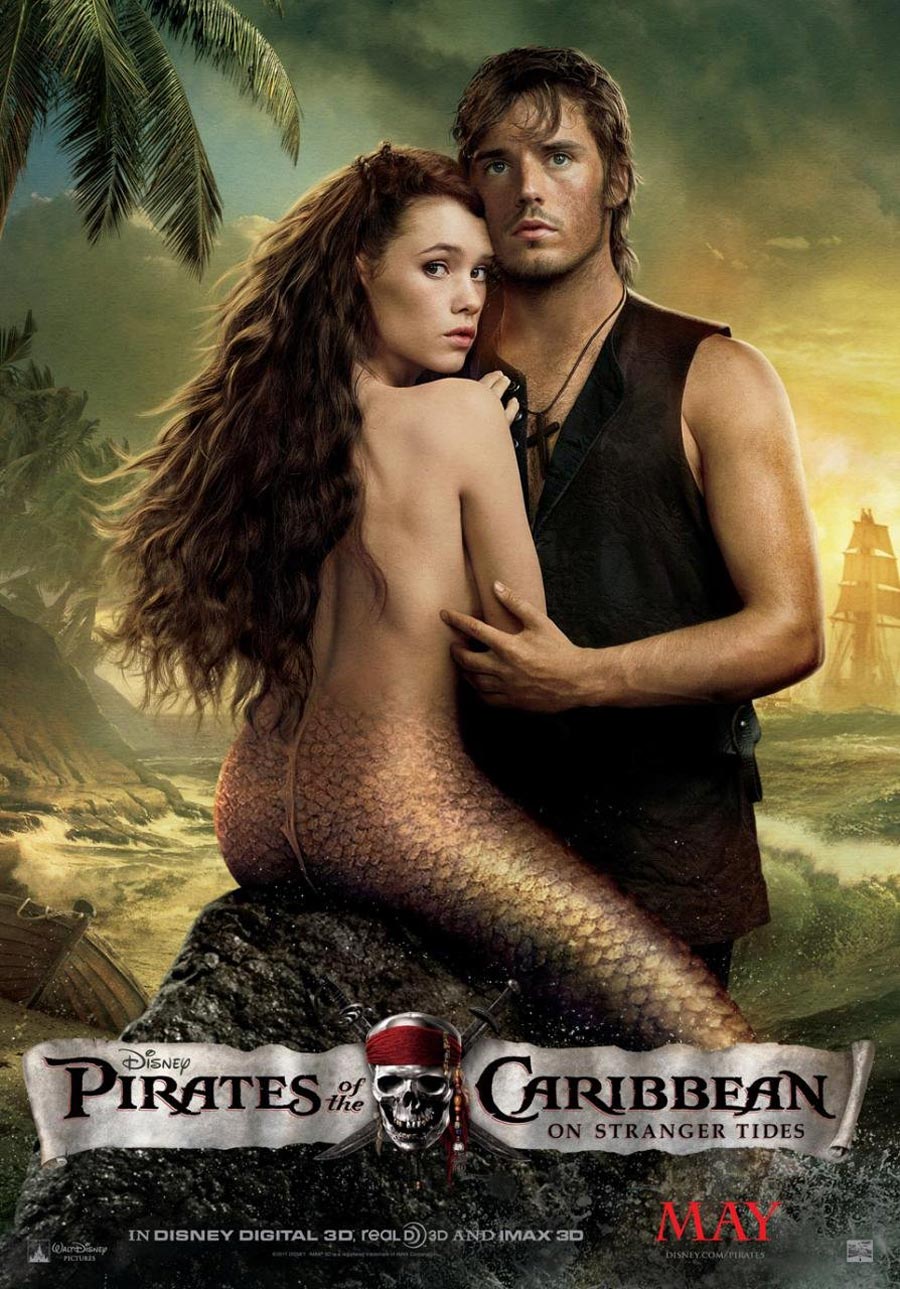
Pirates of the Caribbean: On Stranger Tides (2011)
Directed by Rob Marshall. Starring Johnny Depp, Geoffrey Rush, Kevin R. McNally, Penelope Cruz, and Ian McShane.
The release of Pirates of the Caribbean: On Stranger Tides, the fourth Pirates film, was a momentous occasion for me. In many ways, my love of these movies made me aspire to work in Hollywood and want to go to film school. Additionally, I can quote the first Pirates very nearly in its entirety, and I often rate Curse of the Black Pearl as my absolute favorite movie ever; Johnny Depp is my favorite actor; Hans Zimmer is my favorite composer... You get the idea. So, as it's been four years since At World's End, suffice it to say, I was extremely excited to see this movie.
While many will agree that the first Pirates film was genius, still more will argue that the overblown, out-of-control ambition that governed the second and third movies spoiled them. Too many mythologies, plot lines, characters, effects, and running times that were punishing (138 minutes / 150 minutes respectively), these sequels *tried to do too much.* Now, I would watch Johnny Depp in character as Captain Jack read the phone book for two hours and call it great fun, so perhaps I am biased, but I still enjoyed those films. That's not to say I don't agree that they went a bit overboard (so to speak).... This past week, I re-watched all three films to "prepare" for the fourth, and I definitely see where they lost many fans. This is all important to keep in mind going to On Stranger Tides. Even Johnny Depp was aware of it when making Dead Man's Chest and At World's End, as he told Entertainment Weekly in his recent cover story.
I've long believed that a film is what you make of it. You can control your enjoyment by crafting your expectations. If you expect Michael Bay to make an Oscar-worthy Transformers film, well, there's no two ways about it... you're going to be disappointed. Same if you expect Terrence Malick to make a fun, light, summer Blockbuster. That said, it's a well known fact that sequels are rarely "as good as" or "better" than their parent films. And, my question is 'why should they be?' Yes, in an ideal world, it'd be great if a creative team could aspire to the same levels they reached before, but it's just not that likely in a business like the Hollywood dream factory.
If you want a film that is as good as Pirates of the Caribbean: Curse of the Black Pearl, go watch Pirates of the Caribbean: Curse of the Black Pearl. Films like that are good because they are new, they tried something risky (hello Johnny Depp's portrayal of Keith Richards-inspired Jack Sparrow), they are inventive and creative, unaware of (and thus free from worries about) how they will be received, etc. Sequels aren't and simply cannot live up to those qualities. So, please, if you go watch On Stranger Tides, don't expect Curse of the Black Pearl... or you will probably be disappointed. If you go in expecting to spend two hours with the FABULOUS Jack Sparrow on another one of his crazy adventures, you'll enjoy it eversomuch more.
I really liked On Stranger Tides. I thought it was very scaled down compared to the last film -- not just because of the lack of SO SO many characters and storylines, not just because they filmed in Hawaii instead of the Caribbean... but because this story moves faster, has fewer twists and turns, and doesn't try to do as much. This is a character driven film, driven by Jack and the audience's changing understanding of who he is. Yes, he's a rum-soaked, wobbly-legged pirate... but as we see, he might just have a heart as well. And so, Penelope Cruz is a great addition to the plot as Angelica, daughter of the fearsome pirate Blackbeard, and once-lover of dear ol' Jack. (Fun fact: ever notice that little strip of lace dangling from Johnny's left wrist as part of his Captain Jack costume? He added it in when they were filming the second film, imagining it as a trinket given to him by a lover in the past. Well...) Angelica is in many ways a female version of Jack, which is a fabulous dynamic and one that makes the film feel fresh.
Furthermore, Geoffrey Rush makes a welcome return to this film -- ever since his line that "The code's more guidelines than actual rules," I've had a special place in my heart for Barbossa. The dynamic between Jack Sparrow and Hector Barbossa continues to evolve, and is interesting and fun, one of my favorite parts of the film. The plot is about the race to the Fountain of Youth -- something that was brought up at the end of the last film. Barbossa, the Spanish, and Blackbeard (also a new character) are racing to be the first to get there, and Jack gets caught up in the race. In order to drink from its waters and avoid mortality, you must have a mermaid... which brings in a neat sideplot featuring these newcomers, who certainly may appear in future films. (Yes, the screenplay for the fifth Pirates was turned in recently).
Overall, with all these ingredients in place, director Rob Marshall (Gore Verbinski didn't return for this one) steers the film through new locales -- London, for example -- to familiar lush islands, off cliffs and through caves to the Fountain. I thought there were some great action sequences, plenty of laugh-out-loud lines and moments, and some great development of relationships. In short, everything that I love about a Pirates film was present. My only bone to pick with this film was that, perhaps, the stakes weren't high enough and that the finale wasn't grand enough (yes, okay, grand words after the last two films, but perhaps they skewed my expectations). The action is pretty front-loaded -- with an exciting escape sequence within the first half hour -- that it left me wanting a bit more by the end. Still, given what I've said already about problems with the last two, perhaps it's better they steered clear of anything too crazy.
Personally, I can't wait to see On Stranger Tides at least once more in theaters, and I recommend you see it if you've ever enjoyed Captain Jack Sparrow. This film will entertain you for a couple of hours, and whisk you away on the high seas for another supernatural and grand adventure. It's fun, funny, and made for the fans... proof that this franchise will likely carry on for a while longer. And, well, that's fine by me... I'm not ready to see Jack hang up his hat just yet.
This is a film blog by an avid movie-goer, for the movie-goers of the world. I seek to lift the tone of film reviews from overly critical to thoughtful. As a student in Film Studies and a hopeful future filmmaker, I attempt to bring my knowledge of the film industry and its history to bear on the films I write about -- whether the latest summer Blockbuster, or a timeless classic, and anything in between.
Friday, May 20, 2011
Sunday, May 15, 2011
Thor
Thor (2011)Directed by Kenneth Branaugh. Starring Chris Hemsworth, Natalie Portman, Stellan Starsgard, and Anthony Hopkins.
Superhero movies are hard to review because of their sheer quantity nowadays. It's impossible to watch one without comparing it to another because they stack up so quickly in theaters. And yet, despite the fact that they are squished together into one extremely popular genre, I like to try to remember that these are still individual films.
Thor is on a particularly imaginative branch of the superhero film tree. Far more based in the realm of mythology and fantasy than the others, the hero doesn't get his powers from a spider bite or a fancy utility belt... he has them because he is the God of Thunder. Take that, Batman. In a lot of ways, this is a coming-of-age story more than one of good versus evil. Think along the lines of Peter Parker being told "With great power comes great responsibility." Thor must learn what to fight for, because from the film's opening, it's clear that he already knows how to fight -- to the point of recklessness.
Director Kenneth Branaugh, best known for film adaptations of Shakespeare plays (as well as his own acting), brings a clear vision and unusual touch to such a Blockbuster-y summer tentpole picture. The visual effects that bring Thor's to life are stunning -- in fact, I wanted to see more of his magical world than we did. And, in a dizzying display of marketing, the film does a wonderful job starting to set up The Avengers movie coming next year. (Captain America finishes off the set-up).*
So, while I enjoyed Thor, in retrospect, I think it fell a little flat. The romance was largely uninteresting -- though it was good to see Natalie Portman out of the pointe shoes. And the climactic battle, or perhaps the lead-up to it, was disappointing. In fact, I didn't realize it WAS the final battle until the credits rolled. Overall, this was a good popcorn flick. I'm glad to see a desire in the Marvel camp to be more creative, and to recruit interesting directors to make their films better, but in the end, I don't think it went above and beyond its Blockbuster status.
*I recommend that you ALWAYS stay until after the credits at Marvel movies.
Friday, May 13, 2011
Fair Game
Fair Game (2010)Directed by Doug Liman. Starring Naomi Watts and Sean Penn.
I was just young enough during the George W. Bush presidency and Valarie Plame scandal that I didn't really follow the full story. This movie does an excellent job filling in those gaps for me, detailing one of the biggest scandals to rock the intelligence agencies in recent years. There are apparently many discussions online about historical accuracy and creative liberty in the film... but as the book cites Valarie Plame and Joseph Wilson's autobiographies as sources, it's clear that, at the very least, their side of the story is being told well.
The film is directed by Doug Liman, best known for his thriller spy films like The Bourne Identity and Mr. and Mrs. Smith. At times, the overly dramatic tendencies from those films show through, somewhat out-of-place in a political biopic. So, perhaps the film has some difficulty with the balance between its multiple genres. Yet, the acting is superb, and the story drives the movie with a relentless intensity. Above all, it's the mood of the film that stands out... it simmers with anger at the system, and leaves the viewer feeling similarly ticked off.
This is a smart film with a "docudrama" leaning... one that shows such a nasty side of our political system that it's hard to believe it's based in real events.
Monday, May 9, 2011
Kill Bill Vol. 1 and Vol. 2
Kill Bill, Vol. 1 (2003) and Kill Bill, Vol. 2 (2004)Directed by Quentin Tarantino. Starring Uma Thurman.
Perhaps there's no excuse for taking so long to see these acclaimed films by Quentin Tarantino, but in a lot of ways, I'm really glad I saw them when I did... Viewing them straight after two semesters of Film History made them all the more interesting. Plain and simple, the Kill Bill films are a cornucopia of filmic styles, cliches, and references that overwhelmed this film student's brain, but left me highly impressed. To some extent in the past, I've felt that I don't understand "the big deal" with Tarantino, but now I definitely take that back. There's no one else like him.
The two volumes of Kill Bill are highly different, but since they were originally intended to be one film, I'll talk about them together. The films are best summarized by Roger Ebert's simple explanation: "The movie is all storytelling and no story." (Source). EVERY possible style is employed at least once... from black & white to voiceover to animation to anything else you can think of. Tarantino jumps from homages to classic Hollywood with a rear-screen projected sequence to Hong Kong Kung Fu films through Gordon Liu to American and Italian Westerns and beyond with a frenzied energy that somehow holds it all together. For every source I identified, I'm sure countless references went over my head. (I mean, just glance at this "Kill Bill Reference Guide" to get a sense of the scale we're talking about).
It doesn't seem enough to call these films "good" -- because they're really not good or bad... they're more in the category of "damn impressive." Sure, the violence is intense, but it's made bearable by Uma Thurman's unyielding determination and stoicism. She's a fascinating heroine. Plus, it's a revenge story, so for every bad guy hacked apart by that amazing sword of hers, you can't help but cheer. Overall, I think everyone should see these films... They're a crash course in film studies in four hours or less. They're proof that filmmaker master artists still exist in an industry where the Michael Bay of the world are slowly taking over. They're classics, less than 10 years after they were released.
Thursday, May 5, 2011
The Hangover
The Hangover (2009)
Directed by Todd Phillips. Starring Bradley Cooper, Ed Helms, Zack Galifianakas, Ken Jeong, and Justin Bartha
This is the ultimate high-concept film. A high-concept plot or pitch refers to a storyline that can easily and succinctly be summarized. A classic example is: Jaws - "what if a shark attacks?" High-concept movies have become more and more basic... Speed can be described as "Die Hard on a bus," while for movies like Snakes On A Plane and Cowboys & Aliens, well, it's all in the title. The Hangover is similar to these last to examples. The entire film's plot revolves around the hilarious consequences of a drunk night in Vegas -- the whole film is about a hangover.
This simplicity isn't a bad thing -- and there's no denying that this is a very funny movie. In fact, having such a simple idea at the base of this movie allows the plot to "get out of the way." This, in turn, enables the zany antics of the three main stars to take over and to be as hilarious as they are. The Hangover was the first thing I turned to when my summer vacation started, and as a mindless, ridiculous, over-the-top comedy, it certainly delivered. The central conceit, though actually explained by the end of the film, is that these three friends cannot remember what happened to them during the previous wild night. Thus, among other things, they cannot explain why their fourth friend, who is due at his own wedding very soon, is missing. They also don't know why they have a baby and a tiger in their hotel room, and why one of them is missing a tooth and wearing a wedding ring. (All this is in the trailer -- as I've said, it's really not the plot that matters, so it's not something I can "spoil.")
Though this movie is well on its way to becoming a franchise with the sequel that was released earlier this year, this was by no means a typical Hollywood comedy that was assured success. The three actors main actors were basically unknowns (though now of course, they're big stars)... and R-rated comedies without the name Judd Apatow attached to them typically stay small. So, I think it's safe to say that it was a big surprise when this went on to be the highest grossing R-rated film of all time.
Many movies in today's film industryare becoming increasingly complex... which is great! Films like Inception cannot easily be boiled down to a one-sentence pitch, which makes them interesting to watch. Still, balance in Hollywood is key, so a film that's so unabashedly basic... "what if three men wake up with the worst hangover ever?" yet still creative and comedic is a real gem.
Directed by Todd Phillips. Starring Bradley Cooper, Ed Helms, Zack Galifianakas, Ken Jeong, and Justin Bartha
This is the ultimate high-concept film. A high-concept plot or pitch refers to a storyline that can easily and succinctly be summarized. A classic example is: Jaws - "what if a shark attacks?" High-concept movies have become more and more basic... Speed can be described as "Die Hard on a bus," while for movies like Snakes On A Plane and Cowboys & Aliens, well, it's all in the title. The Hangover is similar to these last to examples. The entire film's plot revolves around the hilarious consequences of a drunk night in Vegas -- the whole film is about a hangover.
This simplicity isn't a bad thing -- and there's no denying that this is a very funny movie. In fact, having such a simple idea at the base of this movie allows the plot to "get out of the way." This, in turn, enables the zany antics of the three main stars to take over and to be as hilarious as they are. The Hangover was the first thing I turned to when my summer vacation started, and as a mindless, ridiculous, over-the-top comedy, it certainly delivered. The central conceit, though actually explained by the end of the film, is that these three friends cannot remember what happened to them during the previous wild night. Thus, among other things, they cannot explain why their fourth friend, who is due at his own wedding very soon, is missing. They also don't know why they have a baby and a tiger in their hotel room, and why one of them is missing a tooth and wearing a wedding ring. (All this is in the trailer -- as I've said, it's really not the plot that matters, so it's not something I can "spoil.")
Though this movie is well on its way to becoming a franchise with the sequel that was released earlier this year, this was by no means a typical Hollywood comedy that was assured success. The three actors main actors were basically unknowns (though now of course, they're big stars)... and R-rated comedies without the name Judd Apatow attached to them typically stay small. So, I think it's safe to say that it was a big surprise when this went on to be the highest grossing R-rated film of all time.
Many movies in today's film industryare becoming increasingly complex... which is great! Films like Inception cannot easily be boiled down to a one-sentence pitch, which makes them interesting to watch. Still, balance in Hollywood is key, so a film that's so unabashedly basic... "what if three men wake up with the worst hangover ever?" yet still creative and comedic is a real gem.
Sunday, May 1, 2011
State of Play
State of Play (2009)
Directed by Kevin Macdonald. Starring Russell Crowe, Rachel McAdams, Ben Afflek, and Helen Mirren.
State of Play was a solid and satisfying thriller. Based on a British miniseries, and bearing hints of All the President's Men, and other political scandal stories, this is a smart film, well in tune with the world we live in. To my delight, it even managed to surprise me at several twists and turns (something that I find happens less and less as I see more and more movies). The cast is as good as it gets... with leading man Russell Crowe proving that he still has that irresistible ability to command the screen and pull audience's along heart and soul through a treacherous story.
The plot is only a mere step removed from reality... in many ways, it could be ripped from the headlines. Cal (Crowe) plays a dying breed of journalist... one who seeps his stories in research and facts, who pounds out copy for a print newspaper on a computer that looks 10 year too old, and who turns up his nose at Rachel McAdams' character, a lowly blogger who doesn't know what real reporting is. When a young woman is killed on the Metro in an apparent suicide, not only does Cal start investigating whether this was in fact murder, but he also becomes wrapped up in the drama of a college friend. It turns out the young woman was the mistress of Senator Collins (Ben Affleck)... and a whole web of intrigue involving a mercenary company with ties in the Middle East. (Like I said, the film takes many cues from the real world).
Despite the connections to the political climate around us, the films is entertaining -- it's not so "real" that it becomes bleak, and it still manages to raise interesting questions about human nature. As the screenwriter of the original miniseries noted, it's a "story about whether or not someone is justified in doing a pretty awful thing, if they themselves are doing great things in other areas of their life." (Source) It's essentially a question of good and evil, and the many, many shades of gray in between.
I recommend this film as one most people probably missed, and one that the average intelligent adult aware of politics and current events will most likely enjoy.
Directed by Kevin Macdonald. Starring Russell Crowe, Rachel McAdams, Ben Afflek, and Helen Mirren.
State of Play was a solid and satisfying thriller. Based on a British miniseries, and bearing hints of All the President's Men, and other political scandal stories, this is a smart film, well in tune with the world we live in. To my delight, it even managed to surprise me at several twists and turns (something that I find happens less and less as I see more and more movies). The cast is as good as it gets... with leading man Russell Crowe proving that he still has that irresistible ability to command the screen and pull audience's along heart and soul through a treacherous story.
The plot is only a mere step removed from reality... in many ways, it could be ripped from the headlines. Cal (Crowe) plays a dying breed of journalist... one who seeps his stories in research and facts, who pounds out copy for a print newspaper on a computer that looks 10 year too old, and who turns up his nose at Rachel McAdams' character, a lowly blogger who doesn't know what real reporting is. When a young woman is killed on the Metro in an apparent suicide, not only does Cal start investigating whether this was in fact murder, but he also becomes wrapped up in the drama of a college friend. It turns out the young woman was the mistress of Senator Collins (Ben Affleck)... and a whole web of intrigue involving a mercenary company with ties in the Middle East. (Like I said, the film takes many cues from the real world).
Despite the connections to the political climate around us, the films is entertaining -- it's not so "real" that it becomes bleak, and it still manages to raise interesting questions about human nature. As the screenwriter of the original miniseries noted, it's a "story about whether or not someone is justified in doing a pretty awful thing, if they themselves are doing great things in other areas of their life." (Source) It's essentially a question of good and evil, and the many, many shades of gray in between.
I recommend this film as one most people probably missed, and one that the average intelligent adult aware of politics and current events will most likely enjoy.
Sunday, April 24, 2011
Water for Elephants
Water for Elephants (2011)
Directed by Francis Lawrence. Starring Robert Pattinson, Reese Witherspoon, Christoph Waltz, and Hal Holbrook.
Having read the book before watching Water for Elephants, it seemed to me that it would be pretty hard to mess it up -- the story is just that good. This proved to be true. So, while this isn't an incredible film, it's a good one, all because of its core plot, characters, and sparkling circus magic.
It's hard to boil this story down to a single genre or category. It's a historical piece that delves into the world of a traveling circus during the Great Depression. It's a coming-of-age story, and a dealing-with-age story, as its main character Jacob, in his 90s, reflects on the formative years of his life in his 20s. It's a spectacle film, while it's also driven by its narrative. Yet above all, it's a love story -- about forbidden love, love overcoming obstacles, and love triumphing in the end.
Following the death of his parents and loss of life as he knew it, young Jacob starts walking along the railroad tracks, lost, and looking for what to do next. The next chapter of his life very nearly runs him over, literally, in the form of a Benzini Brothers' Circus train. There, he delves into a new world, drawn to the circus' magic and, in particular, to the beautiful Marlena. The catch, (there's always a catch) is Marlena's husband August... owner of the circus (or, in the book, second-in-command), who is at times vindictive, kind, cruel, helpful, and downright frightening.
Of all the performances, Christoph Waltz's is the most impressive. This is due, of course, to his sheer skill -- witnessed most notably in an Oscar-winning role in Inglorious Basterds. Waltz crackles with electricity in every moment and brings every mood-swing to terrifying fruition. He is perfectly cast -- it's as if the role was written for someone with that twinkle in his eye, and that hardness in the set of his jaw.
Robert Pattinson, who I have mixed feelings about due to his body of work, turns in a solid performance. He is is emotional, yet also subdued, as he is not the center of the show, but rather the eyes watching it -- the audience's main subject of identification. And, indeed, he does a lot of watching and gaping and staring in this film. Reese Witherspoon is similarly good -- perhaps not great, but she certainly turns in the right attitude for her character. There's something slightly flat about the chemistry between the two actors. This was saved in my mind only by the chemistry of the characters, a holdover from my powerful experience reading Sara Gruen's novel.
Above all, I enjoyed a certain quality of the filmmaking that's difficult to put my finger on. There's a magic to the lighting, to the loving way the circus is brought to life. This is an enjoyable movie, but it's not a fluffy rom com. It's more serious than that. It has its dark moments, yet also its frivolity. At times romantic, suspenseful, and intriguing, it carries you away -- even if it's not the kind of film to make such a big impression that it will stay with you for years to come. (The same could NOT be said of the book, though, as it is an even more powerful experience and I likely WILL remember it for quite some time). In all, this is a good film to curl up with on a sleepy afternoon, particularly if you read and liked the book.
Directed by Francis Lawrence. Starring Robert Pattinson, Reese Witherspoon, Christoph Waltz, and Hal Holbrook.
Having read the book before watching Water for Elephants, it seemed to me that it would be pretty hard to mess it up -- the story is just that good. This proved to be true. So, while this isn't an incredible film, it's a good one, all because of its core plot, characters, and sparkling circus magic.
It's hard to boil this story down to a single genre or category. It's a historical piece that delves into the world of a traveling circus during the Great Depression. It's a coming-of-age story, and a dealing-with-age story, as its main character Jacob, in his 90s, reflects on the formative years of his life in his 20s. It's a spectacle film, while it's also driven by its narrative. Yet above all, it's a love story -- about forbidden love, love overcoming obstacles, and love triumphing in the end.
Following the death of his parents and loss of life as he knew it, young Jacob starts walking along the railroad tracks, lost, and looking for what to do next. The next chapter of his life very nearly runs him over, literally, in the form of a Benzini Brothers' Circus train. There, he delves into a new world, drawn to the circus' magic and, in particular, to the beautiful Marlena. The catch, (there's always a catch) is Marlena's husband August... owner of the circus (or, in the book, second-in-command), who is at times vindictive, kind, cruel, helpful, and downright frightening.
Of all the performances, Christoph Waltz's is the most impressive. This is due, of course, to his sheer skill -- witnessed most notably in an Oscar-winning role in Inglorious Basterds. Waltz crackles with electricity in every moment and brings every mood-swing to terrifying fruition. He is perfectly cast -- it's as if the role was written for someone with that twinkle in his eye, and that hardness in the set of his jaw.
Robert Pattinson, who I have mixed feelings about due to his body of work, turns in a solid performance. He is is emotional, yet also subdued, as he is not the center of the show, but rather the eyes watching it -- the audience's main subject of identification. And, indeed, he does a lot of watching and gaping and staring in this film. Reese Witherspoon is similarly good -- perhaps not great, but she certainly turns in the right attitude for her character. There's something slightly flat about the chemistry between the two actors. This was saved in my mind only by the chemistry of the characters, a holdover from my powerful experience reading Sara Gruen's novel.
Above all, I enjoyed a certain quality of the filmmaking that's difficult to put my finger on. There's a magic to the lighting, to the loving way the circus is brought to life. This is an enjoyable movie, but it's not a fluffy rom com. It's more serious than that. It has its dark moments, yet also its frivolity. At times romantic, suspenseful, and intriguing, it carries you away -- even if it's not the kind of film to make such a big impression that it will stay with you for years to come. (The same could NOT be said of the book, though, as it is an even more powerful experience and I likely WILL remember it for quite some time). In all, this is a good film to curl up with on a sleepy afternoon, particularly if you read and liked the book.
Saturday, April 23, 2011
The Chronicles of Narnia: The Voyage of the Dawn Treader
The Chronicles of Narnia: The Voyage of the Dawn Treader (2010)
Directed by Michael Apted. Starring Ben Barnes, Skandar Keynes, and Georgie Henley.
When a franchise changes hands for the first time, it can lead to trouble. Sure, you've got your James Bonds and Harry Potters which have survived multiple creative shifts, but for every one of these, there's another several that didn't succeed. (This is particularly true of comic book movies... X-Men and Spiderman come to mind -- but more on that soon). After being the creative force and the studio behind both The Lion, The Witch, and the Wardrobe and Prince Caspian, both Andrew Adams and Disney sat this one out. Still, it was full force ahead under Walden Media. (On a less obvious note, the composer of the first two films, Harry Gregson-Williams also did not return... to my particular and great disappointment).
Still, The Voyage of the Dawn Treader brings the book to life, is adventurous and entertaining, and is reasonably true to the spirit of the franchise thus far. It's been a while since I've read the book, so it was nice to rediscover the story with the film. Much like Prince Caspian, it takes certain liberties to make it a more interesting movie -- for once, in my opinion, there's actually not enough material in the book for the film, and this has been true with the last few, if not all, Narnia movies. That's what makes them such great film adaptations. They can bring the books to life and, in a sense, improve on them.
Dawn Treader is a very different story from the other two. It's not structured around a single enemy and doesn't climax with a battle. Instead, it's an adventure-on-the-high-seas tale, a treasure hunt that takes our characters to strange and scary lands beyond the edge of the map. The film modifies this with a mysterious "green mist" that, in a sense, is the "bad guy" of the story. So, for anyone feeling fatigued by the structure of Prince Caspian resembling the storyline of Lion/Witch/Wardrobe, this film is relatively fresh.
Additionally, the faces change. If you haven't read the Narnia books, you may not be familiar with this, but nearly every book introduces a new character or two, who then carries on the series in the next. The Pevensies begin in Lion/Witch/Wardrobe and return in Prince Caspian... but by Dawn Treader, Peter and Susan are too old for Narnia. So, this time, it's just Edmund and Lucy, except that they accidentally bring along their annoying cousin Eustace. (Eustace later goes on to return to Narnia in the next book, with his friend Polly, who then returns without him in the book after that). Caspian is back (though interestingly, Ben Barnes dropped the Mediterranean accent and reverted to his native British lilt this time around... awkward at first, but better all around in the end).
I'm writing this after my second viewing of the film -- the first in theaters, the second with some of the kids I babysit. Both times, I noticed that the audience was younger than I would have thought. Overall, I think these films lack the darkness and intensity that, say, can be found in a rival fantasy franchise, The Lord of the Rings, something that I would wager is the leading factor in drawing in an older demographic. Still, the film is an entertaining, Disney-esque film (though it now lacks Disney) that is fitting "on the shelf" next to the first two. It is a pity that this series has dropped off (in terms of box office and popular interest), as it's looking unlikely that future books will be adapted onscreen (at least with this generation of actors -- in the future, who knows?)
In the end, and I think I'm qualified to say this, fans of the series won't be disappointed in seeing this next book in the series brought to life. Though it lacks the scale and grandeur of the first two, it is still imaginative and spectacular in its representation of Narnia.
Directed by Michael Apted. Starring Ben Barnes, Skandar Keynes, and Georgie Henley.
When a franchise changes hands for the first time, it can lead to trouble. Sure, you've got your James Bonds and Harry Potters which have survived multiple creative shifts, but for every one of these, there's another several that didn't succeed. (This is particularly true of comic book movies... X-Men and Spiderman come to mind -- but more on that soon). After being the creative force and the studio behind both The Lion, The Witch, and the Wardrobe and Prince Caspian, both Andrew Adams and Disney sat this one out. Still, it was full force ahead under Walden Media. (On a less obvious note, the composer of the first two films, Harry Gregson-Williams also did not return... to my particular and great disappointment).
Still, The Voyage of the Dawn Treader brings the book to life, is adventurous and entertaining, and is reasonably true to the spirit of the franchise thus far. It's been a while since I've read the book, so it was nice to rediscover the story with the film. Much like Prince Caspian, it takes certain liberties to make it a more interesting movie -- for once, in my opinion, there's actually not enough material in the book for the film, and this has been true with the last few, if not all, Narnia movies. That's what makes them such great film adaptations. They can bring the books to life and, in a sense, improve on them.
Dawn Treader is a very different story from the other two. It's not structured around a single enemy and doesn't climax with a battle. Instead, it's an adventure-on-the-high-seas tale, a treasure hunt that takes our characters to strange and scary lands beyond the edge of the map. The film modifies this with a mysterious "green mist" that, in a sense, is the "bad guy" of the story. So, for anyone feeling fatigued by the structure of Prince Caspian resembling the storyline of Lion/Witch/Wardrobe, this film is relatively fresh.
Additionally, the faces change. If you haven't read the Narnia books, you may not be familiar with this, but nearly every book introduces a new character or two, who then carries on the series in the next. The Pevensies begin in Lion/Witch/Wardrobe and return in Prince Caspian... but by Dawn Treader, Peter and Susan are too old for Narnia. So, this time, it's just Edmund and Lucy, except that they accidentally bring along their annoying cousin Eustace. (Eustace later goes on to return to Narnia in the next book, with his friend Polly, who then returns without him in the book after that). Caspian is back (though interestingly, Ben Barnes dropped the Mediterranean accent and reverted to his native British lilt this time around... awkward at first, but better all around in the end).
I'm writing this after my second viewing of the film -- the first in theaters, the second with some of the kids I babysit. Both times, I noticed that the audience was younger than I would have thought. Overall, I think these films lack the darkness and intensity that, say, can be found in a rival fantasy franchise, The Lord of the Rings, something that I would wager is the leading factor in drawing in an older demographic. Still, the film is an entertaining, Disney-esque film (though it now lacks Disney) that is fitting "on the shelf" next to the first two. It is a pity that this series has dropped off (in terms of box office and popular interest), as it's looking unlikely that future books will be adapted onscreen (at least with this generation of actors -- in the future, who knows?)
In the end, and I think I'm qualified to say this, fans of the series won't be disappointed in seeing this next book in the series brought to life. Though it lacks the scale and grandeur of the first two, it is still imaginative and spectacular in its representation of Narnia.
Friday, April 22, 2011
The King's Speech
The King's Speech (2010)
Directed by Tom Hooper. Starring Collin Firth, Geoffrey Rush, and Helena Bonham Carter.
83rd Oscars - 8 Nominations and 4 Won: Best Picture, Best Director (Tom Hooper), Best Original Screenplay (David Seidler), Best Actor Leading Role (Collin Firth)
Several months ago, The King's Speech won Best Picture, along with a number of other awards, at the 83rd Oscar Ceremony. Some people were disappointed in this winning -- let me say right off that I was not one of them. Sure, there's the argument that Inception was a more interesting film, the kind the Academy needs to branch out and start awarding (I agree with that). And, sure, The Social Network was more a film "for my generation" (I also think that's right)... But The King's Speech is a solid, well-made, well-acted, well-done film, well worth praising. I'm writing this after viewing it a second time, since it's now on DVD, so I can safely say I see its merits.
I mean, what's not to like? It's a feel-good, underdog tale, a slice of history and a biopic, starring two talented and - until recently - wildly underrated actors, and an actress who is such a surprising chameleon that she can play the Queen's Mother at the same time she's filming Harry Potter! Several months out, I think lot of the negative comments regarding this winning Big Picture distill into one argument: it is too Oscary. In other words, the Academy rewards too many pictures of this nature - stories of someone overcoming hardship, battling something (in this case, a speech defect), and rising above your problems to triumph in the public sphere. (Seriously, glance at a list of Best Picture winners. So many of them fit this formula).
So, yes, this film is a bit predictable - at least, predictable as a winner. The biggest complaint about the 83rd Oscar Ceremony was that the whole night was a bore; the biggest surprise was Kirk Douglas's presentation of the Best Supporting Actress category. (For the record, I still enjoyed the show, but I always get carried away by the glitz and glamour!) If you share this viewpoint, I encourage you to try looking at it another way: in The King's Speech, these filmmakers managed to make gold (literally) out of a tried and true filmic setup.... They managed to take something that's been done and done again, and still do it well! Any-who... In my opinion, The King's Speech makes a good addition to the Best Picture category. *steps off soapbox*
On a personal note, I really loved this film - both times watching it! Reading/watching ANYTHING about British history is one of my favorite pastimes, and it was interesting to learn about a king I knew little about, other than his relationship to Elizabeth II. I've already said that I adore Geoffrey Rush in my Pirates review... And so I enjoyed watching him take on, shall we say, a more substantial performance. Rush is delightfully eccentric and - for all that Collin Firth manages that st-st-stammer quite well - darn near carries the film. (It's a pity Rush didn't carry away a trophy as well). Speaking of Firth, he manages a transformation INTO Bertie, the second son who never wanted to be King. He is a man who must find his own inner strength in order to show said strength to his nation in a time of great hardship. He really brings this man to life. The film is emotional, yet uplifting. It carries you away yet somehow manages to speak to your own life. Bravo!
Directed by Tom Hooper. Starring Collin Firth, Geoffrey Rush, and Helena Bonham Carter.
83rd Oscars - 8 Nominations and 4 Won: Best Picture, Best Director (Tom Hooper), Best Original Screenplay (David Seidler), Best Actor Leading Role (Collin Firth)
Several months ago, The King's Speech won Best Picture, along with a number of other awards, at the 83rd Oscar Ceremony. Some people were disappointed in this winning -- let me say right off that I was not one of them. Sure, there's the argument that Inception was a more interesting film, the kind the Academy needs to branch out and start awarding (I agree with that). And, sure, The Social Network was more a film "for my generation" (I also think that's right)... But The King's Speech is a solid, well-made, well-acted, well-done film, well worth praising. I'm writing this after viewing it a second time, since it's now on DVD, so I can safely say I see its merits.
I mean, what's not to like? It's a feel-good, underdog tale, a slice of history and a biopic, starring two talented and - until recently - wildly underrated actors, and an actress who is such a surprising chameleon that she can play the Queen's Mother at the same time she's filming Harry Potter! Several months out, I think lot of the negative comments regarding this winning Big Picture distill into one argument: it is too Oscary. In other words, the Academy rewards too many pictures of this nature - stories of someone overcoming hardship, battling something (in this case, a speech defect), and rising above your problems to triumph in the public sphere. (Seriously, glance at a list of Best Picture winners. So many of them fit this formula).
So, yes, this film is a bit predictable - at least, predictable as a winner. The biggest complaint about the 83rd Oscar Ceremony was that the whole night was a bore; the biggest surprise was Kirk Douglas's presentation of the Best Supporting Actress category. (For the record, I still enjoyed the show, but I always get carried away by the glitz and glamour!) If you share this viewpoint, I encourage you to try looking at it another way: in The King's Speech, these filmmakers managed to make gold (literally) out of a tried and true filmic setup.... They managed to take something that's been done and done again, and still do it well! Any-who... In my opinion, The King's Speech makes a good addition to the Best Picture category. *steps off soapbox*
On a personal note, I really loved this film - both times watching it! Reading/watching ANYTHING about British history is one of my favorite pastimes, and it was interesting to learn about a king I knew little about, other than his relationship to Elizabeth II. I've already said that I adore Geoffrey Rush in my Pirates review... And so I enjoyed watching him take on, shall we say, a more substantial performance. Rush is delightfully eccentric and - for all that Collin Firth manages that st-st-stammer quite well - darn near carries the film. (It's a pity Rush didn't carry away a trophy as well). Speaking of Firth, he manages a transformation INTO Bertie, the second son who never wanted to be King. He is a man who must find his own inner strength in order to show said strength to his nation in a time of great hardship. He really brings this man to life. The film is emotional, yet uplifting. It carries you away yet somehow manages to speak to your own life. Bravo!
Monday, April 18, 2011
D.D.L.J.
D.D.L.J aka Dilwale Dulhania Le Jayenge aka "The Lover Takes the Bride" (1995)
Directed by Aditya Chopra. Starring Shah Rukh Khan and Kajol.
Much like The 36th Chamber of Shaolin, which I reviewed recently, DDLJ is an example of a non-Hollywood popular-cinema movie. Bollywood, aka Hindi-language cinema, is a huge and beloved industry (its audience is estimated to be 3 billion people globally -- almost half the world's population). Its films are boisterous, musical, colorful, predictable, and extremely fun to watch. DDLJ is one of the longest running Bollywood films -- though it was made in the 90s, it can still be found on some screens in India today. Though it clocks in at over 3 hours, it's a wild ride that's totally gorgeous (particularly on Blu-Ray), filled with catchy ear-worm songs, and starring one of the world's biggest movie stars (Shah Rukh Khan). In other words, it's well worth seeing.
This film is, of course, a boy meets girl story... but it's also about cultures and generations clashing. The two main characters are second-generation immigrants living in London who meet when traveling across Europe -- the boy, after college; the girl, before an arranged marriage is to take place. In a wonderful Pride and Prejudice -esque plot, hate becomes love, though the two are separated by the end of the trip and the girl's impending marriage. The second half of the film (most Bollywood movies have intermissions) transfers to India, where wedding preparations become the backdrop for the boy's last ditch efforts to get the girl -- or "take the bride."
In a lot of ways, this is a film driven by music -- more so at times than images. As you'll know if you've ever seen ANY clip of ANY Bollywood movie, the songs are lipsynched. More specifically, the songs are performed by vocal artists (who are sometimes more famous than the movie stars). This playback singing is as important as the movie story. Often, songs are released before films, and it is even said that Bollywood films are the "picturization" of the music. Still, the visuals are playful spectacles. Some scenes seem more like music videos than anything else -- see the many locations and jumps in this clip, from about a third of the way into the film, in which the "good girl" character gets drunk and has a wild night. Perhaps what's most striking in these films is the color... just look at that poster, an actual scene in the film (also, this is another great clip).
As one of the biggest Bollywood hits of all time, this is a wonderful film if you want to expand your horizons and get a representative taste of another culture's filmmaking. It's fun -- you'll be dancing in your seat in no time -- as well as romantic, funny, and crowd-pleasing.
Directed by Aditya Chopra. Starring Shah Rukh Khan and Kajol.
Much like The 36th Chamber of Shaolin, which I reviewed recently, DDLJ is an example of a non-Hollywood popular-cinema movie. Bollywood, aka Hindi-language cinema, is a huge and beloved industry (its audience is estimated to be 3 billion people globally -- almost half the world's population). Its films are boisterous, musical, colorful, predictable, and extremely fun to watch. DDLJ is one of the longest running Bollywood films -- though it was made in the 90s, it can still be found on some screens in India today. Though it clocks in at over 3 hours, it's a wild ride that's totally gorgeous (particularly on Blu-Ray), filled with catchy ear-worm songs, and starring one of the world's biggest movie stars (Shah Rukh Khan). In other words, it's well worth seeing.
This film is, of course, a boy meets girl story... but it's also about cultures and generations clashing. The two main characters are second-generation immigrants living in London who meet when traveling across Europe -- the boy, after college; the girl, before an arranged marriage is to take place. In a wonderful Pride and Prejudice -esque plot, hate becomes love, though the two are separated by the end of the trip and the girl's impending marriage. The second half of the film (most Bollywood movies have intermissions) transfers to India, where wedding preparations become the backdrop for the boy's last ditch efforts to get the girl -- or "take the bride."
In a lot of ways, this is a film driven by music -- more so at times than images. As you'll know if you've ever seen ANY clip of ANY Bollywood movie, the songs are lipsynched. More specifically, the songs are performed by vocal artists (who are sometimes more famous than the movie stars). This playback singing is as important as the movie story. Often, songs are released before films, and it is even said that Bollywood films are the "picturization" of the music. Still, the visuals are playful spectacles. Some scenes seem more like music videos than anything else -- see the many locations and jumps in this clip, from about a third of the way into the film, in which the "good girl" character gets drunk and has a wild night. Perhaps what's most striking in these films is the color... just look at that poster, an actual scene in the film (also, this is another great clip).
As one of the biggest Bollywood hits of all time, this is a wonderful film if you want to expand your horizons and get a representative taste of another culture's filmmaking. It's fun -- you'll be dancing in your seat in no time -- as well as romantic, funny, and crowd-pleasing.
Saturday, April 16, 2011
Source Code
Source Code (2011)
Directed by Duncan Jones. Starring Jake Gyllenhaal, Michelle Monaghan, and Vera Farmiga.
This is a film that succeeds where many others have failed. Though it, in some regard, reminds me of at least a half dozen other movies (Vantage Point, Deja Vu, even the recent Adjustment Bureau, as well as the TV series 24), it manages to be inventive and exciting. I was not surprised to read that Duncan Jones also directed the fantastic film Moon from a few years ago... it shows the same fresh look at and deft handling of science fiction that is becoming rare as the genre merges more and more with mainstream Blockbuster filmmaking.
A key part of my review from this film is something I can't fully explain without giving the plot away too much... and that's something I would hate to do. There came a point roughly three quarters of the way through the film, as we were nearing the climax and the conclusion, where I saw two paths the remainder of the film could take. One would have left me feeling like I did about the Adjustment Bureau. It would have left me thinking the filmmakers weren't willing to commit to their own idea, willing to risk it all for a really interesting and "out there" imaginative sci-fi concept. The other, which is thankfully what ended up being the case, left me chattering with my viewing companions about "what it meant." I walked away pleased by a satisfying twist and a puzzling finale, still thinking about the possibilities it raised long after the credits rolled
Source Code wasn't a film I was intending to see -- at least not in theaters. While it seemed intriguing, it didn't hook me enough ahead of time, particularly with its release coming during school. But, I heard so much about it from others that, how could I resist? While I rarely listen to bad reviews, I definitely take recommendations -- particularly from friends -- seriously. It was nice to see a film I wasn't highly attached to, that I didn't have high hopes for, but that I was ready to be surprised by. So, down to business. Source Code is about a soldier who wakes up in someone else's body on a train that's going to explode in 8 minutes. Only, when it explodes, he doesn't die -- he wakes up, and is told to try again, try to figure out who caused the explosion. So he wakes up on the train again, and again. Of course, there's a girl, a bad guy, and a lot of twists, but it's the who of the main character and how of the main plot that are most intriguing.
As I look back on this film, the one thing I realize more and more is that I need to see it again. It's one that makes more sense once you've hit the ending, and of course you groan and say "oh, that's what they were doing earlier," and then chuckle at the ingenuity of it all. I love films like this -- those that reward an attentive audience member and multiple viewings. I love the ideas that Source Code deals with -- ones, as I've said, that have come up in many other science fiction films, but either not worked or deserved reconsidering. The past... the future: How are they connected? Can the past be changed? Is the future pre-determined? Fascinating. I love the opportunities Source Code took to be creative with the filmmaking... Like the more-or-less flop Vantage Point from a few years back, Source Code shows one scene multiple times, with variations. This is a device that is hard to do well, but is a fun one to try.
Source Code strikes a nice balance between being BIG (action-adventure, complicated idea but one that's understandable, special effects, movie star) and not too big (tightly-structured, not dominated by CGI, not too dumbed down). This is clearly not a summer Blockbuster like Inception. Though it has a similar feel, it's definitely a March release type. In all, this is a film I would recommend to catch on DVD if you, like I did, initially decided to pass on it.
Directed by Duncan Jones. Starring Jake Gyllenhaal, Michelle Monaghan, and Vera Farmiga.
This is a film that succeeds where many others have failed. Though it, in some regard, reminds me of at least a half dozen other movies (Vantage Point, Deja Vu, even the recent Adjustment Bureau, as well as the TV series 24), it manages to be inventive and exciting. I was not surprised to read that Duncan Jones also directed the fantastic film Moon from a few years ago... it shows the same fresh look at and deft handling of science fiction that is becoming rare as the genre merges more and more with mainstream Blockbuster filmmaking.
A key part of my review from this film is something I can't fully explain without giving the plot away too much... and that's something I would hate to do. There came a point roughly three quarters of the way through the film, as we were nearing the climax and the conclusion, where I saw two paths the remainder of the film could take. One would have left me feeling like I did about the Adjustment Bureau. It would have left me thinking the filmmakers weren't willing to commit to their own idea, willing to risk it all for a really interesting and "out there" imaginative sci-fi concept. The other, which is thankfully what ended up being the case, left me chattering with my viewing companions about "what it meant." I walked away pleased by a satisfying twist and a puzzling finale, still thinking about the possibilities it raised long after the credits rolled
Source Code wasn't a film I was intending to see -- at least not in theaters. While it seemed intriguing, it didn't hook me enough ahead of time, particularly with its release coming during school. But, I heard so much about it from others that, how could I resist? While I rarely listen to bad reviews, I definitely take recommendations -- particularly from friends -- seriously. It was nice to see a film I wasn't highly attached to, that I didn't have high hopes for, but that I was ready to be surprised by. So, down to business. Source Code is about a soldier who wakes up in someone else's body on a train that's going to explode in 8 minutes. Only, when it explodes, he doesn't die -- he wakes up, and is told to try again, try to figure out who caused the explosion. So he wakes up on the train again, and again. Of course, there's a girl, a bad guy, and a lot of twists, but it's the who of the main character and how of the main plot that are most intriguing.
As I look back on this film, the one thing I realize more and more is that I need to see it again. It's one that makes more sense once you've hit the ending, and of course you groan and say "oh, that's what they were doing earlier," and then chuckle at the ingenuity of it all. I love films like this -- those that reward an attentive audience member and multiple viewings. I love the ideas that Source Code deals with -- ones, as I've said, that have come up in many other science fiction films, but either not worked or deserved reconsidering. The past... the future: How are they connected? Can the past be changed? Is the future pre-determined? Fascinating. I love the opportunities Source Code took to be creative with the filmmaking... Like the more-or-less flop Vantage Point from a few years back, Source Code shows one scene multiple times, with variations. This is a device that is hard to do well, but is a fun one to try.
Source Code strikes a nice balance between being BIG (action-adventure, complicated idea but one that's understandable, special effects, movie star) and not too big (tightly-structured, not dominated by CGI, not too dumbed down). This is clearly not a summer Blockbuster like Inception. Though it has a similar feel, it's definitely a March release type. In all, this is a film I would recommend to catch on DVD if you, like I did, initially decided to pass on it.
Friday, April 15, 2011
In the Loop
In the Loop (2009)
Directed by Armando Iannucci. Starring Tom Hollander, Peter Capaldi, and James Gandolfini.
This is a wild and witty political comedy. Based loosely on the relationship and interactions between British and American diplomats leading up to the Iraq War, this movie shines because of its sharp, biting screenplay. Laugh out loud lines fly at you, one after another. The acting is hilarious. Yet, it's smart humor -- a relief in a day and age when The Hangover and Judd Apatow seem to lord over the genre. Above all, what stood out to me about this film was its dark absurdity. Yes, everything these diplomats say or do is ridiculous... but their statements and actions decided the fate of two major countries and changed countless lives. It shows how incidental something major can be -- how one action leads to another leads to another and suddenly, we're at war with Iraq. Not a very comforting thought.
In the Loop manages to deal with politics without becoming overly political or preachy. It points to the errors and misunderstandings that may have played a role in this period of history, but lets you draw your own conclusions about who's to blame. It's particularly interesting for me, as someone who was slightly too young to be fully aware of what was going on in politics in this period, to see a film like this, which is a commentary on those events. Much like the film Fair Game, about Valerie Plame (which I will be reviewing shortly), I have only a dim recollection and vague understanding of the time, so the film both amplifies and substitutes what I remember.
Above all, it's not hard to see why this film received an Oscar nomination for its screenplay.... it is truly superb writing. In addition to one-liners that keep you laughing, the plot deals with the idea that politics are driven by language. For example, one minor MP saying that war is "unforeseeable" sets the whole thing off. This and other statements by other characters lead to information leaking, bad information being spread... and voila, a muddled up situation that some power-hungry men can take advantage of and start a war. As a film released in 2009 when the US, at least, was ready to move on to the more optimistic and hopeful Obama Era, this film perhaps received less attention than it would have a few years before. Still, I think it's absolutely worth seeing, for many reasons... it's historically interesting, side-splittingly hilarious, quite entertaining, yet still a film that can make you think.
Directed by Armando Iannucci. Starring Tom Hollander, Peter Capaldi, and James Gandolfini.
This is a wild and witty political comedy. Based loosely on the relationship and interactions between British and American diplomats leading up to the Iraq War, this movie shines because of its sharp, biting screenplay. Laugh out loud lines fly at you, one after another. The acting is hilarious. Yet, it's smart humor -- a relief in a day and age when The Hangover and Judd Apatow seem to lord over the genre. Above all, what stood out to me about this film was its dark absurdity. Yes, everything these diplomats say or do is ridiculous... but their statements and actions decided the fate of two major countries and changed countless lives. It shows how incidental something major can be -- how one action leads to another leads to another and suddenly, we're at war with Iraq. Not a very comforting thought.
In the Loop manages to deal with politics without becoming overly political or preachy. It points to the errors and misunderstandings that may have played a role in this period of history, but lets you draw your own conclusions about who's to blame. It's particularly interesting for me, as someone who was slightly too young to be fully aware of what was going on in politics in this period, to see a film like this, which is a commentary on those events. Much like the film Fair Game, about Valerie Plame (which I will be reviewing shortly), I have only a dim recollection and vague understanding of the time, so the film both amplifies and substitutes what I remember.
Above all, it's not hard to see why this film received an Oscar nomination for its screenplay.... it is truly superb writing. In addition to one-liners that keep you laughing, the plot deals with the idea that politics are driven by language. For example, one minor MP saying that war is "unforeseeable" sets the whole thing off. This and other statements by other characters lead to information leaking, bad information being spread... and voila, a muddled up situation that some power-hungry men can take advantage of and start a war. As a film released in 2009 when the US, at least, was ready to move on to the more optimistic and hopeful Obama Era, this film perhaps received less attention than it would have a few years before. Still, I think it's absolutely worth seeing, for many reasons... it's historically interesting, side-splittingly hilarious, quite entertaining, yet still a film that can make you think.
Tuesday, April 12, 2011
The 36th Chamber of Shaolin
The 36th Chamber of Shaolin (1978)
Directed by Chia-Liang Liu. Starring Gordon Liu.
This was a fun film for me... an adventure into a new genre. The 36th Chamber of Shaolin appealed to me because, though it is not Hollywood and thus not what I'm used to, it still falls within the realm of "popular" cinema (as opposed to art/experimental/avant-garde film), and those are the kinds of movies I always enjoy. This is a classic example of a kung fu film from Hong Kong, a major national film industry and a beloved genre.
The movie is a period piece, telling of a land under a horrible oppressive leader. One man, fleeing the deaths of his family and friends, takes shelter in the famous Shaolin Temple, where he spends years mastering the 35 Chambers (aka levels) of kung fu training. Only when he has become a great master of kung fu does he propose starting a 36th Chamber -- one in which they will train the laymen so they too can fight oppression. This is a useful narrative hook that carries the film along, making you invested in the hero's development and providing ample opportunities to show off the main actor's impressive kung fu skills.
This film was the first for both its director/choreographer and star, and Gordon Liu at least went on to be massive star. Interestingly, he can also be seen in Quentin Tarantino's Kill Bill Vol. 1, a massive homage to HK cinema -- review coming soon! Liu, though certainly not an expressive actor, is a good fit for this role.
An interesting note on the history... these films had to appeal to multiple audiences: those that spoke Cantonese, Mandarin, and, yes, English. Thus, in the interest of being historically faithful, our teacher had us watch it in dubbed English, which was hilariously bad. Every character had an accent that sounded oddly like John Wayne. Bad, but well worth the experience!
This is a film that is well off the beaten track, but well worth watching for anyone who likes action/adventure films. Particularly if you're a fan of Tarantino, Jackie Chan, or any such modern film figures, it's great to see a film from Hong Kong with someone like Gordon Liu to go back to cinema's roots!
Directed by Chia-Liang Liu. Starring Gordon Liu.
This was a fun film for me... an adventure into a new genre. The 36th Chamber of Shaolin appealed to me because, though it is not Hollywood and thus not what I'm used to, it still falls within the realm of "popular" cinema (as opposed to art/experimental/avant-garde film), and those are the kinds of movies I always enjoy. This is a classic example of a kung fu film from Hong Kong, a major national film industry and a beloved genre.
The movie is a period piece, telling of a land under a horrible oppressive leader. One man, fleeing the deaths of his family and friends, takes shelter in the famous Shaolin Temple, where he spends years mastering the 35 Chambers (aka levels) of kung fu training. Only when he has become a great master of kung fu does he propose starting a 36th Chamber -- one in which they will train the laymen so they too can fight oppression. This is a useful narrative hook that carries the film along, making you invested in the hero's development and providing ample opportunities to show off the main actor's impressive kung fu skills.
This film was the first for both its director/choreographer and star, and Gordon Liu at least went on to be massive star. Interestingly, he can also be seen in Quentin Tarantino's Kill Bill Vol. 1, a massive homage to HK cinema -- review coming soon! Liu, though certainly not an expressive actor, is a good fit for this role.
An interesting note on the history... these films had to appeal to multiple audiences: those that spoke Cantonese, Mandarin, and, yes, English. Thus, in the interest of being historically faithful, our teacher had us watch it in dubbed English, which was hilariously bad. Every character had an accent that sounded oddly like John Wayne. Bad, but well worth the experience!
This is a film that is well off the beaten track, but well worth watching for anyone who likes action/adventure films. Particularly if you're a fan of Tarantino, Jackie Chan, or any such modern film figures, it's great to see a film from Hong Kong with someone like Gordon Liu to go back to cinema's roots!
Sunday, April 10, 2011
Temple Grandin
Temple Grandin (2010)
Directed by Mick Jackson. Starring Claire Danes, Julia Ormond, and David Strathairn.
This was not so much a remarkable film as it was a remarkable role.
Claire Danes excels in this performance as Temple Grandin, a contemporary woman with autism, which couldn't have been an easy role to play. Temple dealt with autism in a time when very little was known about it and it was definitely not culturally accepted. For example, the one doctor we see in the film basically blames it on her mother not doing a good job raising her (gotta love the 50s). Temple went on, with the help of a caring teacher, to make it through school and college, and on to master's and doctoral degrees. She then went on to work with animals, which she could understand better than people. Appalled by the conditions on ranches, she went on to redesign many of the systems used in cattle ranches throughout the slaughter process, to allow the cows to stay more calm. Finally, she went on to be an advocate and celebrity in terms of bringing awareness to those living with autism.
Yeah, wow. What a life.
And the film, though an HBO movie and not a theatrical release, is well done. It manages to hint at what autism is like, showing the world through Temple's eyes. For example, when her aunt asks her to open the gate, within a few days, she has managed to design a pulley system that allows one to pull the gate open for the car, allowing just long enough for the car to get through before it swings back closed. We see her figuring this out, imagining angles and forces. The way she sees the world is incredible -- in pictures, rather than words or ideas, like most of us think. Though this is well understood now, it was hardly even considered when Temple was growing up, which makes this film just that much more incredible.
I know Claire Danes best from the Baz Lurhman version of Romeo + Juliet so it was interesting to see her tackle such a complex role. Though I didn't see this before awards season, I remember it taking home lots of trophies at both the Emmy's and Golden Globes... and the real Temple Grandin was at both shows. The images of Temple up on stage with Claire Danes floated around in my head as I watched this, and it added sweetness to the film.
This wasn't the kind of thing I would usually choose to watch on my own, but it was an interesting example of making a film that really explores an individual's POV. I was utterly carried away by Temple's life and completely engrossed in the story. A well done work all around!
Directed by Mick Jackson. Starring Claire Danes, Julia Ormond, and David Strathairn.
This was not so much a remarkable film as it was a remarkable role.
Claire Danes excels in this performance as Temple Grandin, a contemporary woman with autism, which couldn't have been an easy role to play. Temple dealt with autism in a time when very little was known about it and it was definitely not culturally accepted. For example, the one doctor we see in the film basically blames it on her mother not doing a good job raising her (gotta love the 50s). Temple went on, with the help of a caring teacher, to make it through school and college, and on to master's and doctoral degrees. She then went on to work with animals, which she could understand better than people. Appalled by the conditions on ranches, she went on to redesign many of the systems used in cattle ranches throughout the slaughter process, to allow the cows to stay more calm. Finally, she went on to be an advocate and celebrity in terms of bringing awareness to those living with autism.
Yeah, wow. What a life.
And the film, though an HBO movie and not a theatrical release, is well done. It manages to hint at what autism is like, showing the world through Temple's eyes. For example, when her aunt asks her to open the gate, within a few days, she has managed to design a pulley system that allows one to pull the gate open for the car, allowing just long enough for the car to get through before it swings back closed. We see her figuring this out, imagining angles and forces. The way she sees the world is incredible -- in pictures, rather than words or ideas, like most of us think. Though this is well understood now, it was hardly even considered when Temple was growing up, which makes this film just that much more incredible.
I know Claire Danes best from the Baz Lurhman version of Romeo + Juliet so it was interesting to see her tackle such a complex role. Though I didn't see this before awards season, I remember it taking home lots of trophies at both the Emmy's and Golden Globes... and the real Temple Grandin was at both shows. The images of Temple up on stage with Claire Danes floated around in my head as I watched this, and it added sweetness to the film.
This wasn't the kind of thing I would usually choose to watch on my own, but it was an interesting example of making a film that really explores an individual's POV. I was utterly carried away by Temple's life and completely engrossed in the story. A well done work all around!
Jane Eyre
Jane Eyre (2011)
Directed by Cary Fukunaga. Starring Mia Wasikowski, Michael Fassbender, Jamie Bell, and Judi Dench.
Adapting a book into a film -- and making the film both good in its own right and good in comparison to the source material -- is never easy. However, there's a special place in the realm of "based on the book by" for those written by authors like Jane Austen and Charlotte Brontë... they just work. Perhaps its their cinematic settings in, often, Northern England, or their emotional plots, witty characters, and complex relationships. Plus, there's enough distance from the books that you rarely hear upset about something being changed or left out the way you hear people nitpick the latest Harry Potter film.
This latest version of Jane Eyre is no exception to the grand tradition of adapting 17th and 18th century books into films and TV series. I read the book Jane Eyre almost two years ago, when I had exhausted Jane Austen's works and was searching for something in the same vein (although it's not actually that similar). It's more difficult to grasp, somehow, than Austen. Jane Eyre is a very different heroine from Elizabeth Bennet, Woodhouse, or any other Austen ladies. She's a tortured soul, trapped in a life with no light at the end of the tunnel, and facing a darker story than the gals from Sense and Sensibility or even the suspicious chica in Northanger Abbey could ever handle. Still, there was something about the book that I felt I never could grasp. I couldn't imagine the story playing out in my mind's eye... the emotions weren't coming across right... character motivations were getting tangled up somehow.
Cue the movie. I was, rightly so it turns out, really looking forwards to seeing this story played out. Though the language in the writing is classic, I wanted to get past that and understand the heart of the story... the soul of Jane Eyre. This film version did an excellent job of making sense of the story for me. In Jane Eyre, happy endings seem impossible. Jane grows up unloved and unwanted by her aunt and cousins. She moves onto a school where her one friend dies. She moves onto a position as a governess only to have more trouble mar her path. In short, not a happy story. But, Jane is not an unlikable character. She's stoic, sure-footed, and decent hearted, despite all the forces in the world trying to make her otherwise.
Newcomer Michael Fassbender (also coming to theaters soon in the new X-Men: First Class) does an excellent job as Mr. Rochester. Judi Dench, as always, is fabulous. Mia Wasikowski (also seen in a diverse group of films that includes Alice in Wonderland and The Kids Are All Right) continues to prove herself as an excellent young actress. In fact, she alone makes this movie sing -- the other actors just back her up.
This was a movie I was expecting to like, and I wasn't disappointed. It's a great film to curl up with, particularly for fans of the genre or book. It's nice to see continued interest in these types of films (take the Keira Knightley led Pride and Prejudice from a few years ago) and I hope it continues.
Directed by Cary Fukunaga. Starring Mia Wasikowski, Michael Fassbender, Jamie Bell, and Judi Dench.
Adapting a book into a film -- and making the film both good in its own right and good in comparison to the source material -- is never easy. However, there's a special place in the realm of "based on the book by" for those written by authors like Jane Austen and Charlotte Brontë... they just work. Perhaps its their cinematic settings in, often, Northern England, or their emotional plots, witty characters, and complex relationships. Plus, there's enough distance from the books that you rarely hear upset about something being changed or left out the way you hear people nitpick the latest Harry Potter film.
This latest version of Jane Eyre is no exception to the grand tradition of adapting 17th and 18th century books into films and TV series. I read the book Jane Eyre almost two years ago, when I had exhausted Jane Austen's works and was searching for something in the same vein (although it's not actually that similar). It's more difficult to grasp, somehow, than Austen. Jane Eyre is a very different heroine from Elizabeth Bennet, Woodhouse, or any other Austen ladies. She's a tortured soul, trapped in a life with no light at the end of the tunnel, and facing a darker story than the gals from Sense and Sensibility or even the suspicious chica in Northanger Abbey could ever handle. Still, there was something about the book that I felt I never could grasp. I couldn't imagine the story playing out in my mind's eye... the emotions weren't coming across right... character motivations were getting tangled up somehow.
Cue the movie. I was, rightly so it turns out, really looking forwards to seeing this story played out. Though the language in the writing is classic, I wanted to get past that and understand the heart of the story... the soul of Jane Eyre. This film version did an excellent job of making sense of the story for me. In Jane Eyre, happy endings seem impossible. Jane grows up unloved and unwanted by her aunt and cousins. She moves onto a school where her one friend dies. She moves onto a position as a governess only to have more trouble mar her path. In short, not a happy story. But, Jane is not an unlikable character. She's stoic, sure-footed, and decent hearted, despite all the forces in the world trying to make her otherwise.
Newcomer Michael Fassbender (also coming to theaters soon in the new X-Men: First Class) does an excellent job as Mr. Rochester. Judi Dench, as always, is fabulous. Mia Wasikowski (also seen in a diverse group of films that includes Alice in Wonderland and The Kids Are All Right) continues to prove herself as an excellent young actress. In fact, she alone makes this movie sing -- the other actors just back her up.
This was a movie I was expecting to like, and I wasn't disappointed. It's a great film to curl up with, particularly for fans of the genre or book. It's nice to see continued interest in these types of films (take the Keira Knightley led Pride and Prejudice from a few years ago) and I hope it continues.
Thursday, April 7, 2011
Do the Right Thing
Do the Right Thing (1989)
Directed by and Starring Spike Lee
This is an EXPLOSIVE film with every moment bursting with energy. Overall, Spike Lee's film Do the Right Thing is loud, controversial, and as such, highly fascinating. Some people call this one of the most written about films in film history. This is another occasion where I will refer you to the great Roger Ebert's review of this film... not because I think his judgement of it is important, but rather because his description of seeing this movie for the first time captures the feeling quite well. Whether or not you have seen this film before, I encourage you to watch this clip in which one racial minority rapidly insults another. It captures the tension and simmering anger that rapidly boils out of control in this film.
This film takes "auteurism" to another level. Spike Lee is all over the film... as the star, the director, the writer, and producer. Thus, it's no wonder that he personally drew a lot of attention after its release, with many people asking him what he thought the "right thing" was, and whether he was advocating violence. Lee was three years out of NYU when he made this movie, and it moved him into the main stream attention rapidly. Everyone in the late 80s and early 90s seemed to have an opinion about what he was trying to say. Some remarked it was as if people were seeing different versions of the same movie, based on their comments.
I think this film is so powerful because it ripped elements of racism right out of the headlines. It references/draws a plot point from a couple of racially motivated attacks in New York in the 1980s (Michael Stewart and Eleanor Bumpers, by NYPD). It draws on old traditions of african americans in films, with actors like Ruby Dee and Ossie Davis. It has every nationality you can imagine, all jammed together into a tiny neighborhood on the hottest day of the year. It begins with the command from the now-iconic Samuel L. Jackson to "Waaaaakkkeee up!" -- but is it ever clear what the audience is meant to wake up to. This film raises more questions than it answers, and so what it does successfully is get you thinking. Lee remarked repeatedly on its release that he wasn't trying to advocate a certain viewpoint; more that he was hoping to open up a dialogue.
Do the Right Thing is grappling with not just issues of race, but how to respond to racism. Non-violence or self-defence?, the movie asks. It does so using dialectical form, an idea from a Russian filmmaker named Eisenstein that a good argument is a thesis, and an antithesis, coming together to make a synthesis. Lee does the first part well, presenting two quotes by Martin Luther King Jr. and Malcolm X at the end of the film, each arguing different points of view about violence. He also continually presents this photo of MLK and Malcolm X throughout the film. However, what's the synthesis? That's up for the viewer to decide.
In short, this is not a film that is about entertaining you. It wants you to wake up and think about something that, yes, was controversial in 1989 -- and in many ways, I think, is still somewhat controversial today. Whether or not racial issues are part of our everyday lives any more, this film is an interesting look at what binds us together -- and tears us apart -- as Americans. This film is a masterpiece, from its vivid color and interesting angles, to its plot device, to its simple ability to string you along with hardly any action until the very end. It is historically significant and beautifully made, and I highly recommend it.
Fun fact... the year this fascinating film was released, Driving Miss Daisy won the Oscar for Best Picture. Could there be two MORE different films on the issue of race?
Directed by and Starring Spike Lee
This is an EXPLOSIVE film with every moment bursting with energy. Overall, Spike Lee's film Do the Right Thing is loud, controversial, and as such, highly fascinating. Some people call this one of the most written about films in film history. This is another occasion where I will refer you to the great Roger Ebert's review of this film... not because I think his judgement of it is important, but rather because his description of seeing this movie for the first time captures the feeling quite well. Whether or not you have seen this film before, I encourage you to watch this clip in which one racial minority rapidly insults another. It captures the tension and simmering anger that rapidly boils out of control in this film.
This film takes "auteurism" to another level. Spike Lee is all over the film... as the star, the director, the writer, and producer. Thus, it's no wonder that he personally drew a lot of attention after its release, with many people asking him what he thought the "right thing" was, and whether he was advocating violence. Lee was three years out of NYU when he made this movie, and it moved him into the main stream attention rapidly. Everyone in the late 80s and early 90s seemed to have an opinion about what he was trying to say. Some remarked it was as if people were seeing different versions of the same movie, based on their comments.
I think this film is so powerful because it ripped elements of racism right out of the headlines. It references/draws a plot point from a couple of racially motivated attacks in New York in the 1980s (Michael Stewart and Eleanor Bumpers, by NYPD). It draws on old traditions of african americans in films, with actors like Ruby Dee and Ossie Davis. It has every nationality you can imagine, all jammed together into a tiny neighborhood on the hottest day of the year. It begins with the command from the now-iconic Samuel L. Jackson to "Waaaaakkkeee up!" -- but is it ever clear what the audience is meant to wake up to. This film raises more questions than it answers, and so what it does successfully is get you thinking. Lee remarked repeatedly on its release that he wasn't trying to advocate a certain viewpoint; more that he was hoping to open up a dialogue.
Do the Right Thing is grappling with not just issues of race, but how to respond to racism. Non-violence or self-defence?, the movie asks. It does so using dialectical form, an idea from a Russian filmmaker named Eisenstein that a good argument is a thesis, and an antithesis, coming together to make a synthesis. Lee does the first part well, presenting two quotes by Martin Luther King Jr. and Malcolm X at the end of the film, each arguing different points of view about violence. He also continually presents this photo of MLK and Malcolm X throughout the film. However, what's the synthesis? That's up for the viewer to decide.
In short, this is not a film that is about entertaining you. It wants you to wake up and think about something that, yes, was controversial in 1989 -- and in many ways, I think, is still somewhat controversial today. Whether or not racial issues are part of our everyday lives any more, this film is an interesting look at what binds us together -- and tears us apart -- as Americans. This film is a masterpiece, from its vivid color and interesting angles, to its plot device, to its simple ability to string you along with hardly any action until the very end. It is historically significant and beautifully made, and I highly recommend it.
Fun fact... the year this fascinating film was released, Driving Miss Daisy won the Oscar for Best Picture. Could there be two MORE different films on the issue of race?
Friday, April 1, 2011
Wilde
Wilde (1997)
Directed by Brian Gilbert. Starring Stephen Fry, Jude Law, Michael Sheen, Vanessa Redgrave.
Consider this a follow-up to my review of Chaplin, as it was my experience with that film that inspired me to bring Wilde to the top of my Netflix queue. I have a longstanding love of Oscar Wilde due to his play The Importance of Being Earnest. (The 2002 film adaptation is hilarious, wild, and romantic, and a personal favorite). However, I knew very little about Wilde's life, other than the skeletal outline of facts: outrageous personality, homosexual, jailed. This, combined with my recent interest in the late 80s/early 90s sketch comedy show "A Bit of Fry and Laurie" made me very curious about this film for its performance by Stephen Fry.
Wilde's life is rather sad. Though he was quite a literary sensation in his own time (and is still beloved to this day), he was unable to hide his homosexuality, and was persecuted for it. It's somewhat a story of "wrong place, wrong time" -- both in the sense that the differences between that day and age and today are plain (heightened by the knowledge that Stephen Fry is himself gay), and in that Wilde seems to fall in love with the wrong man. His lover, "Bosie" -- played by Jude Law -- happens to have a bad relationship with his father, and Wilde gets dragged into, and down by, it.
I thought Stephen Fry was well-suited to this part. He completely looks like Wilde, and brings Wilde's spirit to life effortlessly. To be honest, his portrayal of Wilde was less eccentric than I imagined he would be, but that may be because I had an incorrect impression of Wilde based on just having read/watched Earnest. Fry does spend a great deal of the movie looking rather bemused or baffled -- having a somewhat permanent "deer in the headlights" expression, but he also brings the many layers of Wilde's emotions to the screen. Additionally, he has plenty of aptly placed quips that bring a certain expected quirk to his character. Overall, he carries out Wilde's story in way I'm not sure ANYONE else could have.
Like Chaplin, this is a well-done film that is entertaining and interesting. It is one that rings particularly true in today's political climate, though it is more than 10 years since Wilde was released, 20 years since the book this film was based on was written, and over 100 years since Wilde's life. I recommend this film heartily, for its compassionate portrayal of an important historical figure and its quality performance by the scrumptious Stephen Fry.
Directed by Brian Gilbert. Starring Stephen Fry, Jude Law, Michael Sheen, Vanessa Redgrave.
Consider this a follow-up to my review of Chaplin, as it was my experience with that film that inspired me to bring Wilde to the top of my Netflix queue. I have a longstanding love of Oscar Wilde due to his play The Importance of Being Earnest. (The 2002 film adaptation is hilarious, wild, and romantic, and a personal favorite). However, I knew very little about Wilde's life, other than the skeletal outline of facts: outrageous personality, homosexual, jailed. This, combined with my recent interest in the late 80s/early 90s sketch comedy show "A Bit of Fry and Laurie" made me very curious about this film for its performance by Stephen Fry.
Wilde's life is rather sad. Though he was quite a literary sensation in his own time (and is still beloved to this day), he was unable to hide his homosexuality, and was persecuted for it. It's somewhat a story of "wrong place, wrong time" -- both in the sense that the differences between that day and age and today are plain (heightened by the knowledge that Stephen Fry is himself gay), and in that Wilde seems to fall in love with the wrong man. His lover, "Bosie" -- played by Jude Law -- happens to have a bad relationship with his father, and Wilde gets dragged into, and down by, it.
I thought Stephen Fry was well-suited to this part. He completely looks like Wilde, and brings Wilde's spirit to life effortlessly. To be honest, his portrayal of Wilde was less eccentric than I imagined he would be, but that may be because I had an incorrect impression of Wilde based on just having read/watched Earnest. Fry does spend a great deal of the movie looking rather bemused or baffled -- having a somewhat permanent "deer in the headlights" expression, but he also brings the many layers of Wilde's emotions to the screen. Additionally, he has plenty of aptly placed quips that bring a certain expected quirk to his character. Overall, he carries out Wilde's story in way I'm not sure ANYONE else could have.
Like Chaplin, this is a well-done film that is entertaining and interesting. It is one that rings particularly true in today's political climate, though it is more than 10 years since Wilde was released, 20 years since the book this film was based on was written, and over 100 years since Wilde's life. I recommend this film heartily, for its compassionate portrayal of an important historical figure and its quality performance by the scrumptious Stephen Fry.
Thursday, March 31, 2011
Close Encounters of the Third Kind
Close Encounters of the Third Kind (1977)
Directed by Steven Spielberg. Starring Richard Dreyfuss and Francois Truffaut.
Though it may not seem fitting at first, Close Encounters is an excellent follow-up film to discuss after Bonnie & Clyde. Let's follow the timeline... Interestingly, the New Hollywood generation of films I talked about yesterday quickly lead to the Blockbuster era of filmmaking. There are some positively classic examples of the early Blockbuster films, all of which I mentioned in my previous post (The Godfather, Jaws, and Star Wars were all key), and Close Encounters is also in the same vein. Just look at the year it was released... 1977. It's hard to think of Spielberg's alien film in conjunction with the release of the game changing Star Wars Episode IV: A New Hope, and I'm sure one overshadowed the other, but bad timing aside, Close Encounters of the Third Kind remains an intriguing UFO film rivaled only perhaps by Contact.
I had seen Close Encounters before viewing it again in my film history class -- of course. Spielberg is a fantastic filmmaker, and I'm sure I wasn't the only kid who grew up with E.T. then graduated to this as a more adult film version of a film about humans meeting aliens. Amazingly, this film really stands the test of time... We watched it in class on Blu-Ray on our nice large projection screen and it was *almost* like it would have been seeing it in theaters. To be honest, I was actually surprised how good even the spaceship and aliens at the end look... a little aged, perhaps, but in general, the special effects were quite well done for the 70s.
I find this movie interesting because it's particularly memorable to everyone who's seen it. Ask anyone what they remember, and I bet you'll hear a whistled version of the theme music, a joke about mashed potatoes, and a comment about the Devil's Tower. These things just stay with you. But there is more to the film than that, of course. Close Encounters is about believing in the impossible, and having others not believe in you. It's about children and adults seeing the world differently (as many of Spielberg's films are), and I think the film encourages a certainly childlike openness and wonder in the audience. In the end, it's wonderful to see a science fiction film that can hold its own in the annals of film history.
Though perhaps this film falls into the beginning of the era when Hollywood began caring more about Box Office returns than the quality of every storyline, I DON'T think Close Encounters is an example of a film or filmmaker that sold out. Okay, sure, this was a film that was made for roughly $19 million and made $300+ million, but this isn't a popcorn film like today's Transformers franchise... it's imaginative and creative. It made money, I'm sure, because people thought it was new and intriguing, and well-made. It's one of those movies where all of its pieces come together brilliantly -- from the special effects to John William's wondrous soundtrack to Richard Dreyfuss's manic acting. So, instead of seeing it already as a Hollywood Blockbuster, I think this film -- and others of the same period, like Star Wars -- mark the transition between "New Hollywood" and the Blockbuster era. Spielberg was still trying something new, like others in the 60s and 70s in Hollywood, but he was beginning to see that he could make money doing so. Still, he's aware of what came before... sci fi like 2001: Space Odyssey and even film history. (Fun fact: In an interesting nod to the French New Wave, which inspired many of the "movie brats," including Spielberg, it seems, the French scientist in Close Encounters is played by French filmmaker Francois Truffaut.)
Close Encounters is the best of both worlds... a smashing hit that is also an entertaining thrill. It's a film with a little bit of melodrama, some romance, a conspiracy theory or two, and plenty of eerie "close encounters" with flying saucers. This is a timeless hit that's worth seeing at any age.
Directed by Steven Spielberg. Starring Richard Dreyfuss and Francois Truffaut.
Though it may not seem fitting at first, Close Encounters is an excellent follow-up film to discuss after Bonnie & Clyde. Let's follow the timeline... Interestingly, the New Hollywood generation of films I talked about yesterday quickly lead to the Blockbuster era of filmmaking. There are some positively classic examples of the early Blockbuster films, all of which I mentioned in my previous post (The Godfather, Jaws, and Star Wars were all key), and Close Encounters is also in the same vein. Just look at the year it was released... 1977. It's hard to think of Spielberg's alien film in conjunction with the release of the game changing Star Wars Episode IV: A New Hope, and I'm sure one overshadowed the other, but bad timing aside, Close Encounters of the Third Kind remains an intriguing UFO film rivaled only perhaps by Contact.
I had seen Close Encounters before viewing it again in my film history class -- of course. Spielberg is a fantastic filmmaker, and I'm sure I wasn't the only kid who grew up with E.T. then graduated to this as a more adult film version of a film about humans meeting aliens. Amazingly, this film really stands the test of time... We watched it in class on Blu-Ray on our nice large projection screen and it was *almost* like it would have been seeing it in theaters. To be honest, I was actually surprised how good even the spaceship and aliens at the end look... a little aged, perhaps, but in general, the special effects were quite well done for the 70s.
I find this movie interesting because it's particularly memorable to everyone who's seen it. Ask anyone what they remember, and I bet you'll hear a whistled version of the theme music, a joke about mashed potatoes, and a comment about the Devil's Tower. These things just stay with you. But there is more to the film than that, of course. Close Encounters is about believing in the impossible, and having others not believe in you. It's about children and adults seeing the world differently (as many of Spielberg's films are), and I think the film encourages a certainly childlike openness and wonder in the audience. In the end, it's wonderful to see a science fiction film that can hold its own in the annals of film history.
Though perhaps this film falls into the beginning of the era when Hollywood began caring more about Box Office returns than the quality of every storyline, I DON'T think Close Encounters is an example of a film or filmmaker that sold out. Okay, sure, this was a film that was made for roughly $19 million and made $300+ million, but this isn't a popcorn film like today's Transformers franchise... it's imaginative and creative. It made money, I'm sure, because people thought it was new and intriguing, and well-made. It's one of those movies where all of its pieces come together brilliantly -- from the special effects to John William's wondrous soundtrack to Richard Dreyfuss's manic acting. So, instead of seeing it already as a Hollywood Blockbuster, I think this film -- and others of the same period, like Star Wars -- mark the transition between "New Hollywood" and the Blockbuster era. Spielberg was still trying something new, like others in the 60s and 70s in Hollywood, but he was beginning to see that he could make money doing so. Still, he's aware of what came before... sci fi like 2001: Space Odyssey and even film history. (Fun fact: In an interesting nod to the French New Wave, which inspired many of the "movie brats," including Spielberg, it seems, the French scientist in Close Encounters is played by French filmmaker Francois Truffaut.)
Close Encounters is the best of both worlds... a smashing hit that is also an entertaining thrill. It's a film with a little bit of melodrama, some romance, a conspiracy theory or two, and plenty of eerie "close encounters" with flying saucers. This is a timeless hit that's worth seeing at any age.
Tuesday, March 29, 2011
Bonnie & Clyde
Bonnie & Clyde (1967)
Directed by Arthur Penn. Starring Warren Beatty and Faye Dunaway.
Let's return to film history with Bonnie and Clyde, which is a remarkable and landmark film. Famous for its graphic violence, among other things, this is a film that could only have been made in 1967 or later. Here's your historical context... Much like The Graduate (also 1967), this film came at the end of the life of the Production Code, a set of self-censorship rules Hollywood used to decide what was okay for movies and what wasn't. The code was officially abolished in 1968 and replaced with the MPAA rating system we have today (so instead of saying "you can't put that in a movie," now they just say, "you can't put that in a movie for 10-year-olds" -- etc). By 1967, though the code was still officially around, it was limping out the door (its decline is often said to have started in 1966).
Bonnie Parker and Clyde Barrow are well-known cultural figures (so well known that apparently they are worthy of a new film called Bonnie & Clyde Vs. Dracula -- but I digress). The very "based on real life" lives of Bonnie and Clyde were those of depression-era outlaws... They were bank robbers in the "public enemy" era of the early 1930s. They were well known in their own time due to a great deal of publicity in the newspapers as they killed their way across the country, but interestingly, I think it was this film in '67 which really made them icons.
This film, in addition to its relationship to the Production Code, is a great example of a particularly important period in Hollywood. Just before the Blockbuster era was ushered in by films like The Godfather, Jaws, and Star Wars (the great three Coppola, Spielberg, and Lucas films, respectively), there was a burst of creative output from Hollywood studios. Following in the footsteps of many "new wave" filmmaking movements in many European countries, the so-called "New Hollywood" is a fascinating period... and Bonnie & Clyde is often considered the most important movie of this movement. Films under New Hollywood are characterized by being fresh and different from what came before (for "Old Hollywood," think big studio pictures like Cleopatra, My Fair Lady, and even The Sound of Music). New Hollywood films were made by a new generation of young filmmakers who went to film school and were aware of film history and filmmaking movements (the "movie brats"), as well as being individuals who were tapped into the counterculture energy sweeping the country in the late 60s and 70s.
Back now to Bonnie & Clyde. I found this film interesting because of its moral ambiguity. You are, after all, rooting for a couple who, according to history, killed at least nine policemen and possibly more civilians in a seemingly goal-less cross-country rampage, robbing gas stations and banks in a time when people didn't have money to spare. But you do, definitely, end up rooting for them. In no uncertain terms, I think, the film wants you to see them as the "good robbers" chased by the "bad cops." Their death, though something you anticipate, is not a resolution you look forward to -- In fact, as the end drew nearer, I was positively dreading it, especially since I had read a description of the famous final scene before. In all, I can see why this film was both controversial and well received by critics and the public alike. Of course, I can also see why this film struck a particular nerve with the youth generation in the 60s. After all, Bonnie's restlessness as well as the whole gang's disaffected nature bears resemblance to the feelings behind the counterculture movement. Faye Dunaway, with her glamorous blonde hair, very nearly could be a 60s girl, not someone living through the Great Depression.
This is a rare classic film that falls squarely on the list of "must see if you want to call yourself a film-lover" but that doesn't seem like a chore to watch (*cough*Citizen Kane*cough*). The editing is so well crafted that it makes me want to go back and watch it again. It's entertaining, emotional, well-acted, significant historically, and beautifully made. It is, in summation, a masterpiece of American filmmaking.
Directed by Arthur Penn. Starring Warren Beatty and Faye Dunaway.
Let's return to film history with Bonnie and Clyde, which is a remarkable and landmark film. Famous for its graphic violence, among other things, this is a film that could only have been made in 1967 or later. Here's your historical context... Much like The Graduate (also 1967), this film came at the end of the life of the Production Code, a set of self-censorship rules Hollywood used to decide what was okay for movies and what wasn't. The code was officially abolished in 1968 and replaced with the MPAA rating system we have today (so instead of saying "you can't put that in a movie," now they just say, "you can't put that in a movie for 10-year-olds" -- etc). By 1967, though the code was still officially around, it was limping out the door (its decline is often said to have started in 1966).
Bonnie Parker and Clyde Barrow are well-known cultural figures (so well known that apparently they are worthy of a new film called Bonnie & Clyde Vs. Dracula -- but I digress). The very "based on real life" lives of Bonnie and Clyde were those of depression-era outlaws... They were bank robbers in the "public enemy" era of the early 1930s. They were well known in their own time due to a great deal of publicity in the newspapers as they killed their way across the country, but interestingly, I think it was this film in '67 which really made them icons.
This film, in addition to its relationship to the Production Code, is a great example of a particularly important period in Hollywood. Just before the Blockbuster era was ushered in by films like The Godfather, Jaws, and Star Wars (the great three Coppola, Spielberg, and Lucas films, respectively), there was a burst of creative output from Hollywood studios. Following in the footsteps of many "new wave" filmmaking movements in many European countries, the so-called "New Hollywood" is a fascinating period... and Bonnie & Clyde is often considered the most important movie of this movement. Films under New Hollywood are characterized by being fresh and different from what came before (for "Old Hollywood," think big studio pictures like Cleopatra, My Fair Lady, and even The Sound of Music). New Hollywood films were made by a new generation of young filmmakers who went to film school and were aware of film history and filmmaking movements (the "movie brats"), as well as being individuals who were tapped into the counterculture energy sweeping the country in the late 60s and 70s.
Back now to Bonnie & Clyde. I found this film interesting because of its moral ambiguity. You are, after all, rooting for a couple who, according to history, killed at least nine policemen and possibly more civilians in a seemingly goal-less cross-country rampage, robbing gas stations and banks in a time when people didn't have money to spare. But you do, definitely, end up rooting for them. In no uncertain terms, I think, the film wants you to see them as the "good robbers" chased by the "bad cops." Their death, though something you anticipate, is not a resolution you look forward to -- In fact, as the end drew nearer, I was positively dreading it, especially since I had read a description of the famous final scene before. In all, I can see why this film was both controversial and well received by critics and the public alike. Of course, I can also see why this film struck a particular nerve with the youth generation in the 60s. After all, Bonnie's restlessness as well as the whole gang's disaffected nature bears resemblance to the feelings behind the counterculture movement. Faye Dunaway, with her glamorous blonde hair, very nearly could be a 60s girl, not someone living through the Great Depression.
This is a rare classic film that falls squarely on the list of "must see if you want to call yourself a film-lover" but that doesn't seem like a chore to watch (*cough*Citizen Kane*cough*). The editing is so well crafted that it makes me want to go back and watch it again. It's entertaining, emotional, well-acted, significant historically, and beautifully made. It is, in summation, a masterpiece of American filmmaking.
Sunday, March 27, 2011
Chaplin
Chaplin (1992)
Directed by Richard Attenborough. Starring Robert Downey Jr and MANY others.
I don't think there is any genre of films that is as consistently satisfying, creative, and fascinating as the bio-pic, and Chaplin is no exception.
Charlie Chaplin is, of course, a famous figure in film history. One of the great silent film actor/directors and perhaps the most classic comedian of all time, his "Little Tramp" is iconic. Richard Attenborough's Chaplin actually shows you very little of the man himself and includes hardly any footage of his movies. Except for a montage when Chaplin is awarded a lifetime Oscar, you see Charlie in character only briefly. Instead, this film deals with the man once the makeup, mustache, and clown shoes comes off and the bowler hat and cane get hung up for the day. In fact, this is set up by the opening scene, in which Chaplin carefully wipes of his makeup as if to signal that this is about the Charlie found beneath the surface of the Little Tramp. I've only seen one Chaplin film -- The Immigrant. Still, I know OF Chaplin in the way that everyone does... with an unavoidable and nigh universal awareness of a such an important cultural figure, but with very little familiarity. From what I've read, this film was criticized for glossing over Chaplin's life and taking too many creative liberties... but that's always an issue with this genre. I say this as a preface because I don't want to tell you how Chaplin compares to the life of Charlie Chaplin... I merely want to look at this film as just that: a film.
Robert Downey Jr.'s transformation into Chaplin is remarkable. This was of course made early in his career, amidst the tumult of his personal troubles. Still, I found it impossible to watch him in this film without thinking of him now -- cocky at the Oscars and other award shows, clever as Tony Stark or sharp as Sherlock Holmes, always lately on the top of his game. Seeing such talent from him so many years ago is very cool. Downey Jr. manages to flesh out Chaplin at every stage of his life -- his unknown young adulthood, the height of his celebrity, the ups and downs of his many marriages, the scandal and clashes with J. Edgar Hoover, and finally his exile and last years writing his biography. This is a demanding range for any actor. Not an easy role.
The supporting cast is equally wonderful. The film even stars the granddaughter of Charlie Chaplin in the role of Chaplin's mother -- a wonderful nod to history, I thought. The film is structured around Chaplin discussing his biography with his publisher/editor. This is the means with which he is reflecting on his own life. Thus, the primary narrative device is that of a series of flashbacks. I thought this worked well, though the movie certainly had to cover a lot of ground. Chaplin's life was dramatic and tumultuous. His love of younger women often got him into trouble, and his over-the-top work ethic and perfectionism led to many difficulties. Still, this is a portrait of a comedic and artistic genius... one of the first great filmmakers who knew what people wanted, and knew how to give it to them.
While perhaps not true to life, this movie is interesting and entertaining. It's a must-see for anyone who is a fan of Chaplin's work, and is an excellent way to at least get a sense of his life. Finally, it's a prime example of an actor as a true chameleon, with Robert Downey Jr. *becoming* the great Little Tramp and his creator.
Directed by Richard Attenborough. Starring Robert Downey Jr and MANY others.
I don't think there is any genre of films that is as consistently satisfying, creative, and fascinating as the bio-pic, and Chaplin is no exception.
Charlie Chaplin is, of course, a famous figure in film history. One of the great silent film actor/directors and perhaps the most classic comedian of all time, his "Little Tramp" is iconic. Richard Attenborough's Chaplin actually shows you very little of the man himself and includes hardly any footage of his movies. Except for a montage when Chaplin is awarded a lifetime Oscar, you see Charlie in character only briefly. Instead, this film deals with the man once the makeup, mustache, and clown shoes comes off and the bowler hat and cane get hung up for the day. In fact, this is set up by the opening scene, in which Chaplin carefully wipes of his makeup as if to signal that this is about the Charlie found beneath the surface of the Little Tramp. I've only seen one Chaplin film -- The Immigrant. Still, I know OF Chaplin in the way that everyone does... with an unavoidable and nigh universal awareness of a such an important cultural figure, but with very little familiarity. From what I've read, this film was criticized for glossing over Chaplin's life and taking too many creative liberties... but that's always an issue with this genre. I say this as a preface because I don't want to tell you how Chaplin compares to the life of Charlie Chaplin... I merely want to look at this film as just that: a film.
Robert Downey Jr.'s transformation into Chaplin is remarkable. This was of course made early in his career, amidst the tumult of his personal troubles. Still, I found it impossible to watch him in this film without thinking of him now -- cocky at the Oscars and other award shows, clever as Tony Stark or sharp as Sherlock Holmes, always lately on the top of his game. Seeing such talent from him so many years ago is very cool. Downey Jr. manages to flesh out Chaplin at every stage of his life -- his unknown young adulthood, the height of his celebrity, the ups and downs of his many marriages, the scandal and clashes with J. Edgar Hoover, and finally his exile and last years writing his biography. This is a demanding range for any actor. Not an easy role.
The supporting cast is equally wonderful. The film even stars the granddaughter of Charlie Chaplin in the role of Chaplin's mother -- a wonderful nod to history, I thought. The film is structured around Chaplin discussing his biography with his publisher/editor. This is the means with which he is reflecting on his own life. Thus, the primary narrative device is that of a series of flashbacks. I thought this worked well, though the movie certainly had to cover a lot of ground. Chaplin's life was dramatic and tumultuous. His love of younger women often got him into trouble, and his over-the-top work ethic and perfectionism led to many difficulties. Still, this is a portrait of a comedic and artistic genius... one of the first great filmmakers who knew what people wanted, and knew how to give it to them.
While perhaps not true to life, this movie is interesting and entertaining. It's a must-see for anyone who is a fan of Chaplin's work, and is an excellent way to at least get a sense of his life. Finally, it's a prime example of an actor as a true chameleon, with Robert Downey Jr. *becoming* the great Little Tramp and his creator.
Saturday, March 26, 2011
Ondine
Ondine (2009)
Directed by Neil Jordan. Starring Collin Farrell.
This is an unusual film that deals with the relationship between myth and reality. It walks the line between viewing the world through the eyes of a child; and being unable to look away from the harsh violence that governs many adult lives. This is a film where the Irish accents run thick and the Celtic legends run deep.
Ondine tells the story of a fisherman who pulls a woman out of his net on a routine day. His daughter becomes convinced that the mysterious woman, who takes on the name Ondine, is a legendary selkie... a kind of shapeshifting mermaid. (Or, more specifically, a seal creature that can shed its skin and become human. Their stories are often romantic tragedies involving them coming to land and falling in love with a human. But, the mythology is more complex than this... as the name ondine also has some important implications. This is yet another water nymph creature who is -- you guessed it -- also involved in romantic literature and romantic tragedies). The film encourages, even builds this mythology, to the point where you believe it! I won't spoil the ending, but let's just say that it involves dragging this airy story back to the ground of reality.
I found this film particularly interesting because it shows that myths are not just stories of yore... Far from being relegated to damp forests with Greek maidens, legends still live and breathe in our modern-day lives. The film is extremely creative in dealing with how myths are created... In fact, Ondine creates its own mythology in a way, while dealing with existing classic myths. This movie creates its own world, even though it's meant to be set in present-day Ireland. It bears a dreamlike quality and floats along, but it bears its share of drama. The whole time you watch it, you feel as if you are in the rolling green hills and misty air of a small Irish coastal village.
Ondine is a different and refreshing take on the romantic drama film genre. It bears a distinctly Irish touch that I find rather beautiful. Though it stars the fairly famous Collin Farrell, it feels like a small film; something you might find tucked away on a dusty shelf -- like an old book of myths waiting to inspire awe.
Directed by Neil Jordan. Starring Collin Farrell.
This is an unusual film that deals with the relationship between myth and reality. It walks the line between viewing the world through the eyes of a child; and being unable to look away from the harsh violence that governs many adult lives. This is a film where the Irish accents run thick and the Celtic legends run deep.
Ondine tells the story of a fisherman who pulls a woman out of his net on a routine day. His daughter becomes convinced that the mysterious woman, who takes on the name Ondine, is a legendary selkie... a kind of shapeshifting mermaid. (Or, more specifically, a seal creature that can shed its skin and become human. Their stories are often romantic tragedies involving them coming to land and falling in love with a human. But, the mythology is more complex than this... as the name ondine also has some important implications. This is yet another water nymph creature who is -- you guessed it -- also involved in romantic literature and romantic tragedies). The film encourages, even builds this mythology, to the point where you believe it! I won't spoil the ending, but let's just say that it involves dragging this airy story back to the ground of reality.
I found this film particularly interesting because it shows that myths are not just stories of yore... Far from being relegated to damp forests with Greek maidens, legends still live and breathe in our modern-day lives. The film is extremely creative in dealing with how myths are created... In fact, Ondine creates its own mythology in a way, while dealing with existing classic myths. This movie creates its own world, even though it's meant to be set in present-day Ireland. It bears a dreamlike quality and floats along, but it bears its share of drama. The whole time you watch it, you feel as if you are in the rolling green hills and misty air of a small Irish coastal village.
Ondine is a different and refreshing take on the romantic drama film genre. It bears a distinctly Irish touch that I find rather beautiful. Though it stars the fairly famous Collin Farrell, it feels like a small film; something you might find tucked away on a dusty shelf -- like an old book of myths waiting to inspire awe.
Friday, March 25, 2011
Grey Gardens
Grey Gardens (2009)
TV Movie, HBO Films. Directed by Michael Sucsy. Starring Drew Barrymore and Jessica Lange.
HOW have I not heard this story before? That's the question I kept asking myself as I watched Grey Gardens, the story of the eccentric, idiosyncratic, and let's face it, just plain crazy cousin and aunt of Jackie Kennedy. Social recluses who don't seem to recognize how odd their lives are, the lives of "Big Edie" and "Little Edie" are quite tragic in a lot of ways. Drew Barrymore and Jessica Lange turn in phenomenal and award-winning performances in this HBO Film.
Interestingly, the film about these women bears the same name as the documentary featuring them (when they Big Edie was still alive) from the 70s. This documentary is actually being made throughout THIS film. However, this Grey Gardens is more of a narrative biopic, tracing the descent into a form of madness of the two women. The story is actually told in a non-linear way, jumping all around, starting from Barrymore's debut as a debutante, and culminating with the 1970s premier of the documentary. This film is unsettling, there's no two ways about it. You get that distinctly sick feeling in the pit of your stomach that comes from watching someone who is totally out-of-touch with reality. Both Edies seem increasingly out-of-touch with the rest of the world, and the Grey Gardens house spirals into disrepair.
This is a film that doesn't have something to SAY, per se, but more to highlight a culturally significant figure (or, rather, pair). The selling point of Big and Little Edie is clearly that they were related to the Onassis clan... so perhaps it's pointing out how far the mighty can fall? This is a showcase for good acting (particularly by Barrymore) and a "true story you've never heard of" gem someone found in a history book or documentary collection. I thought it was interesting to have a film being made within the film... a very self-referential way that makes us, as the audience of THIS film, question our own role as spectator. Worth seeing for the performances, but not something I particularly enjoyed.
TV Movie, HBO Films. Directed by Michael Sucsy. Starring Drew Barrymore and Jessica Lange.
HOW have I not heard this story before? That's the question I kept asking myself as I watched Grey Gardens, the story of the eccentric, idiosyncratic, and let's face it, just plain crazy cousin and aunt of Jackie Kennedy. Social recluses who don't seem to recognize how odd their lives are, the lives of "Big Edie" and "Little Edie" are quite tragic in a lot of ways. Drew Barrymore and Jessica Lange turn in phenomenal and award-winning performances in this HBO Film.
Interestingly, the film about these women bears the same name as the documentary featuring them (when they Big Edie was still alive) from the 70s. This documentary is actually being made throughout THIS film. However, this Grey Gardens is more of a narrative biopic, tracing the descent into a form of madness of the two women. The story is actually told in a non-linear way, jumping all around, starting from Barrymore's debut as a debutante, and culminating with the 1970s premier of the documentary. This film is unsettling, there's no two ways about it. You get that distinctly sick feeling in the pit of your stomach that comes from watching someone who is totally out-of-touch with reality. Both Edies seem increasingly out-of-touch with the rest of the world, and the Grey Gardens house spirals into disrepair.
This is a film that doesn't have something to SAY, per se, but more to highlight a culturally significant figure (or, rather, pair). The selling point of Big and Little Edie is clearly that they were related to the Onassis clan... so perhaps it's pointing out how far the mighty can fall? This is a showcase for good acting (particularly by Barrymore) and a "true story you've never heard of" gem someone found in a history book or documentary collection. I thought it was interesting to have a film being made within the film... a very self-referential way that makes us, as the audience of THIS film, question our own role as spectator. Worth seeing for the performances, but not something I particularly enjoyed.
Friday, March 18, 2011
The Big Lebowski
The Big Lebowski (1998)
Directed by Joel and Ethan Coen. Starring Jeff Bridges, John Goodman, Julianne Moore.
I feel slightly bad saying this since I know The Big Lebowski is a big cult classic and fan favorite, but I didn't really enjoy it. I wanted to... especially since I like Jeff Bridges... but I just couldn't get into this movie. The plot seems to ramble along, without being particularly compelling or comedic, and it doesn't ever end up anywhere.
I suppose it has something interesting to say about what it means to be a slacker i.e. not focused on ambition and a fast-paced lifestyle like many Americans. "The Dude" is certainly an unconventional hero for a movie. Additionally, I'll admit that there were two aspects of the film I did enjoy: the narration by a complete stranger, and the creative and fantastical dream sequences. However, these two components didn't make up for the rest of the movie, which I found either dull or dumb.
As my film studies education continues, I realize that I am unsure of how to understand films by the Coen brothers. I'd love to take a class on them sometime. They're capable of creating something as oddball as this at the same time as something as mainstream as True Grit. They're clearly interesting filmmakers, but I haven't been able to figure out quite why. Let me see... As The Big Lebowski shows, the Coens are clearly skilled at creating idiosyncratic stories with eccentric characters. And, as I've been discussing with friends lately, all truly great films have great characters. Furthermore, I read recently that the Coen Brothers are known for paying homage to classic genres -- for example, the Western with True Grit or heroic journey of O, Brother Where Art Thou? Following that train of thought, I'm not sure what genre this film would fall into... Perhaps the "mistaken identity" crime / film noir genre.
In the end, this was a film that I had heard mentioned enough times that I figured I SHOULD see it, and now I have. I should have known by the description that it wasn't exactly up my alley, but as I've said before, it's always good to try something new in film viewing, to see if you've misjudged yourself and you'll end up liking it. Overall, since I have liked other Coen Brothers movies, I'm thinking this one just wasn't for me.
Directed by Joel and Ethan Coen. Starring Jeff Bridges, John Goodman, Julianne Moore.
I feel slightly bad saying this since I know The Big Lebowski is a big cult classic and fan favorite, but I didn't really enjoy it. I wanted to... especially since I like Jeff Bridges... but I just couldn't get into this movie. The plot seems to ramble along, without being particularly compelling or comedic, and it doesn't ever end up anywhere.
I suppose it has something interesting to say about what it means to be a slacker i.e. not focused on ambition and a fast-paced lifestyle like many Americans. "The Dude" is certainly an unconventional hero for a movie. Additionally, I'll admit that there were two aspects of the film I did enjoy: the narration by a complete stranger, and the creative and fantastical dream sequences. However, these two components didn't make up for the rest of the movie, which I found either dull or dumb.
As my film studies education continues, I realize that I am unsure of how to understand films by the Coen brothers. I'd love to take a class on them sometime. They're capable of creating something as oddball as this at the same time as something as mainstream as True Grit. They're clearly interesting filmmakers, but I haven't been able to figure out quite why. Let me see... As The Big Lebowski shows, the Coens are clearly skilled at creating idiosyncratic stories with eccentric characters. And, as I've been discussing with friends lately, all truly great films have great characters. Furthermore, I read recently that the Coen Brothers are known for paying homage to classic genres -- for example, the Western with True Grit or heroic journey of O, Brother Where Art Thou? Following that train of thought, I'm not sure what genre this film would fall into... Perhaps the "mistaken identity" crime / film noir genre.
In the end, this was a film that I had heard mentioned enough times that I figured I SHOULD see it, and now I have. I should have known by the description that it wasn't exactly up my alley, but as I've said before, it's always good to try something new in film viewing, to see if you've misjudged yourself and you'll end up liking it. Overall, since I have liked other Coen Brothers movies, I'm thinking this one just wasn't for me.
Sunday, March 13, 2011
The Adjustment Bureau
The Adjustment Bureau (2011)
Directed by George Nolfi. Starring Matt Damon and Emily Blunt.
I sometimes read Roger Ebert's review of a film I'm attempting to write about... He's so good at what he does that I find it inspiring and thought-provoking. I do often have to challenge me afterwards to stick to my own ideas and language. However, just this once, I simply have to quote him (from this post)... "The Adjustment Bureau is about the conflict between free will and predestination, and right there you have the whole dilemma of life, don't you? Either it makes a difference what you choose to do, or the book had already been written, and all you can do is turn the pages."
I knew this movie was right up my alley even before seeing it... It's an interesting mix of Sci Fi and Romantic Comedy/Drama, and it deals with really interesting ideas about fate. The titular agency is a supposed group that keeps certain important people "on track" with the plans laid out for their lives. In fact, they are tasked with keeping the entire human species on track... but it's really the important people, those who are destined for great things that matter. The explanation for the bureau is fairly well fleshed out (although the head of it, the supreme "god-like" figure is murky and barely explained)... We do get a rather witty glimpse into history, including the fun fact that the few times the Bureau tried a "hands-off" method led to the Dark Ages and the World Wars.
Thus, humans can't govern themselves, other than the tiny daily decisions... what size coffee to drink in the morning, and the like. So, from this premise, you would think that the film seems to put forth an argument for predestination. But I don't think it does, because the film is questioning predestination, testing free will, asking how the two could possibly work together. If anything it argues that free will is out there, but that it must be worked for. It's easy to be a sheep and follow the path laid out for you, but you can also try to reach a higher state of... call it enlightenment... in which you are in charge of your own destiny.
The film puts forth the story of one man, David (Damon) who decides he doesn't like the plan laid out for him. David must choose between his love for Elise and his aspirations in politics, but what happens if he doesn't choose "correctly", as the Bureau wants him to? Of course, the real kicker is that David was never supposed to really meet Elise... or at the very least, not supposed to fall in love with her. She was supposed to be a chance encounter in a men's bathroom... a catalyst that leads him to greatness. But David and Elise do meet again, on a public bus, when David's Bureau handler falls asleep on the job. Faced with the task of getting David back on track, the wonderful John Slattery (I'm not sure of his character's name) reveals all, thinking a full explanation of the Bureau, coupled with a threat to erase his memory if he should share this information with anyone, will solve the problem. Long story short, it doesn't.
This film is good, but it's missing something that would have made it great. It's as if it's not willing to go all in to the science fiction vision of the world it purports. This is not the next Inception, in other words... it treats its topic too lightly, somehow. The stakes for David and Elise never seem as high as those for Mal and Cob in Inception, for example. Though they grapple with similar things -- their entire grasp on reality as they know it falling apart -- The Adjustment Bureau seems to move on too quickly, or not buy into its own idea somehow.
Don't get me wrong, it's a solid, fun two-hour flick... but it's not nearly the class of film I'd expect in, as I've heard it called, "the post-Inception era." I've heard chatter online that Source Code, another film in a this genre may be a true film for the post-Inception age -- a time of intelligent and interesting films -- but I haven't had a chance to see Source Code yet, at the time I'm writing this.
I liked The Adjustment Bureau when all is said and done. Damon and Blunt, along with the supporting actors like Slattery (whom I love from Mad Men) and Anthony Mackie (whom I'm not very familiar with, but was wonderful in this) all turn in great performances. Damon and Blunt, surprisingly, have good chemistry... It's believable that these are two people chance would throw together, and they'd get along well. I'm not sure how memorable this film will be in the long run... Perhaps in a few years, I'll hear the title and say, "Oh, yeah, I saw that, it was good," but to be honest, it's just a March Blockbuster flick, good for a few hours of fun.
Directed by George Nolfi. Starring Matt Damon and Emily Blunt.
I sometimes read Roger Ebert's review of a film I'm attempting to write about... He's so good at what he does that I find it inspiring and thought-provoking. I do often have to challenge me afterwards to stick to my own ideas and language. However, just this once, I simply have to quote him (from this post)... "The Adjustment Bureau is about the conflict between free will and predestination, and right there you have the whole dilemma of life, don't you? Either it makes a difference what you choose to do, or the book had already been written, and all you can do is turn the pages."
I knew this movie was right up my alley even before seeing it... It's an interesting mix of Sci Fi and Romantic Comedy/Drama, and it deals with really interesting ideas about fate. The titular agency is a supposed group that keeps certain important people "on track" with the plans laid out for their lives. In fact, they are tasked with keeping the entire human species on track... but it's really the important people, those who are destined for great things that matter. The explanation for the bureau is fairly well fleshed out (although the head of it, the supreme "god-like" figure is murky and barely explained)... We do get a rather witty glimpse into history, including the fun fact that the few times the Bureau tried a "hands-off" method led to the Dark Ages and the World Wars.
Thus, humans can't govern themselves, other than the tiny daily decisions... what size coffee to drink in the morning, and the like. So, from this premise, you would think that the film seems to put forth an argument for predestination. But I don't think it does, because the film is questioning predestination, testing free will, asking how the two could possibly work together. If anything it argues that free will is out there, but that it must be worked for. It's easy to be a sheep and follow the path laid out for you, but you can also try to reach a higher state of... call it enlightenment... in which you are in charge of your own destiny.
The film puts forth the story of one man, David (Damon) who decides he doesn't like the plan laid out for him. David must choose between his love for Elise and his aspirations in politics, but what happens if he doesn't choose "correctly", as the Bureau wants him to? Of course, the real kicker is that David was never supposed to really meet Elise... or at the very least, not supposed to fall in love with her. She was supposed to be a chance encounter in a men's bathroom... a catalyst that leads him to greatness. But David and Elise do meet again, on a public bus, when David's Bureau handler falls asleep on the job. Faced with the task of getting David back on track, the wonderful John Slattery (I'm not sure of his character's name) reveals all, thinking a full explanation of the Bureau, coupled with a threat to erase his memory if he should share this information with anyone, will solve the problem. Long story short, it doesn't.
This film is good, but it's missing something that would have made it great. It's as if it's not willing to go all in to the science fiction vision of the world it purports. This is not the next Inception, in other words... it treats its topic too lightly, somehow. The stakes for David and Elise never seem as high as those for Mal and Cob in Inception, for example. Though they grapple with similar things -- their entire grasp on reality as they know it falling apart -- The Adjustment Bureau seems to move on too quickly, or not buy into its own idea somehow.
Don't get me wrong, it's a solid, fun two-hour flick... but it's not nearly the class of film I'd expect in, as I've heard it called, "the post-Inception era." I've heard chatter online that Source Code, another film in a this genre may be a true film for the post-Inception age -- a time of intelligent and interesting films -- but I haven't had a chance to see Source Code yet, at the time I'm writing this.
I liked The Adjustment Bureau when all is said and done. Damon and Blunt, along with the supporting actors like Slattery (whom I love from Mad Men) and Anthony Mackie (whom I'm not very familiar with, but was wonderful in this) all turn in great performances. Damon and Blunt, surprisingly, have good chemistry... It's believable that these are two people chance would throw together, and they'd get along well. I'm not sure how memorable this film will be in the long run... Perhaps in a few years, I'll hear the title and say, "Oh, yeah, I saw that, it was good," but to be honest, it's just a March Blockbuster flick, good for a few hours of fun.
Saturday, March 12, 2011
Rango
Rango (2011)
Directed by Gore Verbinski. Starring (voices by) Johnny Depp, Isla Fisher, Abigail Breslin, Ned Beatty, Alfred Molina, Bill Nighy, and others.
Animated film Rango is a horse (or more accurately, a chameleon) of a different color. It's an animated film for adults, rather than children. Most films like this that try to cross the age line focus on the kids and throw in a few nods toward their parents; but the creative team lead by Gore Verbinski really seemed to have set out to make a smart, intelligent, grown-up flick.... and yes, it happens to be non-live action.
Furthermore, Rango was clearly made by somebody who loves films and has seen lots of them... After seeing it, I concluded that Gore Verbinski must be incredibly well versed in genres and cliches. The whole film is one big nod to the classic Western films of the 50s and 60s, drawing on every cowboy convention ever. However, it also tips its hat to surrealist films, Star Wars, Chinatown, and even Fear and Loathing in Las Vegas.
Johnny Depp gives an interesting and dynamic voice performance as the titular character (but really, that's to be expected of him)... as do many of the other actors -- most notably, Bill Nighy (whom I didn't recognize until part of the way into the film). Rango is an incredibly human lizard, which of course is what makes this film so appealing and real despite its animated nature. In the beginning, when he is alone in a glass tank riding in the back of a car, we see him neurotically longing for friends (which comprise the wind-up goldfish toy in the poster, and a headless, legless Barbie doll torso), attempting to figure out who he is, and what role to play (literally). When his tank falls out of the car and he is left stranded in the wilderness of the Mohave desert, we see him struggle to fit into his new surroundings (ironic, of course, since he is a chameleon). There is a wonderful light bulb moment when he first walks into the bar of the little town that the film is about... and Rango decides to reinvent himself.
The CGI animation is impressive. Fur, skin, and scale textures on the many animals are incredibly realistic... as are the desert surroundings. There's one scene that stays in my mind, where the sand is gently blowing in the nighttime breeze... and all I can say is that they nailed it. The sand sparkles in the right way, moves in the right way... It just looks real. If not for the stylization in the characters (oversized faces, and such -- like Rango's left eye), you honestly might question for a moment whether or not it was real.
Fun fact for those interested in how films are made: Verbinski and Co used a system they dubbed "emotion capture" to create the film... where the actors didn't just stand in sound booths and voice their lines, but actually acted the scenes out together. (Read more here.)
To sum up, I really enjoyed Rango. It was entertaining, yet didn't sacrifice intelligence to be so. It was a film that was savvy but legible. It was fun and funny and yet it dealt with some interesting themes (identity, community, environmentalism, interconnectedness). Of course, it helped that it featured my favorite actor and was made by the man who made my favorite movie (Pirates of the Caribbean: The Curse of the Black Pearl)... so I was perhaps pre-disposed to like it. But I really would recommend it to any type of film-goer as an all-around good movie.
Directed by Gore Verbinski. Starring (voices by) Johnny Depp, Isla Fisher, Abigail Breslin, Ned Beatty, Alfred Molina, Bill Nighy, and others.
Animated film Rango is a horse (or more accurately, a chameleon) of a different color. It's an animated film for adults, rather than children. Most films like this that try to cross the age line focus on the kids and throw in a few nods toward their parents; but the creative team lead by Gore Verbinski really seemed to have set out to make a smart, intelligent, grown-up flick.... and yes, it happens to be non-live action.
Furthermore, Rango was clearly made by somebody who loves films and has seen lots of them... After seeing it, I concluded that Gore Verbinski must be incredibly well versed in genres and cliches. The whole film is one big nod to the classic Western films of the 50s and 60s, drawing on every cowboy convention ever. However, it also tips its hat to surrealist films, Star Wars, Chinatown, and even Fear and Loathing in Las Vegas.
Johnny Depp gives an interesting and dynamic voice performance as the titular character (but really, that's to be expected of him)... as do many of the other actors -- most notably, Bill Nighy (whom I didn't recognize until part of the way into the film). Rango is an incredibly human lizard, which of course is what makes this film so appealing and real despite its animated nature. In the beginning, when he is alone in a glass tank riding in the back of a car, we see him neurotically longing for friends (which comprise the wind-up goldfish toy in the poster, and a headless, legless Barbie doll torso), attempting to figure out who he is, and what role to play (literally). When his tank falls out of the car and he is left stranded in the wilderness of the Mohave desert, we see him struggle to fit into his new surroundings (ironic, of course, since he is a chameleon). There is a wonderful light bulb moment when he first walks into the bar of the little town that the film is about... and Rango decides to reinvent himself.
The CGI animation is impressive. Fur, skin, and scale textures on the many animals are incredibly realistic... as are the desert surroundings. There's one scene that stays in my mind, where the sand is gently blowing in the nighttime breeze... and all I can say is that they nailed it. The sand sparkles in the right way, moves in the right way... It just looks real. If not for the stylization in the characters (oversized faces, and such -- like Rango's left eye), you honestly might question for a moment whether or not it was real.
Fun fact for those interested in how films are made: Verbinski and Co used a system they dubbed "emotion capture" to create the film... where the actors didn't just stand in sound booths and voice their lines, but actually acted the scenes out together. (Read more here.)
To sum up, I really enjoyed Rango. It was entertaining, yet didn't sacrifice intelligence to be so. It was a film that was savvy but legible. It was fun and funny and yet it dealt with some interesting themes (identity, community, environmentalism, interconnectedness). Of course, it helped that it featured my favorite actor and was made by the man who made my favorite movie (Pirates of the Caribbean: The Curse of the Black Pearl)... so I was perhaps pre-disposed to like it. But I really would recommend it to any type of film-goer as an all-around good movie.
Subscribe to:
Posts (Atom)